 UpToWhere
What can you see from Mount Olympus (Mytikas)?
Its summit was the throne room of the gods, and nobody reached it until 1913.
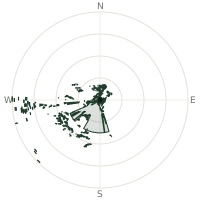
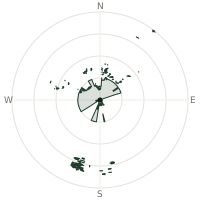
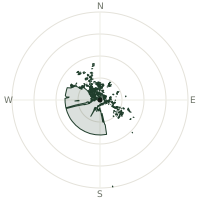
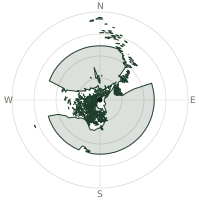
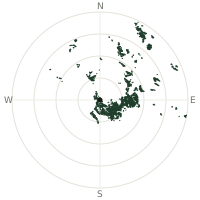
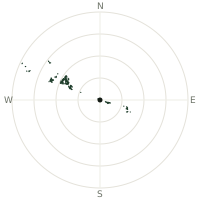
From Mount Olympus (Mytikas), the terrain-limited line of sight reaches up to 283 km. The single farthest piece of visible terrain lies 283 km to the east (bearing 81°), at 1,170 m elevation. These results account for Earth's curvature and standard atmospheric refraction, computed from 30-meter resolution Copernicus GLO-30 elevation data across 2,330,473 terrain samples.
Open the interactive visibility map →Visibility by direction
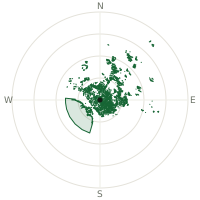
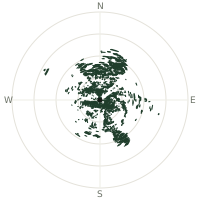
The horizon is most open toward the northeast, where sightlines run 204 km on average; terrain closes the view down fastest to the west-southwest, at 113 km.
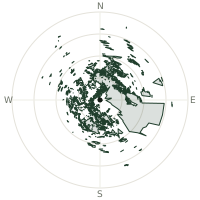
| N | 158 km | |
| NNE | 189 km | |
| NE | 204 km | |
| ENE | 181 km | |
| E | 193 km | |
| ESE | 201 km | |
| SE | 184 km | |
| SSE | 190 km | |
| S | 159 km | |
| SSW | 138 km | |
| SW | 114 km | |
| WSW | 113 km | |
| W | 130 km | |
| WNW | 154 km | |
| NW | 166 km | |
| NNW | 136 km |
Farthest named landmarks in view
568 named peaks, hills and headlands stand inside this viewshed. These are the farthest ones you could pick out on a clear day:
| Landmark | Visible distance | Direction | Elevation |
|---|---|---|---|
| Mount Elias | 277 km | E 81° | 1,397 m |
| Karakachanski Vrah | 249 km | NE 53° | 1,600 m |
| Golyam Kupen | 248 km | NNE 20° | 2,731 m |
| Dhikála | 248 km | NE 55° | 1,726 m |
| Koúla | 248 km | NE 55° | 1,229 m |
| Ardinska Planina | 248 km | NE 54° | 1,564 m |
About Mount Olympus (Mytikas)
Mount Olympus was, in Greek myth, home to the twelve Olympian gods, its true summit, Mytikas, said to be their meeting hall and the neighbouring peak, Stefani, the throne of Zeus. Reaching that summit, 2,917 metres up, did not happen until 2 August 1913, when hunter-guide Christos Kakalos led Swiss climbers Frederic Boissonas and Daniel Baud-Bovy to the top. In 1938 the area became Greece's first national park, later named a UNESCO Biosphere Reserve for the more than 1,700 plant species on its slopes, some found nowhere else on Earth.
Did you know?
- The true summit, called Mytikas or 'the nose,' was not climbed until 1913, remarkably late for such a mythologically famous peak.
- Local guide Christos Kakalos, who led that first ascent, went on to guide climbers on the mountain for decades until his death in 1976.
- Founded in 1938, Olympus National Park was the first national park established in Greece.
- Thick cloud frequently wreathes the ridge between Mytikas and Stefani even on clear days elsewhere on the mountain: a local weather quirk that likely helped cement its reputation as the gods' hidden throne.
- From the summit ridge, views stretch over the Thermaic Gulf toward the plains around Thessaloniki.
Frequently asked questions
How far can you see from Mount Olympus (Mytikas)?
On a clear day the terrain allows a line of sight of up to 283 km from Mount Olympus (Mytikas). The average visible distance across all 360 directions is 163 km. Atmospheric conditions (haze, humidity) usually reduce practical visibility below the terrain-limited maximum.
What is the farthest point visible from Mount Olympus (Mytikas)?
The farthest terrain visible from Mount Olympus (Mytikas) lies 283 km to the east, at an elevation of 1,170 m. Earth's curvature and atmospheric refraction are accounted for in this calculation.
How high is Mount Olympus (Mytikas)?
The observation point at Mount Olympus (Mytikas) sits at 2,909 m above sea level (Copernicus GLO-30 elevation model).
How is this visibility map calculated?
UpToWhere traces lines of sight in 360 directions from the observer using 30 m-resolution Copernicus terrain data, correcting for Earth curvature and standard atmospheric refraction. You can run the same analysis for any point on Earth with the free calculator.
Run your own analysis
Want to know what you can see from your house, a summit you're planning to climb, or a plot of land? UpToWhere computes the same 360° viewshed for any point on Earth in seconds, free.
Try the viewshed calculator