 UpToWhere
What can you see from Gerlachovský štít (High Tatras)?
It spent a decade named after Stalin before Slovaks got its old name back.
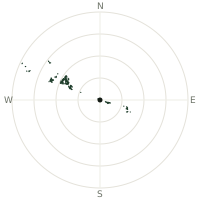
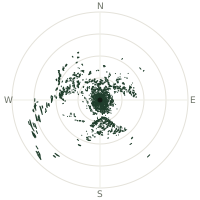
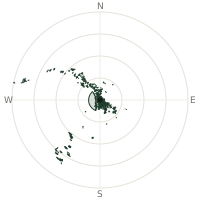
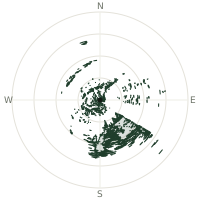
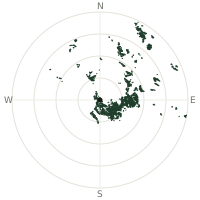
From Gerlachovský štít (High Tatras), the terrain-limited line of sight reaches up to 338 km. The single farthest piece of visible terrain lies 338 km to the southeast (bearing 145°), at 1,690 m elevation. These results account for Earth's curvature and standard atmospheric refraction, computed from 30-meter resolution Copernicus GLO-30 elevation data across 2,294,732 terrain samples.
Open the interactive visibility map →Visibility by direction
The horizon is most open toward the north-northeast, where sightlines run 198 km on average; terrain closes the view down fastest to the west, at 78.8 km.
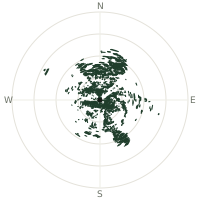
| N | 181 km | |
| NNE | 198 km | |
| NE | 91.7 km | |
| ENE | 135 km | |
| E | 178 km | |
| ESE | 187 km | |
| SE | 162 km | |
| SSE | 171 km | |
| S | 122 km | |
| SSW | 161 km | |
| SW | 101 km | |
| WSW | 79.3 km | |
| W | 78.8 km | |
| WNW | 150 km | |
| NW | 116 km | |
| NNW | 165 km |
Farthest named landmarks in view
944 named peaks, hills and headlands stand inside this viewshed. These are the farthest ones you could pick out on a clear day:
| Landmark | Visible distance | Direction | Elevation |
|---|---|---|---|
| Šerák | 246 km | WNW 299° | 1,350 m |
| Keprník | 245 km | WNW 298° | 1,422 m |
| Vozka | 245 km | WNW 298° | 1,377 m |
| Žalostná [Bělá pod Pradědem-Adolfovice] | 244 km | WNW 299° | 1,352 m |
| Červená hora | 242 km | WNW 298° | 1,337 m |
| (Děrná S) [Bělá pod Pradědem-Domašov] | 235 km | WNW 299° | 1,101 m |
About Gerlachovský štít (High Tatras)
Gerlachovský štít, at 2,655 metres, is the highest peak in Slovakia, in the High Tatras, and in the entire Carpathian range. Teacher and guide Ján Still led the first recorded ascent in 1834, though surveys took until the 1860s and 1870s to confirm it, rather than the more visible Lomnický štít, as the range's true summit. Renamed Stalinov štít, or Stalin Peak, after the 1948 communist takeover, it reverted to its original name in 1959, and today its summit is reachable only with a certified guide or as a member of an alpine club.
Did you know?
- Its first ascent, in 1834, was led by local teacher Ján Still, guiding a small party that included his brother-in-law and two chamois hunters.
- Its neighbour Lomnický štít, lower but more visited, has a cable car all the way to its summit: Gerlachovský štít, the true high point, has none, reachable only on foot.
- Communist authorities renamed it Stalinov štít, Stalin Peak, in 1949; the original name returned in 1959.
- Unlike many High Tatra summits that straddle the Polish border, Gerlachovský štít sits entirely within Slovak territory.
- From the summit, the High Tatras' jagged granite ridgeline is visible running unbroken toward Poland to the north.
Frequently asked questions
How far can you see from Gerlachovský štít (High Tatras)?
On a clear day the terrain allows a line of sight of up to 338 km from Gerlachovský štít (High Tatras). The average visible distance across all 360 directions is 142 km. Atmospheric conditions (haze, humidity) usually reduce practical visibility below the terrain-limited maximum.
What is the farthest point visible from Gerlachovský štít (High Tatras)?
The farthest terrain visible from Gerlachovský štít (High Tatras) lies 338 km to the southeast, at an elevation of 1,690 m. Earth's curvature and atmospheric refraction are accounted for in this calculation.
How high is Gerlachovský štít (High Tatras)?
The observation point at Gerlachovský štít (High Tatras) sits at 2,614 m above sea level (Copernicus GLO-30 elevation model).
How is this visibility map calculated?
UpToWhere traces lines of sight in 360 directions from the observer using 30 m-resolution Copernicus terrain data, correcting for Earth curvature and standard atmospheric refraction. You can run the same analysis for any point on Earth with the free calculator.
Run your own analysis
Want to know what you can see from your house, a summit you're planning to climb, or a plot of land? UpToWhere computes the same 360° viewshed for any point on Earth in seconds, free.
Try the viewshed calculator