 UpToWhere
What can you see from Colosseum?
A 50,000-seat stadium with a trapdoor-riddled basement for surprise tigers.
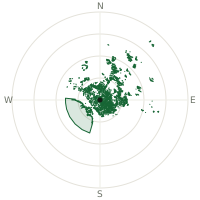
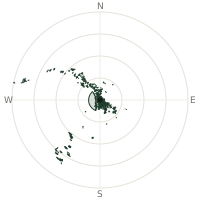
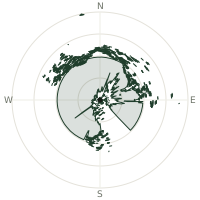
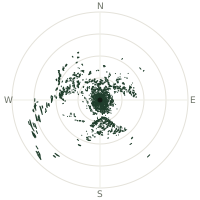
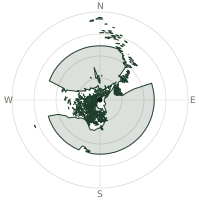
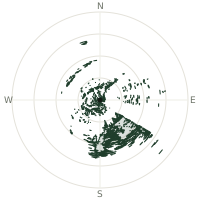
From Colosseum, the terrain-limited line of sight reaches up to 84.3 km. The single farthest piece of visible terrain lies 84.3 km to the east (bearing 100°), at 1,770 m elevation. These results account for Earth's curvature and standard atmospheric refraction, computed from 30-meter resolution Copernicus GLO-30 elevation data across 1,858,432 terrain samples.
Open the interactive visibility map →Visibility by direction
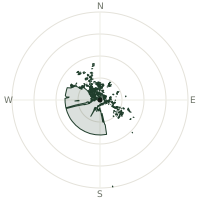
The horizon is most open toward the east-northeast, where sightlines run 53.5 km on average; terrain closes the view down fastest to the west-southwest, at 3.0 km.
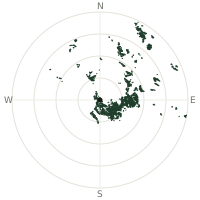
| N | 16.8 km | |
| NNE | 52.5 km | |
| NE | 49.3 km | |
| ENE | 53.5 km | |
| E | 45.8 km | |
| ESE | 27.0 km | |
| SE | 24.0 km | |
| SSE | 17.9 km | |
| S | 17.5 km | |
| SSW | 16.9 km | |
| SW | 6.3 km | |
| WSW | 3.0 km | |
| W | 3.3 km | |
| WNW | 15.5 km | |
| NW | 7.0 km | |
| NNW | 42.4 km |
Farthest named landmarks in view
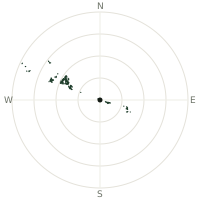
27 named peaks, hills and headlands stand inside this viewshed. These are the farthest ones you could pick out on a clear day:
| Landmark | Visible distance | Direction | Elevation |
|---|---|---|---|
| Monte Velino | 79.0 km | ENE 68° | 2,487 m |
| Monte Terminillo | 77.0 km | NNE 33° | 2,216 m |
| Monte Terminilletto | 76.2 km | NNE 32° | 2,014 m |
| Monte Cimino | 62.3 km | NNW 337° | 1,053 m |
| Monte San Pancrazio | 61.0 km | N 8° | 1,022 m |
| Monte Fontecellese | 56.6 km | ENE 69° | 1,257 m |
About Colosseum
Emperor Vespasian began this amphitheatre around 72 AD, and his son Titus opened it in 80 AD with games that reportedly killed 9,000 animals over their course. It could hold up to 80,000 spectators for gladiator combat and staged hunts, coordinated through a hidden underground level added a decade later, riddled with cages, trapdoors, and dozens of hand-cranked lifts. For centuries afterward, its stone was quarried to build other parts of Rome, including St. Peter's Basilica.
Did you know?
- The underground hypogeum held roughly 80 winch-powered lifts and 36 trapdoors, letting animals and scenery appear from nowhere on the arena floor.
- A retractable canvas awning called the velarium, worked by a crew of sailors, could shade the entire seating bowl from the sun.
- Much of the Colosseum's travertine stone was later stripped away and reused to build Renaissance-era Rome, including parts of St. Peter's Basilica.
- Its inaugural games under Titus in 80 AD lasted 100 days and reportedly killed thousands of animals brought from across the empire.
- Seating was ranked strictly by class, from senators at the front to women and slaves in the topmost, standing-only tier.
Frequently asked questions
How far can you see from Colosseum?
On a clear day the terrain allows a line of sight of up to 84.3 km from Colosseum. The average visible distance across all 360 directions is 24.8 km. Atmospheric conditions (haze, humidity) usually reduce practical visibility below the terrain-limited maximum.
What is the farthest point visible from Colosseum?
The farthest terrain visible from Colosseum lies 84.3 km to the east, at an elevation of 1,770 m. Earth's curvature and atmospheric refraction are accounted for in this calculation.
How high is Colosseum?
The observation point at Colosseum sits at 63 m above sea level (Copernicus GLO-30 elevation model).
How is this visibility map calculated?
UpToWhere traces lines of sight in 360 directions from the observer using 30 m-resolution Copernicus terrain data, correcting for Earth curvature and standard atmospheric refraction. You can run the same analysis for any point on Earth with the free calculator.
Run your own analysis
Want to know what you can see from your house, a summit you're planning to climb, or a plot of land? UpToWhere computes the same 360° viewshed for any point on Earth in seconds, free.
Try the viewshed calculator