 UpToWhere
What can you see from Mount Vesuvius?
It buried Pompeii in a day and remains mainland Europe's only active volcano.
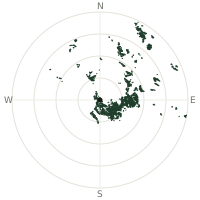
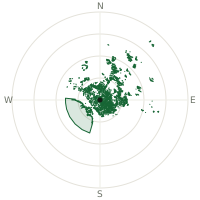
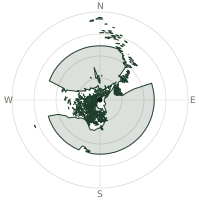
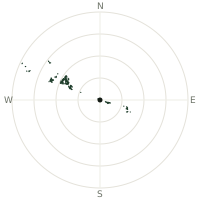
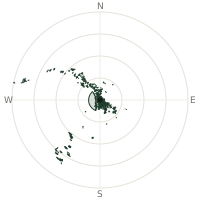
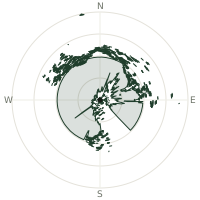
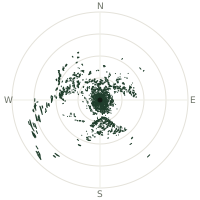
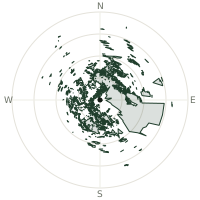
From Mount Vesuvius, the terrain-limited line of sight reaches up to 345 km. The single farthest piece of visible terrain lies 345 km to the south (bearing 172°), at 3,344 m elevation. These results account for Earth's curvature and standard atmospheric refraction, computed from 30-meter resolution Copernicus GLO-30 elevation data across 2,111,467 terrain samples.
Open the interactive visibility map →Visibility by direction
The horizon is most open toward the south, where sightlines run 147 km on average; terrain closes the view down fastest to the south-southeast, at 20.6 km.
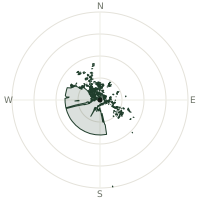
| N | 73.2 km | |
| NNE | 50.4 km | |
| NE | 36.6 km | |
| ENE | 46.0 km | |
| E | 51.5 km | |
| ESE | 101 km | |
| SE | 71.4 km | |
| SSE | 20.6 km | |
| S | 147 km | |
| SSW | 138 km | |
| SW | 138 km | |
| WSW | 130 km | |
| W | 136 km | |
| WNW | 129 km | |
| NW | 115 km | |
| NNW | 118 km |
Farthest named landmarks in view
125 named peaks, hills and headlands stand inside this viewshed. These are the farthest ones you could pick out on a clear day:
| Landmark | Visible distance | Direction | Elevation |
|---|---|---|---|
| Punta Lucia | 343 km | S 172° | 2,932 m |
| Monte Fossa delle Felci | 254 km | S 172° | 962 m |
| La Montea | 182 km | SE 135° | 1,785 m |
| Monte Faghitello | 182 km | SE 135° | 1,432 m |
| Monte Petricelle | 181 km | SE 135° | 1,758 m |
| Monte la Caccia | 181 km | SE 135° | 1,744 m |
About Mount Vesuvius
Mount Vesuvius destroyed Pompeii, Herculaneum, and several other Roman towns in 79 AD, an eruption known largely from two letters the eyewitness Pliny the Younger wrote decades later to the historian Tacitus. It remains the only active volcano on the European mainland, last erupting in 1944, and roughly three million people now live within range of a future eruption. The Osservatorio Vesuviano, founded on its slopes in 1841, is the oldest volcano observatory in the world, and the Bay of Naples and the island of Capri spread out below its crater rim.
Did you know?
- Pliny the Younger's two letters describing the 79 AD eruption are the only surviving eyewitness account of the disaster.
- Sudden, ash-heavy eruptions that blast material high into the sky are now called 'Plinian eruptions' in his honour.
- The Osservatorio Vesuviano, built in 1841, is the world's oldest institution founded to study a volcano.
- Vesuvius's last eruption, in March 1944, destroyed 88 US Army Air Force bombers stationed at a nearby airfield.
- The Bay of Naples, the island of Capri, and the city of Naples are all visible from the volcano's crater rim.
Frequently asked questions
How far can you see from Mount Vesuvius?
On a clear day the terrain allows a line of sight of up to 345 km from Mount Vesuvius. The average visible distance across all 360 directions is 93.8 km. Atmospheric conditions (haze, humidity) usually reduce practical visibility below the terrain-limited maximum.
What is the farthest point visible from Mount Vesuvius?
The farthest terrain visible from Mount Vesuvius lies 345 km to the south, at an elevation of 3,344 m. Earth's curvature and atmospheric refraction are accounted for in this calculation.
How high is Mount Vesuvius?
The observation point at Mount Vesuvius sits at 1,296 m above sea level (Copernicus GLO-30 elevation model).
How is this visibility map calculated?
UpToWhere traces lines of sight in 360 directions from the observer using 30 m-resolution Copernicus terrain data, correcting for Earth curvature and standard atmospheric refraction. You can run the same analysis for any point on Earth with the free calculator.
Run your own analysis
Want to know what you can see from your house, a summit you're planning to climb, or a plot of land? UpToWhere computes the same 360° viewshed for any point on Earth in seconds, free.
Try the viewshed calculator