 UpToWhere
What can you see from Acropolis of Athens?
Classical Athens: temples crowning a sacred rocky outcrop.
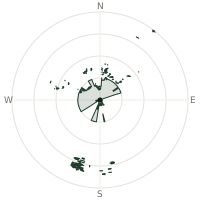
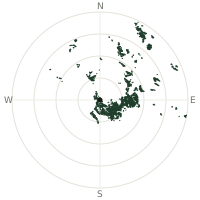
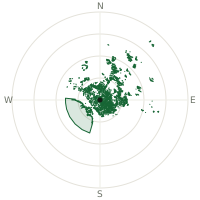
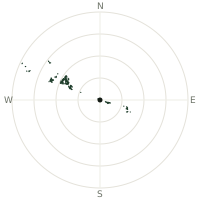
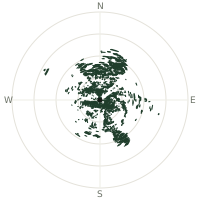
From Acropolis of Athens, the terrain-limited line of sight reaches up to 134 km. The single farthest piece of visible terrain lies 134 km to the west (bearing 271°), at 2,270 m elevation. These results account for Earth's curvature and standard atmospheric refraction, computed from 30-meter resolution Copernicus GLO-30 elevation data across 1,887,869 terrain samples.
Open the interactive visibility map →Visibility by direction
The horizon is most open toward the west, where sightlines run 82.1 km on average; terrain closes the view down fastest to the southeast, at 7.1 km.
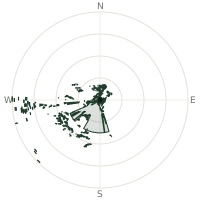
| N | 21.4 km | |
| NNE | 18.8 km | |
| NE | 12.3 km | |
| ENE | 14.3 km | |
| E | 8.4 km | |
| ESE | 7.8 km | |
| SE | 7.1 km | |
| SSE | 22.8 km | |
| S | 49.8 km | |
| SSW | 66.3 km | |
| SW | 70.5 km | |
| WSW | 72.9 km | |
| W | 82.1 km | |
| WNW | 27.0 km | |
| NW | 14.1 km | |
| NNW | 20.8 km |
Farthest named landmarks in view
77 named peaks, hills and headlands stand inside this viewshed. These are the farthest ones you could pick out on a clear day:
| Landmark | Visible distance | Direction | Elevation |
|---|---|---|---|
| Profítis Ilías | 133 km | WSW 254° | 1,981 m |
| Párnonas Óros | 132 km | SW 224° | 1,650 m |
| Megála Toúrla | 125 km | SW 232° | 1,681 m |
| Olígyrtos Óros | 119 km | W 261° | 1,935 m |
| Fragkokoúkoura | 116 km | WSW 256° | 1,632 m |
| Dýo Vouná | 108 km | W 267° | 1,143 m |
About Acropolis of Athens
The Acropolis rises 150 meters above Athens, its 7.4-acre rocky summit crowned by monuments built in the 5th century BC under Pericles' vision. The Parthenon (447-432 BC), Erechtheon, Propylaea, and temple of Athena Nike showcase classical Greek architecture at its zenith.
Did you know?
- In 1687, a Venetian bombardment during a siege ignited Ottoman gunpowder stored inside the Parthenon, blowing off its roof and much of its interior in a catastrophic explosion.
- Many of the Parthenon's original sculptures, removed by Lord Elgin in the early 1800s, remain in London's British Museum: a return has been the subject of ongoing dispute between Greece and the UK.
- Pheidias guided the sculptural program under Pericles.
- The Parthenon served as a Christian church and later a mosque for centuries before its 17th-century destruction, reflecting the site's long, layered religious history.
- UNESCO World Heritage Site representing ancient Greek civilization.
Frequently asked questions
How far can you see from Acropolis of Athens?
On a clear day the terrain allows a line of sight of up to 134 km from Acropolis of Athens. The average visible distance across all 360 directions is 32.3 km. Atmospheric conditions (haze, humidity) usually reduce practical visibility below the terrain-limited maximum.
What is the farthest point visible from Acropolis of Athens?
The farthest terrain visible from Acropolis of Athens lies 134 km to the west, at an elevation of 2,270 m. Earth's curvature and atmospheric refraction are accounted for in this calculation.
How high is Acropolis of Athens?
The observation point at Acropolis of Athens sits at 172 m above sea level (Copernicus GLO-30 elevation model).
How is this visibility map calculated?
UpToWhere traces lines of sight in 360 directions from the observer using 30 m-resolution Copernicus terrain data, correcting for Earth curvature and standard atmospheric refraction. You can run the same analysis for any point on Earth with the free calculator.
Run your own analysis
Want to know what you can see from your house, a summit you're planning to climb, or a plot of land? UpToWhere computes the same 360° viewshed for any point on Earth in seconds, free.
Try the viewshed calculator