 UpToWhere
What can you see from Logan Pass (Glacier National Park)?
Continental Divide crossroads where east meets west in Montana.
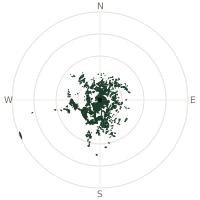
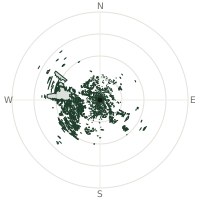
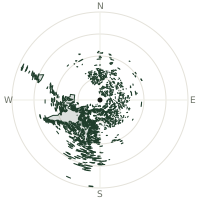
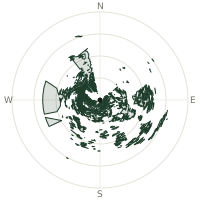
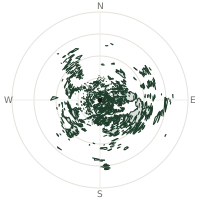
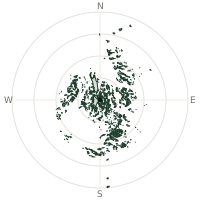
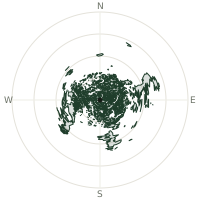
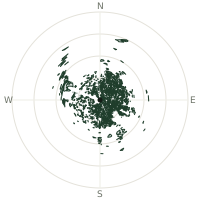
From Logan Pass (Glacier National Park), the terrain-limited line of sight reaches up to 49.0 km. The single farthest piece of visible terrain lies 49.0 km to the northwest (bearing 313°), at 2,959 m elevation. These results account for Earth's curvature and standard atmospheric refraction, computed from 30-meter resolution Copernicus GLO-30 elevation data across 2,222,838 terrain samples.
Open the interactive visibility map →Visibility by direction
The horizon is most open toward the northwest, where sightlines run 24.1 km on average; terrain closes the view down fastest to the north, at 0.2 km.
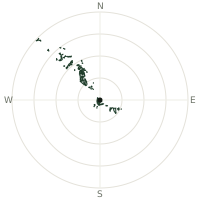
| N | 0.2 km | |
| NNE | 0.4 km | |
| NE | 0.3 km | |
| ENE | 0.3 km | |
| E | 0.2 km | |
| ESE | 5.2 km | |
| SE | 7.3 km | |
| SSE | 3.3 km | |
| S | 2.8 km | |
| SSW | 3.0 km | |
| SW | 3.3 km | |
| WSW | 1.8 km | |
| W | 1.6 km | |
| WNW | 1.6 km | |
| NW | 24.1 km | |
| NNW | 7.1 km |
Farthest named landmarks in view
15 named peaks, hills and headlands stand inside this viewshed. These are the farthest ones you could pick out on a clear day:
| Landmark | Visible distance | Direction | Elevation |
|---|---|---|---|
| Long Knife Peak | 49.1 km | NW 313° | 2,959 m |
| Clark Range | 49.1 km | NW 313° | 2,982 m |
| Livingston Range | 37.1 km | NW 323° | 2,841 m |
| Chapman Peak | 37.1 km | NW 323° | 2,841 m |
| The Sentinel | 33.4 km | NW 319° | 2,679 m |
| The Guardhouse | 32.7 km | NW 318° | 2,844 m |
About Logan Pass (Glacier National Park)
Logan Pass, at 6,646 feet on the Continental Divide, anchors Glacier National Park's Going-to-the-Sun Road. This wind-swept saddle marks where waters diverge to opposite coasts. The seasonal visitor center opens mid-June through late September, serving hikers embarking on alpine trails.
Did you know?
- Ploughing the road open each spring can take up to ten weeks, cutting through snowdrifts that sometimes bury the road under more than 12 metres of snow.
- The pass is one of the most reliable places in North America to see mountain goats up close, as they often wander right onto the boardwalks and parking areas to lick mineral salts.
- Named after Major William R. Logan, park's first superintendent.
- The boardwalk trail toward Hidden Lake Overlook was built specifically to protect the fragile alpine tundra beneath it from erosion by hikers' feet.
- Highline Trail departs northward along the continental spine.
Frequently asked questions
How far can you see from Logan Pass (Glacier National Park)?
On a clear day the terrain allows a line of sight of up to 49.0 km from Logan Pass (Glacier National Park). The average visible distance across all 360 directions is 3.9 km. Atmospheric conditions (haze, humidity) usually reduce practical visibility below the terrain-limited maximum.
What is the farthest point visible from Logan Pass (Glacier National Park)?
The farthest terrain visible from Logan Pass (Glacier National Park) lies 49.0 km to the northwest, at an elevation of 2,959 m. Earth's curvature and atmospheric refraction are accounted for in this calculation.
How high is Logan Pass (Glacier National Park)?
The observation point at Logan Pass (Glacier National Park) sits at 2,053 m above sea level (Copernicus GLO-30 elevation model).
How is this visibility map calculated?
UpToWhere traces lines of sight in 360 directions from the observer using 30 m-resolution Copernicus terrain data, correcting for Earth curvature and standard atmospheric refraction. You can run the same analysis for any point on Earth with the free calculator.
Run your own analysis
Want to know what you can see from your house, a summit you're planning to climb, or a plot of land? UpToWhere computes the same 360° viewshed for any point on Earth in seconds, free.
Try the viewshed calculator