 UpToWhere
What can you see from South Sister (Three Sisters)?
The easiest of three volcanic sisters to climb, yet the tallest at 10,358 feet.
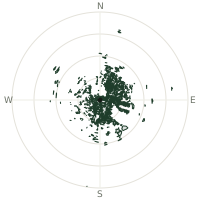
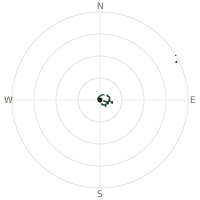
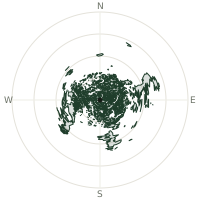
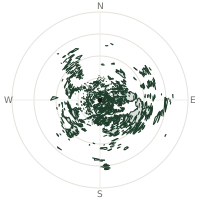
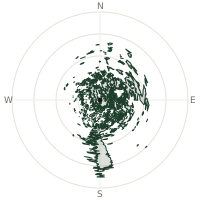
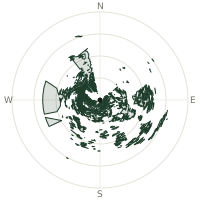
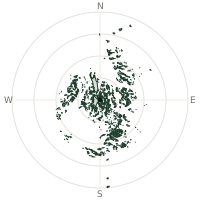
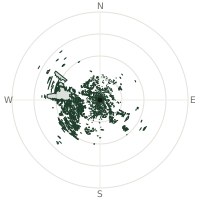
From South Sister (Three Sisters), the terrain-limited line of sight reaches up to 306 km. The single farthest piece of visible terrain lies 306 km to the north (bearing 0°), at 4,392 m elevation. These results account for Earth's curvature and standard atmospheric refraction, computed from 30-meter resolution Copernicus GLO-30 elevation data across 2,359,033 terrain samples.
Open the interactive visibility map →Visibility by direction
The horizon is most open toward the north-northeast, where sightlines run 206 km on average; terrain closes the view down fastest to the south-southwest, at 107 km.
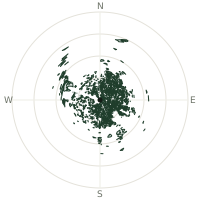
| N | 144 km | |
| NNE | 206 km | |
| NE | 153 km | |
| ENE | 132 km | |
| E | 182 km | |
| ESE | 162 km | |
| SE | 137 km | |
| SSE | 154 km | |
| S | 159 km | |
| SSW | 107 km | |
| SW | 121 km | |
| WSW | 178 km | |
| W | 166 km | |
| WNW | 166 km | |
| NW | 200 km | |
| NNW | 111 km |
Farthest named landmarks in view
636 named peaks, hills and headlands stand inside this viewshed. These are the farthest ones you could pick out on a clear day:
| Landmark | Visible distance | Direction | Elevation |
|---|---|---|---|
| Russell Cliff | 307 km | N 0° | 3,950 m |
| Cascade Range | 306 km | N 0° | 4,392 m |
| Mount Rainier | 306 km | N 0° | 4,392 m |
| Point Success | 305 km | N 0° | 4,302 m |
| Gibraltar Rock | 305 km | N 0° | 3,863 m |
| Nisqually Ice Cliff | 304 km | N 0° | 3,551 m |
About South Sister (Three Sisters)
South Sister, part of the Three Sisters volcanic cluster in Oregon's Cascade Range, at 10,358 feet is the tallest of the three and also the most accessible. The standard route climbs the south ridge for 12.6 miles round-trip, rising from 5,446 feet at the trailhead to the summit. The Three Sisters themselves rank as Oregon's third, fourth, and fifth-highest peaks, with South Sister leading the group. Its accessibility and relative ease have made it one of the most climbed peaks in the region.
Did you know?
- The Three Sisters carry old nicknames from early settlers who called them Faith, Hope, and Charity: South Sister was 'Charity.'
- A small crater lake called Teardrop Pool sits just below South Sister's true summit, one of the highest lakes in Oregon.
- South Sister's Lewis and Clark Glaciers are among the most closely monitored in the Cascades, having lost most of their mass over the past century.
- South Sister is a dormant stratovolcano in the volcanic arc that built the central Cascades.
- A trail runs all the way to the summit, unlike some peaks that require scrambling at higher elevations.
Frequently asked questions
How far can you see from South Sister (Three Sisters)?
On a clear day the terrain allows a line of sight of up to 306 km from South Sister (Three Sisters). The average visible distance across all 360 directions is 155 km. Atmospheric conditions (haze, humidity) usually reduce practical visibility below the terrain-limited maximum.
What is the farthest point visible from South Sister (Three Sisters)?
The farthest terrain visible from South Sister (Three Sisters) lies 306 km to the north, at an elevation of 4,392 m. Earth's curvature and atmospheric refraction are accounted for in this calculation.
How high is South Sister (Three Sisters)?
The observation point at South Sister (Three Sisters) sits at 3,157 m above sea level (Copernicus GLO-30 elevation model).
How is this visibility map calculated?
UpToWhere traces lines of sight in 360 directions from the observer using 30 m-resolution Copernicus terrain data, correcting for Earth curvature and standard atmospheric refraction. You can run the same analysis for any point on Earth with the free calculator.
Run your own analysis
Want to know what you can see from your house, a summit you're planning to climb, or a plot of land? UpToWhere computes the same 360° viewshed for any point on Earth in seconds, free.
Try the viewshed calculator