 UpToWhere
What can you see from Mount Rainier?
Washington's glacial giant: 26 ice masses crown 14,406 feet of Cascade majesty.
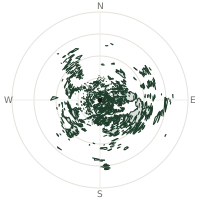
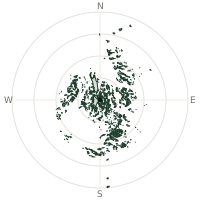
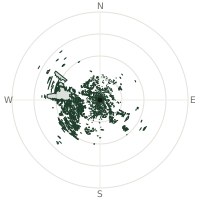
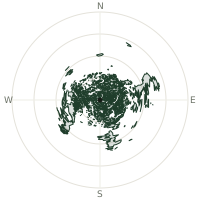
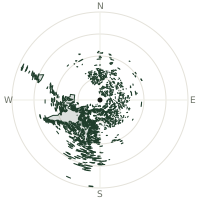
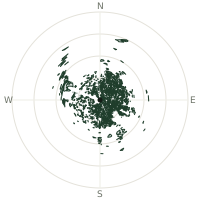
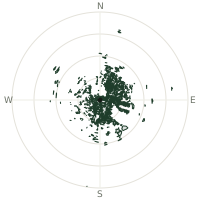
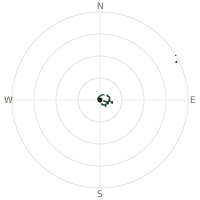
From Mount Rainier, the terrain-limited line of sight reaches up to 390 km. The single farthest piece of visible terrain lies 390 km to the north-northwest (bearing 334°), at 1,784 m elevation. These results account for Earth's curvature and standard atmospheric refraction, computed from 30-meter resolution Copernicus GLO-30 elevation data across 2,489,261 terrain samples.
Open the interactive visibility map →Visibility by direction
The horizon is most open toward the east-southeast, where sightlines run 316 km on average; terrain closes the view down fastest to the northeast, at 0.0 km.
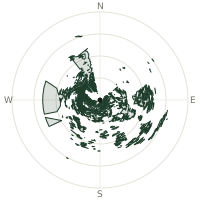
| N | 0.1 km | |
| NNE | 0.0 km | |
| NE | 0.0 km | |
| ENE | 154 km | |
| E | 262 km | |
| ESE | 316 km | |
| SE | 280 km | |
| SSE | 240 km | |
| S | 209 km | |
| SSW | 243 km | |
| SW | 212 km | |
| WSW | 230 km | |
| W | 254 km | |
| WNW | 201 km | |
| NW | 191 km | |
| NNW | 222 km |
Farthest named landmarks in view
948 named peaks, hills and headlands stand inside this viewshed. These are the farthest ones you could pick out on a clear day:
| Landmark | Visible distance | Direction | Elevation |
|---|---|---|---|
| Twin Peaks | 382 km | ESE 115° | 2,929 m |
| Mule Peak | 381 km | ESE 119° | 2,608 m |
| Granite Butte | 381 km | ESE 119° | 2,641 m |
| Burger Butte | 380 km | ESE 119° | 2,572 m |
| Red Mountain | 354 km | SE 127° | 2,715 m |
| Mount Ruth | 350 km | SE 127° | 2,610 m |
About Mount Rainier
Mount Rainier dominates the Cascade Volcanic Arc as its highest peak, an active stratovolcano wrapped in more glacial ice than all other Cascade volcanoes combined. Its 26 major glaciers carve the landscape, making it the most heavily glaciated peak in the lower 48 states and a defining symbol of Pacific Northwest wilderness.
Did you know?
- 14,406 feet elevation: highest Cascade volcano
- 26 major glaciers covering 35 square miles
- Rainier is designated a 'Decade Volcano' by the USGS for its lahar risk: an eruption could rapidly melt its glaciers and send mudflows toward the densely populated valleys near Tacoma, which is why permanent warning sirens are installed there today.
- Stratovolcano cone over 500,000 years old
- Washington's most topographically prominent peak
Frequently asked questions
How far can you see from Mount Rainier?
On a clear day the terrain allows a line of sight of up to 390 km from Mount Rainier. The average visible distance across all 360 directions is 188 km. Atmospheric conditions (haze, humidity) usually reduce practical visibility below the terrain-limited maximum.
What is the farthest point visible from Mount Rainier?
The farthest terrain visible from Mount Rainier lies 390 km to the north-northwest, at an elevation of 1,784 m. Earth's curvature and atmospheric refraction are accounted for in this calculation.
How high is Mount Rainier?
The observation point at Mount Rainier sits at 4,396 m above sea level (Copernicus GLO-30 elevation model).
How is this visibility map calculated?
UpToWhere traces lines of sight in 360 directions from the observer using 30 m-resolution Copernicus terrain data, correcting for Earth curvature and standard atmospheric refraction. You can run the same analysis for any point on Earth with the free calculator.
Run your own analysis
Want to know what you can see from your house, a summit you're planning to climb, or a plot of land? UpToWhere computes the same 360° viewshed for any point on Earth in seconds, free.
Try the viewshed calculator