 UpToWhere
What can you see from Mount Hood?
Once Oregon's tallest at 12,000 feet, ice and time have worn it down to its current 11,244.
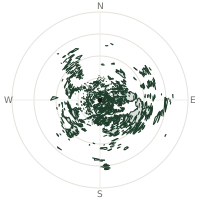
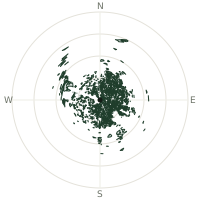
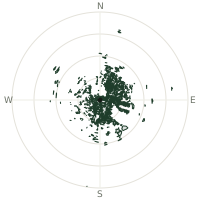
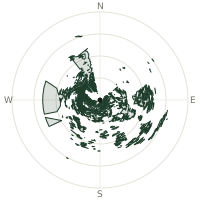
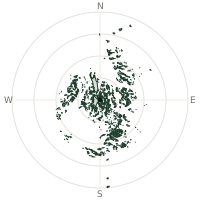
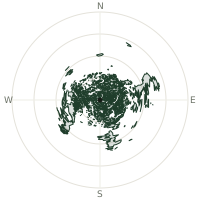
From Mount Hood, the terrain-limited line of sight reaches up to 318 km. The single farthest piece of visible terrain lies 318 km to the east-northeast (bearing 71°), at 1,431 m elevation. These results account for Earth's curvature and standard atmospheric refraction, computed from 30-meter resolution Copernicus GLO-30 elevation data across 2,388,578 terrain samples.
Open the interactive visibility map →Visibility by direction
The horizon is most open toward the east, where sightlines run 247 km on average; terrain closes the view down fastest to the north, at 150 km.
| N | 150 km | |
| NNE | 188 km | |
| NE | 157 km | |
| ENE | 235 km | |
| E | 247 km | |
| ESE | 220 km | |
| SE | 166 km | |
| SSE | 186 km | |
| S | 158 km | |
| SSW | 178 km | |
| SW | 182 km | |
| WSW | 172 km | |
| W | 154 km | |
| WNW | 161 km | |
| NW | 186 km | |
| NNW | 190 km |
Farthest named landmarks in view
861 named peaks, hills and headlands stand inside this viewshed. These are the farthest ones you could pick out on a clear day:
| Landmark | Visible distance | Direction | Elevation |
|---|---|---|---|
| Mount Tom | 312 km | NNW 330° | 2,148 m |
| West Peak | 311 km | NNW 331° | 2,392 m |
| Mount Olympus | 311 km | NNW 331° | 2,307 m |
| Middle Peak | 310 km | NNW 331° | 2,389 m |
| East Peak | 310 km | NNW 331° | 2,318 m |
| Griffin Peak | 305 km | ENE 73° | 1,727 m |
About Mount Hood
Mount Hood is a stratovolcano in the Cascade Range formed 500,000 to 700,000 years ago from repeated eruptions, its summit capped with permanent snow and glaciers. The mountain stands fifty miles east of Portland and has erupted episodically for roughly half a million years, with the most recent eruption in 1865. Ice sheets and erosion have sculpted its profile, reducing what was once the continent's tallest peak to its current height.
Did you know?
- At 11,244 feet, Mount Hood is Oregon's highest peak and the fourth-highest in the Cascade Range.
- The volcano formed between 500,000 and 700,000 years ago during repeated subduction-zone eruptions.
- Its last eruption occurred in 1865 AD, sending ash across the Pacific Northwest.
- At its highest, Hood topped 12,000 feet before ice and erosion reduced the summit.
- A cable car reaches nearly the summit, and trails from the base climb through alpine meadow to the glaciated peak.
Frequently asked questions
How far can you see from Mount Hood?
On a clear day the terrain allows a line of sight of up to 318 km from Mount Hood. The average visible distance across all 360 directions is 183 km. Atmospheric conditions (haze, humidity) usually reduce practical visibility below the terrain-limited maximum.
What is the farthest point visible from Mount Hood?
The farthest terrain visible from Mount Hood lies 318 km to the east-northeast, at an elevation of 1,431 m. Earth's curvature and atmospheric refraction are accounted for in this calculation.
How high is Mount Hood?
The observation point at Mount Hood sits at 3,420 m above sea level (Copernicus GLO-30 elevation model).
How is this visibility map calculated?
UpToWhere traces lines of sight in 360 directions from the observer using 30 m-resolution Copernicus terrain data, correcting for Earth curvature and standard atmospheric refraction. You can run the same analysis for any point on Earth with the free calculator.
Run your own analysis
Want to know what you can see from your house, a summit you're planning to climb, or a plot of land? UpToWhere computes the same 360° viewshed for any point on Earth in seconds, free.
Try the viewshed calculator