 UpToWhere
What can you see from Burj Khalifa?
The world's tallest building at 829.8 metres, with 163 floors and 57 elevators reaching the clouds.
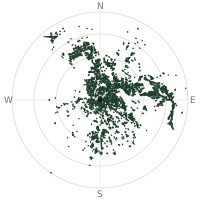
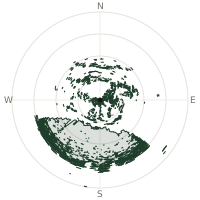
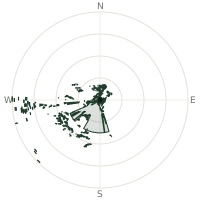
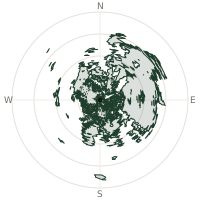
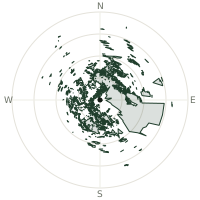
From Burj Khalifa, the terrain-limited line of sight reaches up to 263 km. The single farthest piece of visible terrain lies 263 km to the north-northeast (bearing 20°), at 2,159 m elevation. These results account for Earth's curvature and standard atmospheric refraction, computed from 30-meter resolution Copernicus GLO-30 elevation data across 1,980,332 terrain samples.
Open the interactive visibility map →Visibility by direction
The horizon is most open toward the north, where sightlines run 198 km on average; terrain closes the view down fastest to the south-southwest, at 85.1 km.
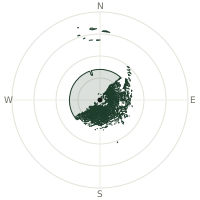
| N | 198 km | |
| NNE | 114 km | |
| NE | 118 km | |
| ENE | 97.5 km | |
| E | 93.5 km | |
| ESE | 87.8 km | |
| SE | 128 km | |
| SSE | 85.4 km | |
| S | 86.7 km | |
| SSW | 85.1 km | |
| SW | 88.5 km | |
| WSW | 91.6 km | |
| W | 92.9 km | |
| WNW | 91.6 km | |
| NW | 92.5 km | |
| NNW | 179 km |
About Burj Khalifa
Burj Khalifa in Dubai, United Arab Emirates, stands 829.8 metres tall and has been the world's tallest structure since its topping-out in 2009, surpassing Taipei 101. The supertall skyscraper was completed in 2010 and designed by Skidmore, Owings & Merrill using reinforced concrete. The structure broke multiple world records: tallest freestanding structure, building with most floors (163), and 57 elevators and 8 escalators serving the tower. Construction consumed 110,000 tonnes of concrete, 55,000 tonnes of steel, and 22 million person-hours. The 'At The Top SKY' observation deck sits at 555 metres.
Did you know?
- The tower was originally called Burj Dubai during construction and was renamed Burj Khalifa at its 2010 opening, honouring UAE president Khalifa bin Zayed Al Nahyan for bailing out Dubai's finances during the 2009 crisis.
- Its spiralling, Y-shaped floor plan was inspired by the Hymenocallis, a desert flower native to the region.
- The tower collects roughly 15 million gallons of condensation from its air conditioning system each year, channelled into irrigation for the surrounding grounds.
- Structural engineer Bill Baker pioneered the 'buttressed core' design used here, a technique now copied by supertall towers worldwide.
- The building's soft coastal soil required piles driven roughly 50 metres deep, anchoring the tower against Dubai's sandy ground.
Frequently asked questions
How far can you see from Burj Khalifa?
On a clear day the terrain allows a line of sight of up to 263 km from Burj Khalifa. The average visible distance across all 360 directions is 108 km. Atmospheric conditions (haze, humidity) usually reduce practical visibility below the terrain-limited maximum.
What is the farthest point visible from Burj Khalifa?
The farthest terrain visible from Burj Khalifa lies 263 km to the north-northeast, at an elevation of 2,159 m. Earth's curvature and atmospheric refraction are accounted for in this calculation.
How high is Burj Khalifa?
The observation point at Burj Khalifa sits at 573 m above sea level (Copernicus GLO-30 elevation model).
How is this visibility map calculated?
UpToWhere traces lines of sight in 360 directions from the observer using 30 m-resolution Copernicus terrain data, correcting for Earth curvature and standard atmospheric refraction. You can run the same analysis for any point on Earth with the free calculator.
Run your own analysis
Want to know what you can see from your house, a summit you're planning to climb, or a plot of land? UpToWhere computes the same 360° viewshed for any point on Earth in seconds, free.
Try the viewshed calculator