 UpToWhere
What can you see from Taj Mahal?
A widower's tomb so vast it took 20,000 workers over two decades.
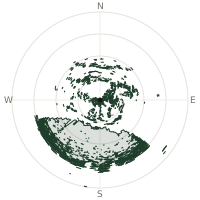
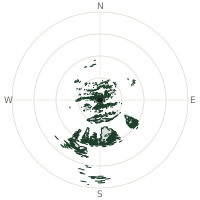
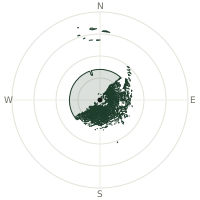
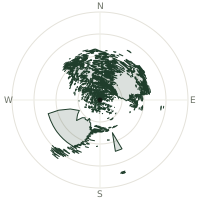
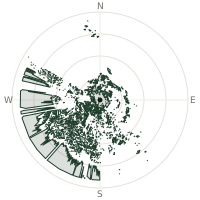
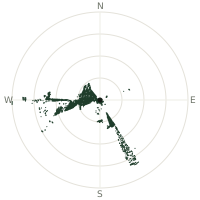
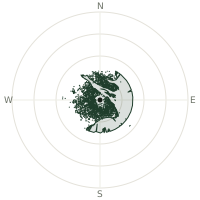
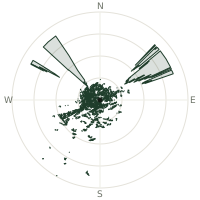
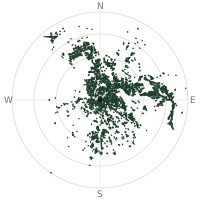
From Taj Mahal, the terrain-limited line of sight reaches up to 40.9 km. The single farthest piece of visible terrain lies 40.9 km to the west-southwest (bearing 237°), at 226 m elevation. These results account for Earth's curvature and standard atmospheric refraction, computed from 30-meter resolution Copernicus GLO-30 elevation data across 1,891,066 terrain samples.
Open the interactive visibility map →Visibility by direction
The horizon is most open toward the east, where sightlines run 19.6 km on average; terrain closes the view down fastest to the west-northwest, at 6.1 km.
| N | 12.1 km | |
| NNE | 14.4 km | |
| NE | 14.1 km | |
| ENE | 16.6 km | |
| E | 19.6 km | |
| ESE | 16.4 km | |
| SE | 12.7 km | |
| SSE | 13.0 km | |
| S | 12.7 km | |
| SSW | 8.8 km | |
| SW | 11.0 km | |
| WSW | 12.3 km | |
| W | 11.8 km | |
| WNW | 6.1 km | |
| NW | 13.8 km | |
| NNW | 17.8 km |
About Taj Mahal
Mughal emperor Shah Jahan commissioned this mausoleum in 1631 after his wife Mumtaz Mahal died giving birth to their fourteenth child, and construction of the white marble complex ran for more than twenty years with over 20,000 artisans drawn from across the empire and beyond. The white Makrana marble is semi-translucent, so it visibly shifts color with the light: pink at dawn, blinding white at noon, gold at sunset. Shah Jahan himself is buried inside, next to Mumtaz.
Did you know?
- Shah Jahan's own son later deposed and imprisoned him in nearby Agra Fort, where legend says he spent his final years gazing at the Taj Mahal across the Yamuna River.
- The white marble is inlaid with thousands of pieces of semi-precious stone in a technique called pietra dura, forming intricate floral patterns.
- More than 20,000 workers and artisans, including stone-carvers and calligraphers from Persia and Central Asia, worked on the complex for over two decades.
- The complex is symmetrical on every axis except one: Shah Jahan's own tomb, added later, breaks the pattern beside his wife's.
- The four minarets around the dome were deliberately built leaning slightly outward, so that in the event of a collapse they would fall away from the mausoleum rather than onto it.
Frequently asked questions
How far can you see from Taj Mahal?
On a clear day the terrain allows a line of sight of up to 40.9 km from Taj Mahal. The average visible distance across all 360 directions is 13.3 km. Atmospheric conditions (haze, humidity) usually reduce practical visibility below the terrain-limited maximum.
What is the farthest point visible from Taj Mahal?
The farthest terrain visible from Taj Mahal lies 40.9 km to the west-southwest, at an elevation of 226 m. Earth's curvature and atmospheric refraction are accounted for in this calculation.
How high is Taj Mahal?
The observation point at Taj Mahal sits at 184 m above sea level (Copernicus GLO-30 elevation model).
How is this visibility map calculated?
UpToWhere traces lines of sight in 360 directions from the observer using 30 m-resolution Copernicus terrain data, correcting for Earth curvature and standard atmospheric refraction. You can run the same analysis for any point on Earth with the free calculator.
Run your own analysis
Want to know what you can see from your house, a summit you're planning to climb, or a plot of land? UpToWhere computes the same 360° viewshed for any point on Earth in seconds, free.
Try the viewshed calculator