 UpToWhere
What can you see from Mount Kenya (Batian)?
A fortress of vertical granite towers, Africa's second-highest peak, conquered via rope and rock.
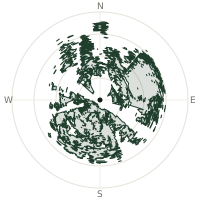
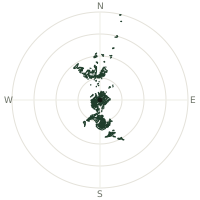
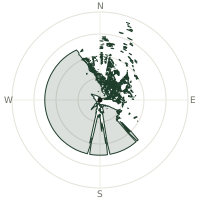
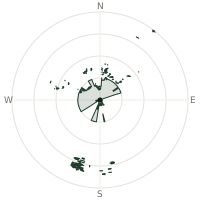
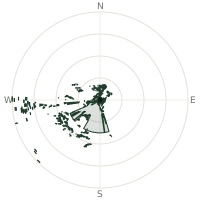
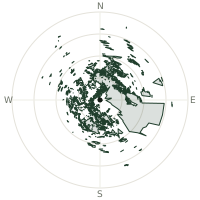
From Mount Kenya (Batian), the terrain-limited line of sight reaches up to 360 km. The single farthest piece of visible terrain lies 360 km to the south-southwest (bearing 207°), at 3,454 m elevation. These results account for Earth's curvature and standard atmospheric refraction, computed from 30-meter resolution Copernicus GLO-30 elevation data across 2,562,126 terrain samples.
Open the interactive visibility map →Visibility by direction
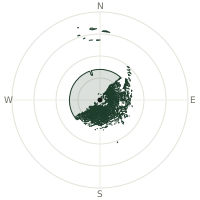
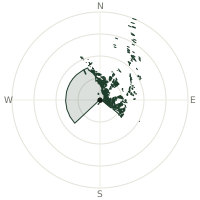
The horizon is most open toward the northeast, where sightlines run 280 km on average; terrain closes the view down fastest to the west-southwest, at 120 km.
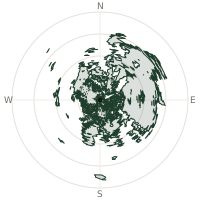
| N | 205 km | |
| NNE | 271 km | |
| NE | 280 km | |
| ENE | 278 km | |
| E | 256 km | |
| ESE | 250 km | |
| SE | 220 km | |
| SSE | 241 km | |
| S | 251 km | |
| SSW | 225 km | |
| SW | 183 km | |
| WSW | 120 km | |
| W | 177 km | |
| WNW | 232 km | |
| NW | 234 km | |
| NNW | 188 km |
Farthest named landmarks in view
957 named peaks, hills and headlands stand inside this viewshed. These are the farthest ones you could pick out on a clear day:
| Landmark | Visible distance | Direction | Elevation |
|---|---|---|---|
| Ela Nairobi | 347 km | SSW 209° | 2,969 m |
| Jaeger Summit | 345 km | SSW 209° | 3,033 m |
| Sudek | 334 km | WNW 295° | 4,306 m |
| Kablabun | 334 km | WNW 293° | 3,469 m |
| Chesingor | 333 km | WNW 294° | 3,570 m |
| Kumokoi Koitoboss | 333 km | WNW 295° | 4,193 m |
About Mount Kenya (Batian)
Mount Kenya's Batian peak rises to 5,199 metres and is Africa's second-highest summit after Kilimanjaro's Uhuru. The mountain is a granite fortress requiring technical rock climbing; the North Face Standard Route involves roughly 20 pitches at grade IV+. The first documented ascent came on 13 September 1899 by Sir Halford Mackinder with guides César Ollier and Joseph Brocherel. Fewer than 100 climbers attempt Batian annually; most are guided and use porters for the 11–13 hour summit push.
Did you know?
- The country of Kenya took its name from the mountain, not the other way around.
- The Kikuyu call it Kirinyaga, 'the mountain of brightness,' and traditionally built their homes with doors facing its summit.
- Mount Kenya National Park became a UNESCO World Heritage Site in 1997, protecting afro-alpine giant groundsels and lobelias found almost nowhere else on Earth.
- Its glaciers have shrunk by more than 90 percent over the past century and are projected to disappear entirely within a few decades.
- The summit push takes 11–13 hours from a 4,600m base across syenite and phonolite.
Frequently asked questions
How far can you see from Mount Kenya (Batian)?
On a clear day the terrain allows a line of sight of up to 360 km from Mount Kenya (Batian). The average visible distance across all 360 directions is 226 km. Atmospheric conditions (haze, humidity) usually reduce practical visibility below the terrain-limited maximum.
What is the farthest point visible from Mount Kenya (Batian)?
The farthest terrain visible from Mount Kenya (Batian) lies 360 km to the south-southwest, at an elevation of 3,454 m. Earth's curvature and atmospheric refraction are accounted for in this calculation.
How high is Mount Kenya (Batian)?
The observation point at Mount Kenya (Batian) sits at 5,169 m above sea level (Copernicus GLO-30 elevation model).
How is this visibility map calculated?
UpToWhere traces lines of sight in 360 directions from the observer using 30 m-resolution Copernicus terrain data, correcting for Earth curvature and standard atmospheric refraction. You can run the same analysis for any point on Earth with the free calculator.
Run your own analysis
Want to know what you can see from your house, a summit you're planning to climb, or a plot of land? UpToWhere computes the same 360° viewshed for any point on Earth in seconds, free.
Try the viewshed calculator