 UpToWhere
What can you see from Pico Bolívar?
Venezuela's highest peak, accessible only on foot despite the world's highest and longest cable car nearly reaching it.
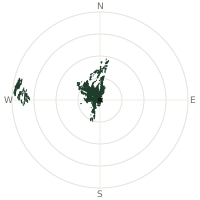
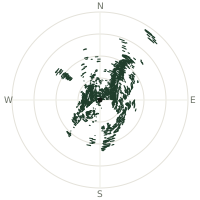
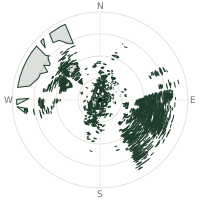
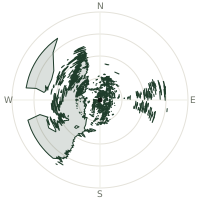
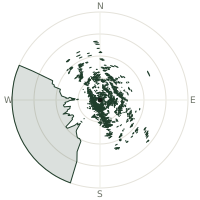
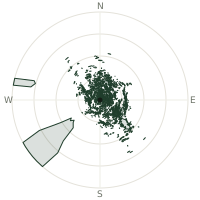
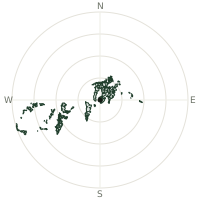
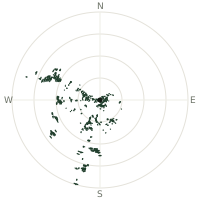
From Pico Bolívar, the terrain-limited line of sight reaches up to 387 km. The single farthest piece of visible terrain lies 387 km to the east-northeast (bearing 66°), at 1,240 m elevation. These results account for Earth's curvature and standard atmospheric refraction, computed from 30-meter resolution Copernicus GLO-30 elevation data across 2,533,398 terrain samples.
Open the interactive visibility map →Visibility by direction
The horizon is most open toward the south-southwest, where sightlines run 265 km on average; terrain closes the view down fastest to the north-northwest, at 25.1 km.
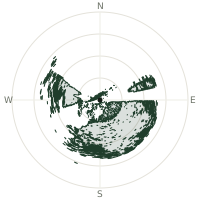
| N | 29.8 km | |
| NNE | 39.5 km | |
| NE | 48.6 km | |
| ENE | 173 km | |
| E | 118 km | |
| ESE | 264 km | |
| SE | 263 km | |
| SSE | 264 km | |
| S | 261 km | |
| SSW | 265 km | |
| SW | 232 km | |
| WSW | 168 km | |
| W | 249 km | |
| WNW | 248 km | |
| NW | 148 km | |
| NNW | 25.1 km |
Farthest named landmarks in view
171 named peaks, hills and headlands stand inside this viewshed. These are the farthest ones you could pick out on a clear day:
| Landmark | Visible distance | Direction | Elevation |
|---|---|---|---|
| Pico La Reina | 378 km | NW 312° | 5,535 m |
| Cerro Los Pajaritos | 293 km | ENE 67° | 202 m |
| Cerro La Capilla | 292 km | SSW 200° | 702 m |
| Cerro Pintado | 285 km | NW 315° | 3,660 m |
| Cuchilla El Lanudo | 271 km | WNW 286° | 1,800 m |
| Alto La Peña de Romeral | 265 km | SSW 210° | 4,464 m |
About Pico Bolívar
Pico Bolívar, at 4,978 metres, is the highest mountain in Venezuela, named after the independence hero Simón Bolívar. The peak can only be reached by walking; the famous Mérida cable car, once the world's highest and longest, ascends to Pico Espejo below the true summit. The technical challenge of the final approach and the isolation of the peak keep it less visited than its elevation might suggest, despite the cable car's presence drawing climbers to the region.
Did you know?
- Pico Bolívar is one of five snow-capped summits in the Sierra Nevada de Mérida collectively nicknamed 'Los Cinco Águilas Blancas,' the Five White Eagles.
- A bronze bust of Simón Bolívar was hauled to the summit in 1951 by a Venezuelan climbing expedition, cementing the mountain's link to the independence hero.
- The Mérida cable car shut down for renovation for nearly a decade in the 2000s and 2010s before reopening in stages, restoring its role as the main gateway to the peak.
- The final ascent to Pico Bolívar is technically challenging and accessible only on foot.
- The cable car system helped make the region a climbing destination despite the final peak's isolation.
Frequently asked questions
How far can you see from Pico Bolívar?
On a clear day the terrain allows a line of sight of up to 387 km from Pico Bolívar. The average visible distance across all 360 directions is 175 km. Atmospheric conditions (haze, humidity) usually reduce practical visibility below the terrain-limited maximum.
What is the farthest point visible from Pico Bolívar?
The farthest terrain visible from Pico Bolívar lies 387 km to the east-northeast, at an elevation of 1,240 m. Earth's curvature and atmospheric refraction are accounted for in this calculation.
How high is Pico Bolívar?
The observation point at Pico Bolívar sits at 4,856 m above sea level (Copernicus GLO-30 elevation model).
How is this visibility map calculated?
UpToWhere traces lines of sight in 360 directions from the observer using 30 m-resolution Copernicus terrain data, correcting for Earth curvature and standard atmospheric refraction. You can run the same analysis for any point on Earth with the free calculator.
Run your own analysis
Want to know what you can see from your house, a summit you're planning to climb, or a plot of land? UpToWhere computes the same 360° viewshed for any point on Earth in seconds, free.
Try the viewshed calculator