 UpToWhere
What can you see from Yerupajá?
The Butcher: Peru's second-highest peak, a near-vertical wall of rock and ice.
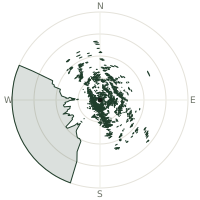
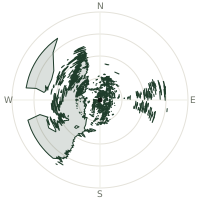
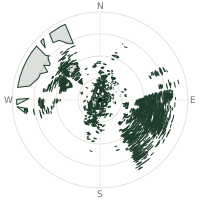
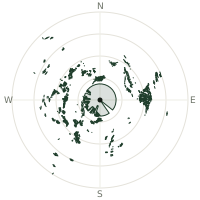
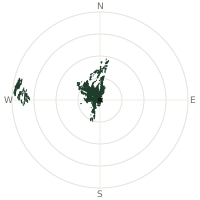
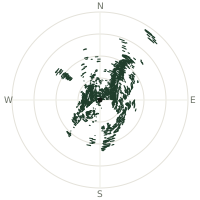
From Yerupajá, the terrain-limited line of sight reaches up to 308 km. The single farthest piece of visible terrain lies 308 km to the southwest (bearing 220°), at 0 m elevation. These results account for Earth's curvature and standard atmospheric refraction, computed from 30-meter resolution Copernicus GLO-30 elevation data across 2,675,727 terrain samples.
Open the interactive visibility map →Visibility by direction
The horizon is most open toward the southwest, where sightlines run 243 km on average; terrain closes the view down fastest to the south-southwest, at 54.1 km.
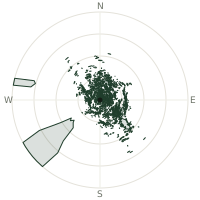
| N | 153 km | |
| NNE | 99.7 km | |
| NE | 92.8 km | |
| ENE | 113 km | |
| E | 95.1 km | |
| ESE | 117 km | |
| SE | 165 km | |
| SSE | 161 km | |
| S | 85.7 km | |
| SSW | 54.1 km | |
| SW | 243 km | |
| WSW | 116 km | |
| W | 71.8 km | |
| WNW | 124 km | |
| NW | 121 km | |
| NNW | 123 km |
Farthest named landmarks in view
972 named peaks, hills and headlands stand inside this viewshed. These are the farthest ones you could pick out on a clear day:
| Landmark | Visible distance | Direction | Elevation |
|---|---|---|---|
| Nevado Huaytapallana | 272 km | SE 132° | 5,558 m |
| Cerro Altarniuco | 226 km | SE 143° | 4,732 m |
| Cerro Capishpotrero | 218 km | SE 132° | 4,747 m |
| Cerro Carrizal | 217 km | SE 132° | 4,786 m |
| Nevado Cullec | 212 km | SSE 149° | 5,212 m |
| Cerro Collquepucro | 211 km | SSE 153° | 5,658 m |
About Yerupajá
Yerupajá rises to 6,635 metres in the Huayhuash range and is Peru's second-highest peak. Its summit is the highest point in the Amazon River watershed. The mountain's nickname, 'The Butcher,' reflects its extreme difficulty: before Jim Maxwell and Dave Harrah's first ascent in 1950, it was the highest unclimbed summit outside Asia. Its knife-edged ridge draped in brittle snow and overhanging ice walls make it one of Earth's most punishing peaks.
Did you know?
- The nearby peak Siula Grande, part of the same Huayhuash range, is the mountain behind Joe Simpson's harrowing survival story 'Touching the Void.'
- The Huayhuash Circuit that rings the range, including Yerupajá, is often rated among the most spectacular multi-day treks on Earth.
- Despite its fearsome reputation among elite alpinists, Yerupajá sees only a handful of summit attempts most years: reaching the remote Huayhuash range alone takes days of travel from Lima.
- Reinhold Messner and Peter Habeler ascended the unclimbed East Face in 1966.
- Its knife-edged ridge and brittle snow flutings make fewer than a dozen successful ascents per year.
Frequently asked questions
How far can you see from Yerupajá?
On a clear day the terrain allows a line of sight of up to 308 km from Yerupajá. The average visible distance across all 360 directions is 121 km. Atmospheric conditions (haze, humidity) usually reduce practical visibility below the terrain-limited maximum.
What is the farthest point visible from Yerupajá?
The farthest terrain visible from Yerupajá lies 308 km to the southwest, at an elevation of 0 m. Earth's curvature and atmospheric refraction are accounted for in this calculation.
How high is Yerupajá?
The observation point at Yerupajá sits at 6,477 m above sea level (Copernicus GLO-30 elevation model).
How is this visibility map calculated?
UpToWhere traces lines of sight in 360 directions from the observer using 30 m-resolution Copernicus terrain data, correcting for Earth curvature and standard atmospheric refraction. You can run the same analysis for any point on Earth with the free calculator.
Run your own analysis
Want to know what you can see from your house, a summit you're planning to climb, or a plot of land? UpToWhere computes the same 360° viewshed for any point on Earth in seconds, free.
Try the viewshed calculator