 UpToWhere
What can you see from Huascarán?
Peru's highest peak, with the deadliest avalanche in modern history at its base.
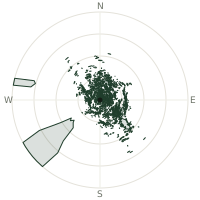
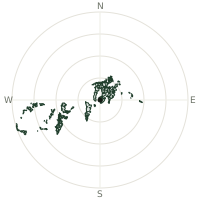
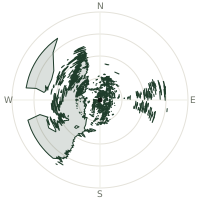
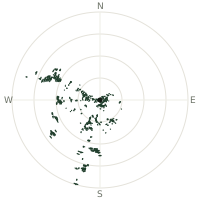
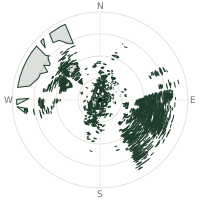
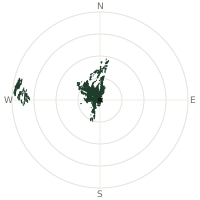
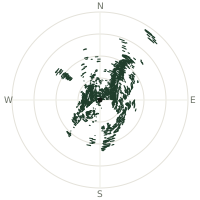
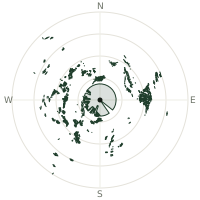
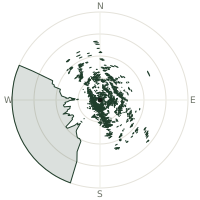
From Huascarán, the terrain-limited line of sight reaches up to 314 km. The single farthest piece of visible terrain lies 314 km to the south-southwest (bearing 201°), at 0 m elevation. These results account for Earth's curvature and standard atmospheric refraction, computed from 30-meter resolution Copernicus GLO-30 elevation data across 2,697,697 terrain samples.
Open the interactive visibility map →Visibility by direction
The horizon is most open toward the southwest, where sightlines run 314 km on average; terrain closes the view down fastest to the south, at 88.6 km.
| N | 162 km | |
| NNE | 124 km | |
| NE | 104 km | |
| ENE | 140 km | |
| E | 96.9 km | |
| ESE | 140 km | |
| SE | 161 km | |
| SSE | 153 km | |
| S | 88.6 km | |
| SSW | 212 km | |
| SW | 314 km | |
| WSW | 314 km | |
| W | 314 km | |
| WNW | 196 km | |
| NW | 133 km | |
| NNW | 176 km |
Farthest named landmarks in view
448 named peaks, hills and headlands stand inside this viewshed. These are the farthest ones you could pick out on a clear day:
| Landmark | Visible distance | Direction | Elevation |
|---|---|---|---|
| Cerro Azufre | 256 km | NNW 338° | 4,094 m |
| Cerro Puchanes | 256 km | NNW 338° | 4,105 m |
| Cerro Pabellón | 256 km | NNW 339° | 4,134 m |
| Nevado Huaguruncho | 241 km | SE 131° | 5,723 m |
| Cerro Sahuan Machay | 240 km | SE 128° | 4,590 m |
| Cerro Perolpucro | 237 km | N 355° | 4,161 m |
About Huascarán
Huascarán rises to 6,768 metres in the Cordillera Blanca and is the highest mountain in the tropics. Its twin summits: Huascarán Sur and Huascarán Norte, are separated by a saddle. First ascended on 20 July 1932 by a joint German–Austrian expedition, the mountain gained tragic fame on 31 May 1970 when a 7.9-magnitude earthquake triggered a massive avalanche that destroyed the town of Yungay, killing over 20,000 people.
Did you know?
- American mountaineer Annie Peck summited the lower north peak in 1908, a landmark climb in the history of women's mountaineering, decades before the higher south summit was reached.
- Rather than rebuild atop the buried town, Peru declared the site a memorial cemetery, Campo Santo, leaving Yungay's ruins undisturbed beneath the earth.
- At 6,768 metres, it is Peru's highest peak and the highest in the tropical Andes.
- Named after the town of Huaraz, whose water sources flow from the mountain's glaciers.
- Huascarán National Park, established 1975, was declared a UNESCO World Heritage Site in 1985.
Frequently asked questions
How far can you see from Huascarán?
On a clear day the terrain allows a line of sight of up to 314 km from Huascarán. The average visible distance across all 360 directions is 177 km. Atmospheric conditions (haze, humidity) usually reduce practical visibility below the terrain-limited maximum.
What is the farthest point visible from Huascarán?
The farthest terrain visible from Huascarán lies 314 km to the south-southwest, at an elevation of 0 m. Earth's curvature and atmospheric refraction are accounted for in this calculation.
How high is Huascarán?
The observation point at Huascarán sits at 6,747 m above sea level (Copernicus GLO-30 elevation model).
How is this visibility map calculated?
UpToWhere traces lines of sight in 360 directions from the observer using 30 m-resolution Copernicus terrain data, correcting for Earth curvature and standard atmospheric refraction. You can run the same analysis for any point on Earth with the free calculator.
Run your own analysis
Want to know what you can see from your house, a summit you're planning to climb, or a plot of land? UpToWhere computes the same 360° viewshed for any point on Earth in seconds, free.
Try the viewshed calculator