 UpToWhere
What can you see from Easter Island (Maunga Terevaka)?
Volcanic cone crowned by moai: Polynesian mystery in the Pacific.
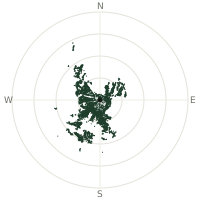
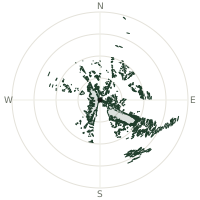
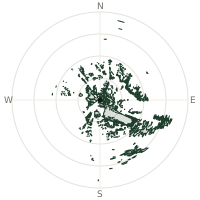
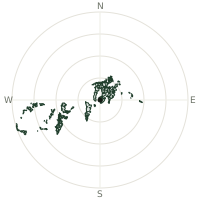
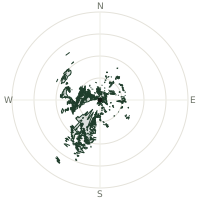
From Easter Island (Maunga Terevaka), the terrain-limited line of sight reaches up to 87.1 km. The single farthest piece of visible terrain lies 87.1 km to the north (bearing 0°), at 0 m elevation. These results account for Earth's curvature and standard atmospheric refraction, computed from 30-meter resolution Copernicus GLO-30 elevation data across 1,969,694 terrain samples.
Open the interactive visibility map →Visibility by direction
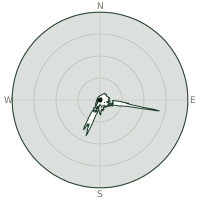
The horizon is most open toward the north, where sightlines run 87.1 km on average; terrain closes the view down fastest to the north, at 87.1 km.
| N | 87.1 km | |
| NNE | 87.1 km | |
| NE | 87.1 km | |
| ENE | 87.1 km | |
| E | 87.1 km | |
| ESE | 87.1 km | |
| SE | 87.1 km | |
| SSE | 87.1 km | |
| S | 87.1 km | |
| SSW | 87.1 km | |
| SW | 87.1 km | |
| WSW | 87.1 km | |
| W | 87.1 km | |
| WNW | 87.1 km | |
| NW | 87.1 km | |
| NNW | 87.1 km |
Farthest named landmarks in view
37 named peaks, hills and headlands stand inside this viewshed. These are the farthest ones you could pick out on a clear day:
| Landmark | Visible distance | Direction | Elevation |
|---|---|---|---|
| Cabo Cumming | 15.2 km | E 98° | 53 m |
| Cabo Roggeveen | 14.8 km | ESE 105° | 9 m |
| Cabo O’Higgins | 14.0 km | E 93° | 60 m |
| Cabo Te Maga | 13.2 km | SSW 209° | 85 m |
| Cabo Sur | 13.1 km | SSW 200° | 0 m |
| Cerro Parehe | 12.9 km | E 95° | 209 m |
About Easter Island (Maunga Terevaka)
Maunga Terevaka, Easter Island's tallest volcano at 507 meters, represents 80% of the island's surface. This extinct peak, formed 360,000 years ago, rises above the Pacific as a monument to Rapa Nui civilization. Approximately 1,000 moai statues carved from tuff at Rano Raraku crater weigh up to 86 tons each.
Did you know?
- Maunga Terevaka: 507 meters elevation, largest and youngest volcano.
- Nearly 400 moai still lie unfinished or abandoned mid-transport in and around the Rano Raraku quarry, frozen in place when the carving tradition abruptly stopped.
- At more than 3,500 kilometres from the nearest inhabited land, Easter Island is one of the remotest places on Earth: its Polynesian settlers reached it using only star-based wayfinding navigation.
- No summit crater; formed from numerous north-south volcanic centers.
- Rapa Nui oral tradition holds that the moai 'walked' to their platforms upright; a 2012 experiment showed a team of just 18 people could rock and shuffle a replica statue forward using ropes, exactly as the legends describe.
Frequently asked questions
How far can you see from Easter Island (Maunga Terevaka)?
On a clear day the terrain allows a line of sight of up to 87.1 km from Easter Island (Maunga Terevaka). The average visible distance across all 360 directions is 87.1 km. Atmospheric conditions (haze, humidity) usually reduce practical visibility below the terrain-limited maximum.
What is the farthest point visible from Easter Island (Maunga Terevaka)?
The farthest terrain visible from Easter Island (Maunga Terevaka) lies 87.1 km to the north, at an elevation of 0 m. Earth's curvature and atmospheric refraction are accounted for in this calculation.
How high is Easter Island (Maunga Terevaka)?
The observation point at Easter Island (Maunga Terevaka) sits at 518 m above sea level (Copernicus GLO-30 elevation model).
How is this visibility map calculated?
UpToWhere traces lines of sight in 360 directions from the observer using 30 m-resolution Copernicus terrain data, correcting for Earth curvature and standard atmospheric refraction. You can run the same analysis for any point on Earth with the free calculator.
Run your own analysis
Want to know what you can see from your house, a summit you're planning to climb, or a plot of land? UpToWhere computes the same 360° viewshed for any point on Earth in seconds, free.
Try the viewshed calculator