 UpToWhere
What can you see from Aconcagua?
The highest peak in the Americas, and the world's highest non-technical mountain.
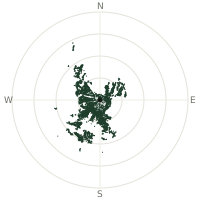
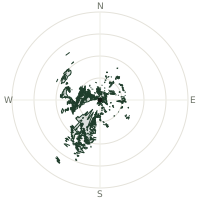
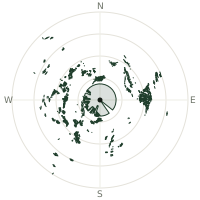
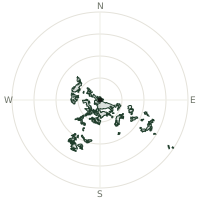
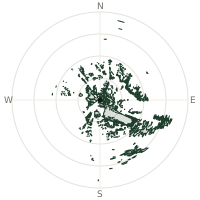
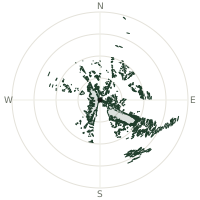
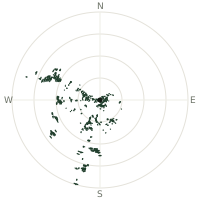
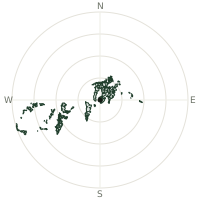
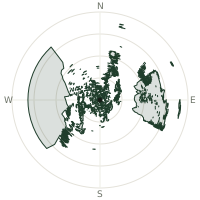
From Aconcagua, the terrain-limited line of sight reaches up to 389 km. The single farthest piece of visible terrain lies 389 km to the east (bearing 87°), at 1,433 m elevation. These results account for Earth's curvature and standard atmospheric refraction, computed from 30-meter resolution Copernicus GLO-30 elevation data across 2,712,034 terrain samples.
Open the interactive visibility map →Visibility by direction
The horizon is most open toward the east, where sightlines run 336 km on average; terrain closes the view down fastest to the southeast, at 65.3 km.
| N | 142 km | |
| NNE | 238 km | |
| NE | 165 km | |
| ENE | 297 km | |
| E | 336 km | |
| ESE | 218 km | |
| SE | 65.3 km | |
| SSE | 83.3 km | |
| S | 134 km | |
| SSW | 159 km | |
| SW | 287 km | |
| WSW | 319 km | |
| W | 319 km | |
| WNW | 319 km | |
| NW | 263 km | |
| NNW | 147 km |
Farthest named landmarks in view
742 named peaks, hills and headlands stand inside this viewshed. These are the farthest ones you could pick out on a clear day:
| Landmark | Visible distance | Direction | Elevation |
|---|---|---|---|
| Cerro los Mendocinos | 361 km | E 92° | 1,658 m |
| Cerro Esquina | 360 km | E 93° | 1,800 m |
| Cerro Retama | 359 km | E 99° | 2,189 m |
| Cerro Blanco | 359 km | E 93° | 1,731 m |
| Cerro Tinaja | 358 km | E 98° | 2,158 m |
| Cerro Valle de Piedra | 358 km | E 100° | 1,960 m |
About Aconcagua
Aconcagua rises to 6,967 metres in Argentina's Andes and is the highest mountain outside Asia. Its first recorded ascent came on 14 January 1897, when Swiss guide Matthias Zurbriggen summited as part of Edward FitzGerald's British expedition. Despite its straightforward climbing route: no ropes or specialised equipment required, altitude sickness affects most climbers. The mountain records roughly three deaths per year, earning it the nickname 'Mountain of Death,' with summit success rates around 30–40%.
Did you know?
- At 6,967 metres, it is the highest peak in the Americas and the highest in the Southern Hemisphere.
- Aconcagua's name is thought to derive from Quechua or Mapuche words meaning 'Stone Sentinel,' though its exact origin is still debated by linguists.
- Often called the world's highest non-technical mountain, yet records ~3 deaths annually.
- Located 112 km northwest of Mendoza near the Argentina-Chile border.
- Summit success rates are 30–40%; the extreme altitude (40% of sea level pressure) kills without ropes.
Frequently asked questions
How far can you see from Aconcagua?
On a clear day the terrain allows a line of sight of up to 389 km from Aconcagua. The average visible distance across all 360 directions is 218 km. Atmospheric conditions (haze, humidity) usually reduce practical visibility below the terrain-limited maximum.
What is the farthest point visible from Aconcagua?
The farthest terrain visible from Aconcagua lies 389 km to the east, at an elevation of 1,433 m. Earth's curvature and atmospheric refraction are accounted for in this calculation.
How high is Aconcagua?
The observation point at Aconcagua sits at 6,926 m above sea level (Copernicus GLO-30 elevation model).
How is this visibility map calculated?
UpToWhere traces lines of sight in 360 directions from the observer using 30 m-resolution Copernicus terrain data, correcting for Earth curvature and standard atmospheric refraction. You can run the same analysis for any point on Earth with the free calculator.
Run your own analysis
Want to know what you can see from your house, a summit you're planning to climb, or a plot of land? UpToWhere computes the same 360° viewshed for any point on Earth in seconds, free.
Try the viewshed calculator