 UpToWhere
What can you see from Monte Fitz Roy?
A granite colossus named after the captain of the Beagle, first climbed in 1952.
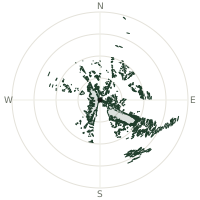
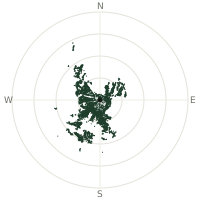
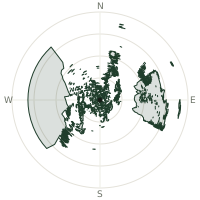
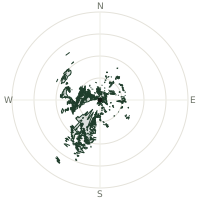
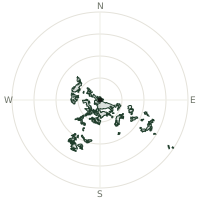
From Monte Fitz Roy, the terrain-limited line of sight reaches up to 211 km. The single farthest piece of visible terrain lies 211 km to the east-southeast (bearing 103°), at 482 m elevation. These results account for Earth's curvature and standard atmospheric refraction, computed from 30-meter resolution Copernicus GLO-30 elevation data across 2,325,585 terrain samples.
Open the interactive visibility map →Visibility by direction
The horizon is most open toward the east-southeast, where sightlines run 163 km on average; terrain closes the view down fastest to the west-southwest, at 31.1 km.
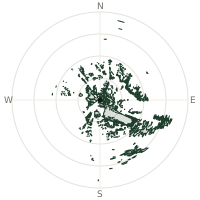
| N | 108 km | |
| NNE | 153 km | |
| NE | 94.6 km | |
| ENE | 115 km | |
| E | 101 km | |
| ESE | 163 km | |
| SE | 150 km | |
| SSE | 163 km | |
| S | 102 km | |
| SSW | 86.4 km | |
| SW | 37.0 km | |
| WSW | 31.1 km | |
| W | 53.8 km | |
| WNW | 92.0 km | |
| NW | 69.4 km | |
| NNW | 76.4 km |
Farthest named landmarks in view
120 named peaks, hills and headlands stand inside this viewshed. These are the farthest ones you could pick out on a clear day:
| Landmark | Visible distance | Direction | Elevation |
|---|---|---|---|
| Cerro Belgrano | 196 km | NNE 27° | 2,115 m |
| Cerro Cochrane | 194 km | NNE 16° | 3,706 m |
| Cerro Paine Grande | 192 km | S 181° | 2,884 m |
| Cerros Barrancos | 191 km | N 6° | 2,281 m |
| Cordillera de Paine | 186 km | S 181° | 1,724 m |
| Cerro Mank Aike | 177 km | ESE 109° | 812 m |
About Monte Fitz Roy
Monte Fitz Roy rises 3,405 metres on the Argentina–Chile border and is named after Robert FitzRoy, captain of HMS Beagle during Darwin's voyage. The peak's sheer granite faces and frequent cloud cover inspired its Tehuelche name, 'the mountain that smokes.' The rock originated as igneous magma roughly 100 million years ago, crystallising deep beneath the Andes before erosion exposed the granite massif. The first ascent came on the southeast ridge in 1952 by French alpinists Lionel Terray and Guido Magnone.
Did you know?
- Named after HMS Beagle's captain Robert FitzRoy, who surveyed Patagonia with Darwin.
- Robert FitzRoy, the mountain's namesake, later pioneered weather forecasting as head of Britain's Meteorological Office: a fitting legacy, since Patagonia's brutal winds leave the peak climbable only a handful of days each year.
- At 3,405 metres, it is the highest spire in the Patagonian granite complex.
- Italian missionary and explorer Alberto De Agostini's early 20th-century photographs first brought the peak to international mountaineering attention.
- The granite formed ~100 million years ago, thrust upward by tectonic collision.
Frequently asked questions
How far can you see from Monte Fitz Roy?
On a clear day the terrain allows a line of sight of up to 211 km from Monte Fitz Roy. The average visible distance across all 360 directions is 99.5 km. Atmospheric conditions (haze, humidity) usually reduce practical visibility below the terrain-limited maximum.
What is the farthest point visible from Monte Fitz Roy?
The farthest terrain visible from Monte Fitz Roy lies 211 km to the east-southeast, at an elevation of 482 m. Earth's curvature and atmospheric refraction are accounted for in this calculation.
How high is Monte Fitz Roy?
The observation point at Monte Fitz Roy sits at 2,868 m above sea level (Copernicus GLO-30 elevation model).
How is this visibility map calculated?
UpToWhere traces lines of sight in 360 directions from the observer using 30 m-resolution Copernicus terrain data, correcting for Earth curvature and standard atmospheric refraction. You can run the same analysis for any point on Earth with the free calculator.
Run your own analysis
Want to know what you can see from your house, a summit you're planning to climb, or a plot of land? UpToWhere computes the same 360° viewshed for any point on Earth in seconds, free.
Try the viewshed calculator