 UpToWhere
What can you see from Sugarloaf Mountain (Rio)?
A monolithic granite and quartz peak at Rio's harbour mouth, named for its sugar-cone shape.
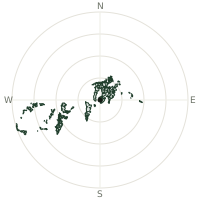
From Sugarloaf Mountain (Rio), the terrain-limited line of sight reaches up to 182 km. The single farthest piece of visible terrain lies 182 km to the west-northwest (bearing 288°), at 2,483 m elevation. These results account for Earth's curvature and standard atmospheric refraction, computed from 30-meter resolution Copernicus GLO-30 elevation data across 1,928,996 terrain samples.
Open the interactive visibility map →Visibility by direction
The horizon is most open toward the northeast, where sightlines run 82.9 km on average; terrain closes the view down fastest to the west, at 9.9 km.
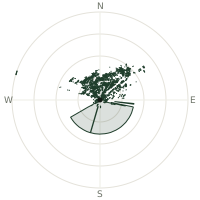
| N | 52.4 km | |
| NNE | 65.5 km | |
| NE | 82.9 km | |
| ENE | 43.1 km | |
| E | 30.0 km | |
| ESE | 70.5 km | |
| SE | 70.5 km | |
| SSE | 70.5 km | |
| S | 70.5 km | |
| SSW | 70.5 km | |
| SW | 70.5 km | |
| WSW | 18.8 km | |
| W | 9.9 km | |
| WNW | 42.4 km | |
| NW | 59.9 km | |
| NNW | 53.9 km |
Farthest named landmarks in view
131 named peaks, hills and headlands stand inside this viewshed. These are the farthest ones you could pick out on a clear day:
| Landmark | Visible distance | Direction | Elevation |
|---|---|---|---|
| Pedro do Toledo | 84.1 km | NNE 32° | 2,099 m |
| Pedra do Faraó | 82.8 km | NE 49° | 1,736 m |
| Pico Pedra dos Frades | 77.2 km | NNE 32° | 2,016 m |
| Morro João Paulo | 76.4 km | NE 39° | 1,071 m |
| Morro do Carmo | 73.8 km | NNE 31° | 1,812 m |
| Morro da Onça | 68.3 km | NNE 30° | 730 m |
About Sugarloaf Mountain (Rio)
Sugarloaf Mountain rises 396 metres on a peninsula at the mouth of Guanabara Bay in Rio de Janeiro. The name, coined in the 16th century by Portuguese traders, reflects sugar's historical importance to Brazil. The mountain belongs to a family of steep-sided rock outcroppings called bornhardts. A glass-walled cable car connects the peaks at 20-minute intervals along a 1,400-metre route. In 2012, the mountain became part of Rio's UNESCO World Heritage Site, and it contains over 270 rock climbing routes.
Did you know?
- The cable car, inaugurated in 1912, was one of the first aerial tramways built anywhere in the world and remains Brazil's oldest.
- At 396 metres, it is a monolithic granite and quartz peak at Rio's harbour entrance.
- The mountain's cable car featured in a famous fight scene in the 1979 James Bond film 'Moonraker,' with villain Jaws battling 007 mid-ride.
- The site is protected as a Natural Monument since 2006; UNESCO World Heritage Site (2012).
- Contains more than 270 rock climbing routes, one of the world's largest urban climbing areas.
Frequently asked questions
How far can you see from Sugarloaf Mountain (Rio)?
On a clear day the terrain allows a line of sight of up to 182 km from Sugarloaf Mountain (Rio). The average visible distance across all 360 directions is 55.1 km. Atmospheric conditions (haze, humidity) usually reduce practical visibility below the terrain-limited maximum.
What is the farthest point visible from Sugarloaf Mountain (Rio)?
The farthest terrain visible from Sugarloaf Mountain (Rio) lies 182 km to the west-northwest, at an elevation of 2,483 m. Earth's curvature and atmospheric refraction are accounted for in this calculation.
How high is Sugarloaf Mountain (Rio)?
The observation point at Sugarloaf Mountain (Rio) sits at 339 m above sea level (Copernicus GLO-30 elevation model).
How is this visibility map calculated?
UpToWhere traces lines of sight in 360 directions from the observer using 30 m-resolution Copernicus terrain data, correcting for Earth curvature and standard atmospheric refraction. You can run the same analysis for any point on Earth with the free calculator.
Run your own analysis
Want to know what you can see from your house, a summit you're planning to climb, or a plot of land? UpToWhere computes the same 360° viewshed for any point on Earth in seconds, free.
Try the viewshed calculatorNearby & related viewpoints
- Christ the Redeemer (Corcovado)6 km away
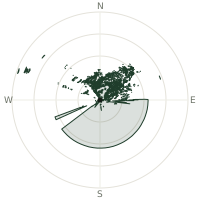
- Iguazú Falls1,183 km away
- Cerro Toco (Atacama)Featured viewpoint
- Salar de Uyuni (Isla Incahuasi)Featured viewpoint
- AconcaguaFeatured viewpoint
- Sky Costanera (Gran Torre Santiago)Featured viewpoint
- Vinicunca (Rainbow Mountain)Featured viewpoint
- Machu PicchuFeatured viewpoint