 UpToWhere
What can you see from Christ the Redeemer (Corcovado)?
A 30-metre Art Deco statue towering over Rio, built between 1926 and 1931 with local donations.
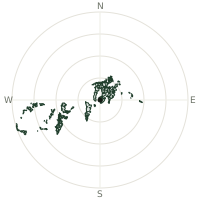
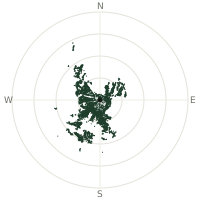
From Christ the Redeemer (Corcovado), the terrain-limited line of sight reaches up to 178 km. The single farthest piece of visible terrain lies 178 km to the west-northwest (bearing 289°), at 2,670 m elevation. These results account for Earth's curvature and standard atmospheric refraction, computed from 30-meter resolution Copernicus GLO-30 elevation data across 1,994,908 terrain samples.
Open the interactive visibility map →Visibility by direction
The horizon is most open toward the east-southeast, where sightlines run 97.1 km on average; terrain closes the view down fastest to the west, at 4.7 km.
| N | 53.7 km | |
| NNE | 60.7 km | |
| NE | 91.3 km | |
| ENE | 74.8 km | |
| E | 83.6 km | |
| ESE | 97.1 km | |
| SE | 97.1 km | |
| SSE | 97.1 km | |
| S | 97.1 km | |
| SSW | 97.1 km | |
| SW | 85.7 km | |
| WSW | 24.5 km | |
| W | 4.7 km | |
| WNW | 53.9 km | |
| NW | 85.8 km | |
| NNW | 50.6 km |
Farthest named landmarks in view
161 named peaks, hills and headlands stand inside this viewshed. These are the farthest ones you could pick out on a clear day:
| Landmark | Visible distance | Direction | Elevation |
|---|---|---|---|
| Pico dos Três Estados | 175 km | WNW 290° | 2,652 m |
| Pedra do Sino de Itatiaia | 162 km | WNW 293° | 2,655 m |
| Pico das Prateleiras | 162 km | WNW 292° | 2,500 m |
| Pico das Agulhas Negras | 162 km | WNW 293° | 2,791 m |
| Pedra Assentada | 161 km | WNW 292° | 2,434 m |
| Morro São João | 129 km | ENE 69° | 687 m |
About Christ the Redeemer (Corcovado)
Christ the Redeemer stands atop Corcovado mountain at 710 metres overlooking Rio de Janeiro. The 30-metre-tall figure, weighing 635 metric tonnes, was designed by French-Polish sculptor Paul Landowski and constructed between 1926 and 1931. The cost: roughly $250,000, was funded almost entirely by Rio's Catholic community. Its outstretched arms span 28 metres. In 2007, it was named one of the New Seven Wonders of the World. More than 2 million people visit annually.
Did you know?
- A cog railway up Corcovado, opened in 1884, predates the statue by more than four decades and still carries most visitors to the summit today.
- While Paul Landowski designed the statue's overall form, its face was sculpted separately by Romanian-French artist Gheorghe Leonida.
- Structural engineering for the statue was led by Brazilian engineer Heitor da Silva Costa, with calculations contributed by Frenchman Albert Caquot.
- Lightning strikes the statue several times a year in Rio's stormy climate; a 2014 strike damaged a finger and part of the head, later repaired.
- A small chapel was added at the statue's base in 2006, where visitors can hold baptisms and small weddings beneath the monument.
Frequently asked questions
How far can you see from Christ the Redeemer (Corcovado)?
On a clear day the terrain allows a line of sight of up to 178 km from Christ the Redeemer (Corcovado). The average visible distance across all 360 directions is 72.2 km. Atmospheric conditions (haze, humidity) usually reduce practical visibility below the terrain-limited maximum.
What is the farthest point visible from Christ the Redeemer (Corcovado)?
The farthest terrain visible from Christ the Redeemer (Corcovado) lies 178 km to the west-northwest, at an elevation of 2,670 m. Earth's curvature and atmospheric refraction are accounted for in this calculation.
How high is Christ the Redeemer (Corcovado)?
The observation point at Christ the Redeemer (Corcovado) sits at 644 m above sea level (Copernicus GLO-30 elevation model).
How is this visibility map calculated?
UpToWhere traces lines of sight in 360 directions from the observer using 30 m-resolution Copernicus terrain data, correcting for Earth curvature and standard atmospheric refraction. You can run the same analysis for any point on Earth with the free calculator.
Run your own analysis
Want to know what you can see from your house, a summit you're planning to climb, or a plot of land? UpToWhere computes the same 360° viewshed for any point on Earth in seconds, free.
Try the viewshed calculatorNearby & related viewpoints
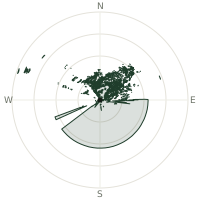
- Sugarloaf Mountain (Rio)6 km away
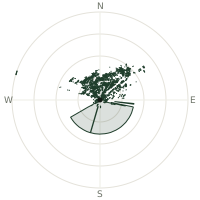
- Iguazú Falls1,177 km away
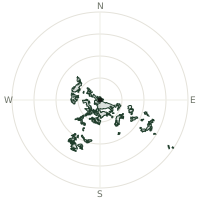
- Cerro Toco (Atacama)Featured viewpoint
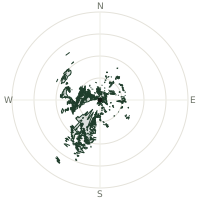
- Salar de Uyuni (Isla Incahuasi)Featured viewpoint
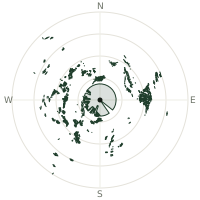
- AconcaguaFeatured viewpoint
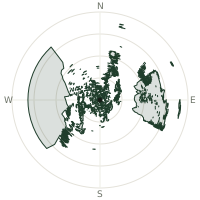
- Sky Costanera (Gran Torre Santiago)Featured viewpoint
- Vinicunca (Rainbow Mountain)Featured viewpoint
- Machu PicchuFeatured viewpoint