 UpToWhere
What can you see from Arc de Triomphe?
Napoleon ordered it, but he'd been dead 15 years before it was finished.
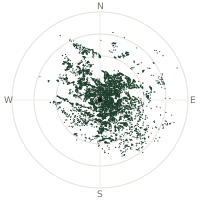
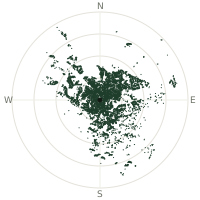
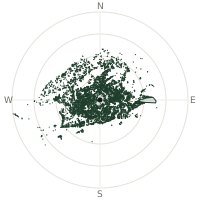
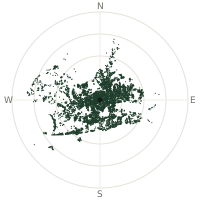
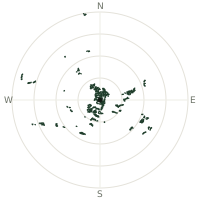
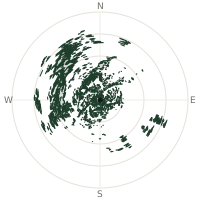
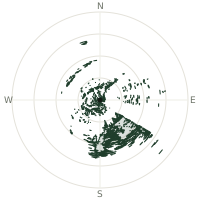
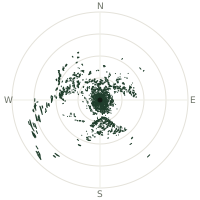
From Arc de Triomphe, the terrain-limited line of sight reaches up to 49.9 km. The single farthest piece of visible terrain lies 49.9 km to the northwest (bearing 316°), at 222 m elevation. These results account for Earth's curvature and standard atmospheric refraction, computed from 30-meter resolution Copernicus GLO-30 elevation data across 1,872,407 terrain samples.
Open the interactive visibility map →Visibility by direction
The horizon is most open toward the northwest, where sightlines run 33.2 km on average; terrain closes the view down fastest to the south-southwest, at 9.7 km.
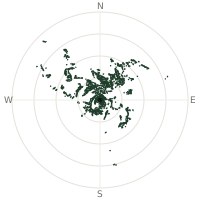
| N | 16.5 km | |
| NNE | 22.6 km | |
| NE | 31.3 km | |
| ENE | 20.6 km | |
| E | 9.9 km | |
| ESE | 23.2 km | |
| SE | 22.2 km | |
| SSE | 14.6 km | |
| S | 10.4 km | |
| SSW | 9.7 km | |
| SW | 10.8 km | |
| WSW | 10.2 km | |
| W | 15.6 km | |
| WNW | 31.0 km | |
| NW | 33.2 km | |
| NNW | 14.4 km |
About Arc de Triomphe
Napoleon commissioned this arch in 1806 to honor French soldiers, but construction dragged through the fall of his empire and his own death in 1821, finally finishing in 1836 under King Louis-Philippe. When Napoleon's remains were brought back from exile in 1840, his funeral procession passed directly beneath it. Today it anchors the western end of the Champs-Élysées, with twelve avenues radiating outward from the roundabout below.
Did you know?
- Beneath the arch burns an eternal flame for the Unknown Soldier of World War I, relit every evening since 1923 without ever going out, even under Nazi occupation.
- The twelve avenues meeting at its roundabout form one of the few intersections in France with no painted lane lines; entering traffic has the right of way.
- From the terrace, the Champs-Élysées, the Louvre, and the modern Grande Arche de la Défense line up along a single straight axis kilometres long.
- Architect Jean Chalgrin died in 1811, 25 years before his design was finally completed.
- Reliefs on the arch's base include François Rude's "La Marseillaise," depicting volunteers rallying to defend revolutionary France.
Frequently asked questions
How far can you see from Arc de Triomphe?
On a clear day the terrain allows a line of sight of up to 49.9 km from Arc de Triomphe. The average visible distance across all 360 directions is 18.5 km. Atmospheric conditions (haze, humidity) usually reduce practical visibility below the terrain-limited maximum.
What is the farthest point visible from Arc de Triomphe?
The farthest terrain visible from Arc de Triomphe lies 49.9 km to the northwest, at an elevation of 222 m. Earth's curvature and atmospheric refraction are accounted for in this calculation.
How high is Arc de Triomphe?
The observation point at Arc de Triomphe sits at 113 m above sea level (Copernicus GLO-30 elevation model).
How is this visibility map calculated?
UpToWhere traces lines of sight in 360 directions from the observer using 30 m-resolution Copernicus terrain data, correcting for Earth curvature and standard atmospheric refraction. You can run the same analysis for any point on Earth with the free calculator.
Run your own analysis
Want to know what you can see from your house, a summit you're planning to climb, or a plot of land? UpToWhere computes the same 360° viewshed for any point on Earth in seconds, free.
Try the viewshed calculator