 UpToWhere
What can you see from London Eye?
When it opened in 2000, it became the world's tallest Ferris wheel and the tallest cantilevered structure.
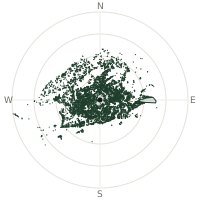
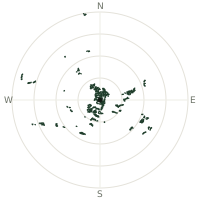
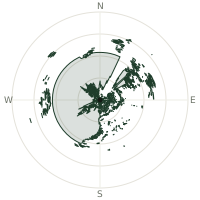
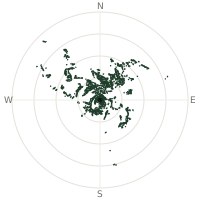
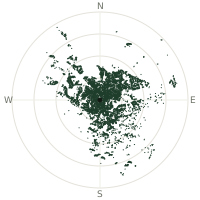
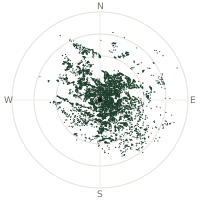
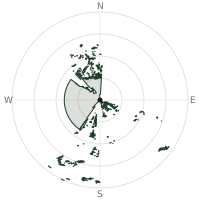
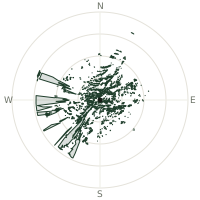
From London Eye, the terrain-limited line of sight reaches up to 69.0 km. The single farthest piece of visible terrain lies 69.0 km to the west (bearing 268°), at 135 m elevation. These results account for Earth's curvature and standard atmospheric refraction, computed from 30-meter resolution Copernicus GLO-30 elevation data across 1,879,872 terrain samples.
Open the interactive visibility map →Visibility by direction
The horizon is most open toward the west-northwest, where sightlines run 54.1 km on average; terrain closes the view down fastest to the north-northwest, at 13.3 km.
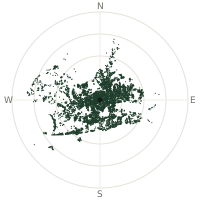
| N | 27.8 km | |
| NNE | 34.6 km | |
| NE | 27.3 km | |
| ENE | 32.9 km | |
| E | 41.4 km | |
| ESE | 29.7 km | |
| SE | 29.6 km | |
| SSE | 26.4 km | |
| S | 25.8 km | |
| SSW | 32.4 km | |
| SW | 47.1 km | |
| WSW | 45.7 km | |
| W | 52.1 km | |
| WNW | 54.1 km | |
| NW | 28.8 km | |
| NNW | 13.3 km |
About London Eye
The London Eye, a cantilevered observation wheel on the South Bank of the River Thames, opened to the paying public on March 9, 2000. Standing 135 metres tall with a diameter of 120 metres, it was originally named the Millennium Wheel and was the world's tallest Ferris wheel when it opened, a record it held until the Star of Nanchang in China surpassed it. Intended initially as a temporary five-year attraction, it was granted permanent status in July 2002 and has become one of London's most iconic and visited attractions.
Did you know?
- The wheel has 32 sealed capsules, numbered 1 to 33: the superstitious number 13 is skipped.
- Each of the wheel's capsules holds up to 25 people, and the wheel moves slowly enough that it rarely needs to stop for passengers to board or disembark.
- It was designed by married architects David Marks and Julia Barfield as an entry to a millennium landmark competition that never named an official winner; they built it anyway with private financing.
- The wheel was assembled lying flat on platforms in the Thames, then hoisted upright over roughly two weeks in October 1999.
- The wheel's diameter is 120 metres, and each rotation takes approximately thirty minutes.
Frequently asked questions
How far can you see from London Eye?
On a clear day the terrain allows a line of sight of up to 69.0 km from London Eye. The average visible distance across all 360 directions is 34.3 km. Atmospheric conditions (haze, humidity) usually reduce practical visibility below the terrain-limited maximum.
What is the farthest point visible from London Eye?
The farthest terrain visible from London Eye lies 69.0 km to the west, at an elevation of 135 m. Earth's curvature and atmospheric refraction are accounted for in this calculation.
How high is London Eye?
The observation point at London Eye sits at 141 m above sea level (Copernicus GLO-30 elevation model).
How is this visibility map calculated?
UpToWhere traces lines of sight in 360 directions from the observer using 30 m-resolution Copernicus terrain data, correcting for Earth curvature and standard atmospheric refraction. You can run the same analysis for any point on Earth with the free calculator.
Run your own analysis
Want to know what you can see from your house, a summit you're planning to climb, or a plot of land? UpToWhere computes the same 360° viewshed for any point on Earth in seconds, free.
Try the viewshed calculator