 UpToWhere
What can you see from Stonehenge?
Neolithic enigma: megaliths aligned with solstice sunlight.
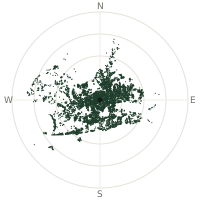
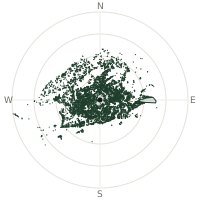
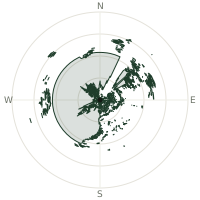
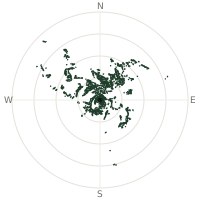
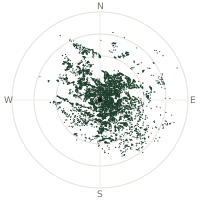
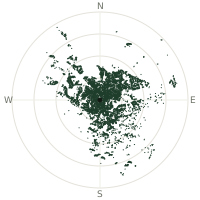
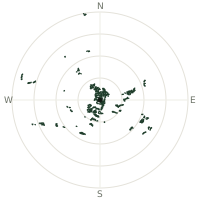
From Stonehenge, the terrain-limited line of sight reaches up to 23.1 km. The single farthest piece of visible terrain lies 23.1 km to the west-northwest (bearing 289°), at 212 m elevation. These results account for Earth's curvature and standard atmospheric refraction, computed from 30-meter resolution Copernicus GLO-30 elevation data across 1,870,825 terrain samples.
Open the interactive visibility map →Visibility by direction
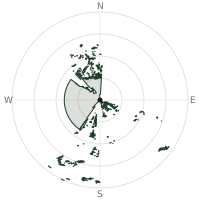
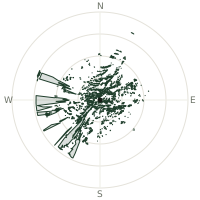
The horizon is most open toward the east-southeast, where sightlines run 10.3 km on average; terrain closes the view down fastest to the west, at 1.8 km.
| N | 4.0 km | |
| NNE | 3.0 km | |
| NE | 3.1 km | |
| ENE | 6.1 km | |
| E | 4.5 km | |
| ESE | 10.3 km | |
| SE | 7.2 km | |
| SSE | 2.6 km | |
| S | 4.2 km | |
| SSW | 7.8 km | |
| SW | 6.4 km | |
| WSW | 10.1 km | |
| W | 1.8 km | |
| WNW | 8.3 km | |
| NW | 4.1 km | |
| NNW | 5.9 km |
Farthest named landmarks in view
4 named peaks, hills and headlands stand inside this viewshed. These are the farthest ones you could pick out on a clear day:
| Landmark | Visible distance | Direction | Elevation |
|---|---|---|---|
| Popple Light Hill | 15.3 km | ESE 119° | 167 m |
| Isle of Wight Hill | 13.5 km | ESE 112° | 172 m |
| Boscombe Down East | 12.3 km | ESE 114° | 142 m |
| Smithen Down | 7.0 km | SSW 198° | 156 m |
About Stonehenge
Stonehenge on Salisbury Plain, Wiltshire, began construction around 3100 BC and continued until 1600 BC over four stages spanning 1,500 years. Its sarsen stones weigh 25 tons each; bluestones originate from Wales, 140 miles distant. The monument aligns with summer and winter solstice sunrises and sunsets.
Did you know?
- A 2021 study pinpointed the exact Welsh quarry, Craig Rhos-y-felin, that supplied several of the bluestones: though how they were transported 140 miles remains debated.
- Stonehenge sits within a much larger ritual landscape, including the nearby Durrington Walls settlement, where archaeologists have found evidence of massive feasts likely tied to construction or ceremonies at the monument.
- The stones were shaped with mortise-and-tenon and tongue-and-groove joints: woodworking techniques translated into stone, suggesting its Neolithic builders had deep carpentry expertise.
- Modern druids and pagans have gathered at Stonehenge for solstice celebrations since the 20th century, a tradition with no direct link to the monument's original Neolithic builders.
- Stonehenge was designated a UNESCO World Heritage Site in 1986, alongside the nearby prehistoric monuments of Avebury.
Frequently asked questions
How far can you see from Stonehenge?
On a clear day the terrain allows a line of sight of up to 23.1 km from Stonehenge. The average visible distance across all 360 directions is 5.6 km. Atmospheric conditions (haze, humidity) usually reduce practical visibility below the terrain-limited maximum.
What is the farthest point visible from Stonehenge?
The farthest terrain visible from Stonehenge lies 23.1 km to the west-northwest, at an elevation of 212 m. Earth's curvature and atmospheric refraction are accounted for in this calculation.
How high is Stonehenge?
The observation point at Stonehenge sits at 108 m above sea level (Copernicus GLO-30 elevation model).
How is this visibility map calculated?
UpToWhere traces lines of sight in 360 directions from the observer using 30 m-resolution Copernicus terrain data, correcting for Earth curvature and standard atmospheric refraction. You can run the same analysis for any point on Earth with the free calculator.
Run your own analysis
Want to know what you can see from your house, a summit you're planning to climb, or a plot of land? UpToWhere computes the same 360° viewshed for any point on Earth in seconds, free.
Try the viewshed calculator