 UpToWhere
What can you see from Ben Nevis?
Britain's tallest peak hides behind cloud on four days out of five.
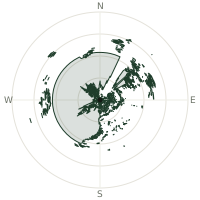
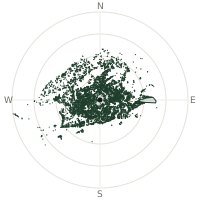
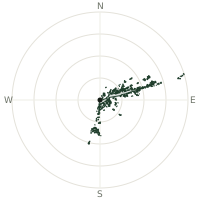
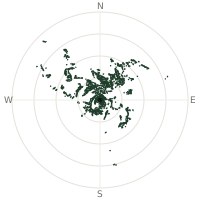
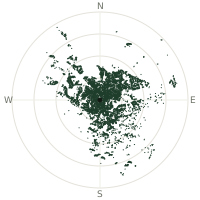
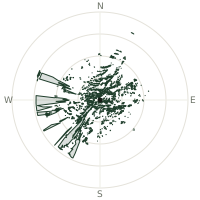
From Ben Nevis, the terrain-limited line of sight reaches up to 194 km. The single farthest piece of visible terrain lies 194 km to the south-southwest (bearing 206°), at 196 m elevation. These results account for Earth's curvature and standard atmospheric refraction, computed from 30-meter resolution Copernicus GLO-30 elevation data across 2,120,150 terrain samples.
Open the interactive visibility map →Visibility by direction
The horizon is most open toward the south-southwest, where sightlines run 115 km on average; terrain closes the view down fastest to the south-southeast, at 51.5 km.
| N | 73.1 km | |
| NNE | 106 km | |
| NE | 58.9 km | |
| ENE | 84.7 km | |
| E | 75.7 km | |
| ESE | 59.2 km | |
| SE | 59.0 km | |
| SSE | 51.5 km | |
| S | 59.7 km | |
| SSW | 115 km | |
| SW | 96.9 km | |
| WSW | 94.7 km | |
| W | 104 km | |
| WNW | 110 km | |
| NW | 74.3 km | |
| NNW | 62.6 km |
Farthest named landmarks in view
1,208 named peaks, hills and headlands stand inside this viewshed. These are the farthest ones you could pick out on a clear day:
| Landmark | Visible distance | Direction | Elevation |
|---|---|---|---|
| Ben Uarie | 164 km | NNE 25° | 623 m |
| Beinn Dhorain | 163 km | NNE 25° | 628 m |
| Gormol | 161 km | NW 325° | 470 m |
| Crionaig | 161 km | NW 325° | 467 m |
| Cnoc Loch nam Faoileag | 161 km | NW 325° | 231 m |
| Na Gilleachan Ruadh | 161 km | W 272° | 48 m |
About Ben Nevis
Ben Nevis is the highest mountain in the British Isles at 1,345 metres, and its exposed granite summit sits under cloud roughly 300 days a year. A full-time weather observatory operated at the top from 1883 to 1904, and time spent there later inspired physicist C.T.R. Wilson to invent the cloud chamber, later used to reveal the structure of the atom. The mountain rises above Fort William, and anchors the UK's Three Peaks Challenge, climbing Ben Nevis, Scafell Pike, and Snowdon within 24 hours.
Did you know?
- The summit weather observatory, staffed around the clock from 1883 to 1904, recorded an average temperature of -16°C on 7 February 1895.
- A snow patch nicknamed the Sphinx, tucked in a gully near the summit, is one of Britain's most persistent: it has fully melted away only a handful of times since enthusiasts began tracking it.
- The mountain's Gaelic name, Beinn Nibheis, has been translated as everything from 'venomous mountain' to 'mountain with its head in the clouds.'
- Cloud covers the summit on roughly 300 days a year, so a clear view from the top is genuinely rare.
- The summit plateau ends in cliffs up to 700 metres tall on its north face, among Britain's biggest, drawing ice climbers throughout winter.
Frequently asked questions
How far can you see from Ben Nevis?
On a clear day the terrain allows a line of sight of up to 194 km from Ben Nevis. The average visible distance across all 360 directions is 80.2 km. Atmospheric conditions (haze, humidity) usually reduce practical visibility below the terrain-limited maximum.
What is the farthest point visible from Ben Nevis?
The farthest terrain visible from Ben Nevis lies 194 km to the south-southwest, at an elevation of 196 m. Earth's curvature and atmospheric refraction are accounted for in this calculation.
How high is Ben Nevis?
The observation point at Ben Nevis sits at 1,353 m above sea level (Copernicus GLO-30 elevation model).
How is this visibility map calculated?
UpToWhere traces lines of sight in 360 directions from the observer using 30 m-resolution Copernicus terrain data, correcting for Earth curvature and standard atmospheric refraction. You can run the same analysis for any point on Earth with the free calculator.
Run your own analysis
Want to know what you can see from your house, a summit you're planning to climb, or a plot of land? UpToWhere computes the same 360° viewshed for any point on Earth in seconds, free.
Try the viewshed calculator