 UpToWhere
What can you see from Torre Latinoamericana?
The world's first earthquake-resistant skyscraper, it stood unharmed through two massive quakes.
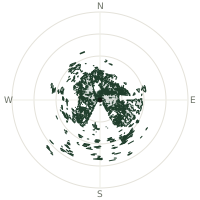
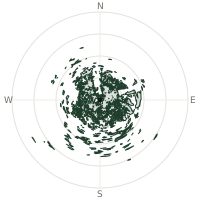
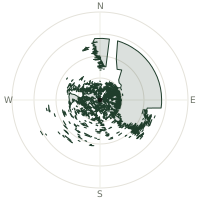
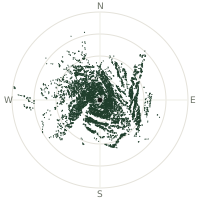
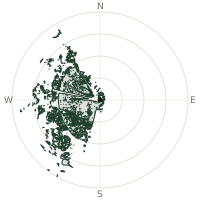
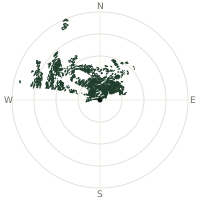
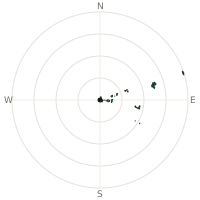
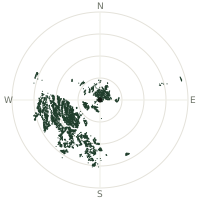
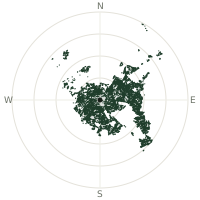
From Torre Latinoamericana, the terrain-limited line of sight reaches up to 95.1 km. The single farthest piece of visible terrain lies 95.1 km to the north-northeast (bearing 30°), at 2,979 m elevation. These results account for Earth's curvature and standard atmospheric refraction, computed from 30-meter resolution Copernicus GLO-30 elevation data across 2,268,684 terrain samples.
Open the interactive visibility map →Visibility by direction
The horizon is most open toward the southeast, where sightlines run 60.1 km on average; terrain closes the view down fastest to the north, at 15.5 km.
| N | 15.5 km | |
| NNE | 31.5 km | |
| NE | 55.8 km | |
| ENE | 47.8 km | |
| E | 44.0 km | |
| ESE | 53.4 km | |
| SE | 60.1 km | |
| SSE | 38.1 km | |
| S | 32.3 km | |
| SSW | 29.0 km | |
| SW | 27.3 km | |
| WSW | 27.4 km | |
| W | 26.1 km | |
| WNW | 36.8 km | |
| NW | 44.0 km | |
| NNW | 33.0 km |
About Torre Latinoamericana
Torre Latinoamericana opened in Mexico City on April 30, 1956, at a height of 182 metres with its antenna. The tower pioneered earthquake-resistant design with innovative features including a foundation of 361 concrete piles driven 33 metres deep and a flexible steel structure with concrete slabs. Most famously, it withstood the magnitude 7.9 earthquake of 1957 and emerged undamaged, later also surviving the catastrophic 8.1 magnitude earthquake of 1985 that damaged much of downtown Mexico City, earning it recognition from the American Institute of Steel Construction.
Did you know?
- Engineer Adolfo Zeevaert designed the tower's deep-pile foundation specifically to cope with Mexico City's notoriously soft, water-logged lakebed soil, which causes most of the city's buildings to slowly sink.
- It withstood a magnitude 7.9 earthquake in 1957, the first major test of its earthquake-resistant design.
- The tower rises on the site of the former Convent of San Francisco, a colonial-era religious complex that once stood in the same block of downtown Mexico City.
- Structural engineers still study the tower's performance during the 1985 quake as a textbook case in earthquake-resistant design, referenced in engineering courses worldwide.
- It was Mexico's tallest building for almost 27 years, from 1956 until 1982.
Frequently asked questions
How far can you see from Torre Latinoamericana?
On a clear day the terrain allows a line of sight of up to 95.1 km from Torre Latinoamericana. The average visible distance across all 360 directions is 37.6 km. Atmospheric conditions (haze, humidity) usually reduce practical visibility below the terrain-limited maximum.
What is the farthest point visible from Torre Latinoamericana?
The farthest terrain visible from Torre Latinoamericana lies 95.1 km to the north-northeast, at an elevation of 2,979 m. Earth's curvature and atmospheric refraction are accounted for in this calculation.
How high is Torre Latinoamericana?
The observation point at Torre Latinoamericana sits at 2,402 m above sea level (Copernicus GLO-30 elevation model).
How is this visibility map calculated?
UpToWhere traces lines of sight in 360 directions from the observer using 30 m-resolution Copernicus terrain data, correcting for Earth curvature and standard atmospheric refraction. You can run the same analysis for any point on Earth with the free calculator.
Run your own analysis
Want to know what you can see from your house, a summit you're planning to climb, or a plot of land? UpToWhere computes the same 360° viewshed for any point on Earth in seconds, free.
Try the viewshed calculator