 UpToWhere
What can you see from Popocatépetl?
One of Mexico's most active volcanoes, erupting nearly daily since 2005 with 30 million people nearby.
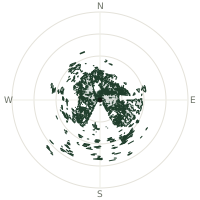
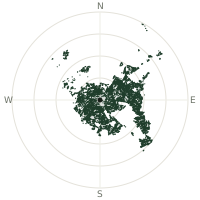
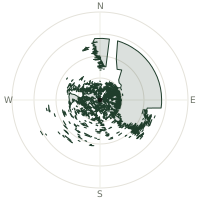
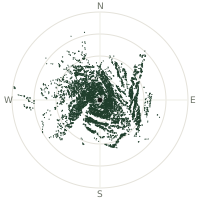
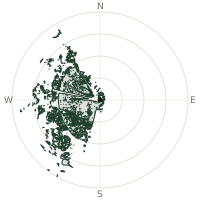
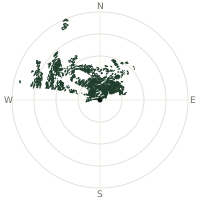
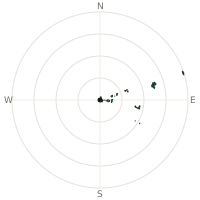
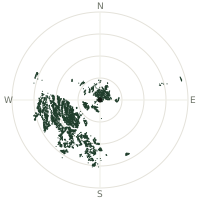
From Popocatépetl, the terrain-limited line of sight reaches up to 305 km. The single farthest piece of visible terrain lies 305 km to the west-southwest (bearing 253°), at 2,468 m elevation. These results account for Earth's curvature and standard atmospheric refraction, computed from 30-meter resolution Copernicus GLO-30 elevation data across 2,584,893 terrain samples.
Open the interactive visibility map →Visibility by direction
The horizon is most open toward the west-southwest, where sightlines run 235 km on average; terrain closes the view down fastest to the northeast, at 107 km.
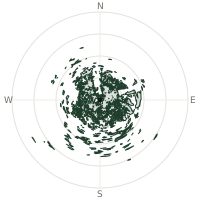
| N | 123 km | |
| NNE | 119 km | |
| NE | 107 km | |
| ENE | 148 km | |
| E | 144 km | |
| ESE | 182 km | |
| SE | 212 km | |
| SSE | 211 km | |
| S | 191 km | |
| SSW | 184 km | |
| SW | 230 km | |
| WSW | 235 km | |
| W | 132 km | |
| WNW | 162 km | |
| NW | 173 km | |
| NNW | 198 km |
Farthest named landmarks in view
2,273 named peaks, hills and headlands stand inside this viewshed. These are the farthest ones you could pick out on a clear day:
| Landmark | Visible distance | Direction | Elevation |
|---|---|---|---|
| Cerro El Billete | 301 km | WSW 252° | 2,707 m |
| Cerro Los Izotes | 294 km | WSW 249° | 1,819 m |
| Cerro Las Muchachas | 293 km | WSW 245° | 2,513 m |
| Cerro El Canal | 293 km | WSW 252° | 2,395 m |
| Cerro El Potrerito de Gomez | 293 km | WSW 253° | 2,304 m |
| Cerro La Bandera | 291 km | WSW 252° | 2,476 m |
About Popocatépetl
Popocatépetl, at 5,426 metres, is a stratovolcano seventy kilometres southeast of Mexico City and one of Mexico's most volatile peaks. Its current eruption period began in January 2005 and continues to produce near-daily episodes of seismic tremors and ash emissions. The volcano sits alarmingly close to a densely populated region: roughly 30 million people live within seventy kilometres of the summit. As of 2026, the alert level remains at 'Yellow Alert – Phase 2,' and the public is warned to stay at least twelve kilometres away from the crater.
Did you know?
- In Aztec legend, the volcano is the warrior Popocatépetl, watching eternally over the neighbouring peak Iztaccíhuatl: his beloved princess, turned to a sleeping mountain by grief.
- Its name, Popocatépetl, means 'Smoking Mountain' in Nahuatl, a description that has held true for centuries of intermittent activity.
- Ash from the volcano has repeatedly forced the closure of Mexico City's international airport, most notably during major eruptive episodes in 2000 and 2019.
- CENAPRED reported continued eruptions between June 2026, with water vapour and ash emissions.
- At 5,426 metres, Popocatépetl is Mexico's second-highest peak, just behind Pico de Orizaba.
Frequently asked questions
How far can you see from Popocatépetl?
On a clear day the terrain allows a line of sight of up to 305 km from Popocatépetl. The average visible distance across all 360 directions is 172 km. Atmospheric conditions (haze, humidity) usually reduce practical visibility below the terrain-limited maximum.
What is the farthest point visible from Popocatépetl?
The farthest terrain visible from Popocatépetl lies 305 km to the west-southwest, at an elevation of 2,468 m. Earth's curvature and atmospheric refraction are accounted for in this calculation.
How high is Popocatépetl?
The observation point at Popocatépetl sits at 5,418 m above sea level (Copernicus GLO-30 elevation model).
How is this visibility map calculated?
UpToWhere traces lines of sight in 360 directions from the observer using 30 m-resolution Copernicus terrain data, correcting for Earth curvature and standard atmospheric refraction. You can run the same analysis for any point on Earth with the free calculator.
Run your own analysis
Want to know what you can see from your house, a summit you're planning to climb, or a plot of land? UpToWhere computes the same 360° viewshed for any point on Earth in seconds, free.
Try the viewshed calculator