 UpToWhere
What can you see from Iztaccíhuatl?
Mexico's sleeping woman: four peaks that resemble a reclining figure when viewed from afar.
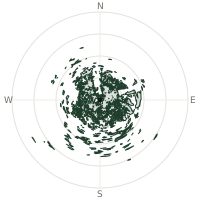
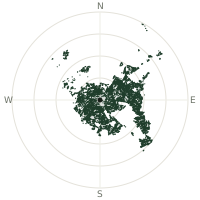
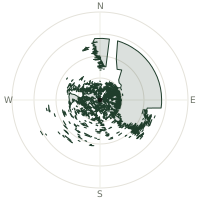
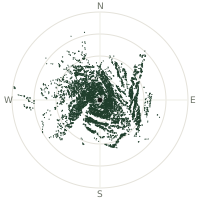
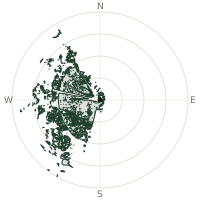
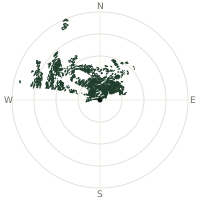
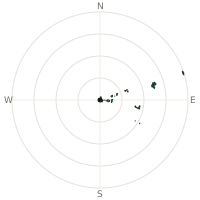
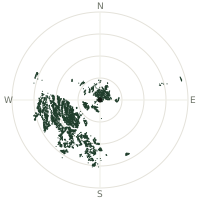
From Iztaccíhuatl, the terrain-limited line of sight reaches up to 301 km. The single farthest piece of visible terrain lies 301 km to the west-southwest (bearing 245°), at 2,377 m elevation. These results account for Earth's curvature and standard atmospheric refraction, computed from 30-meter resolution Copernicus GLO-30 elevation data across 2,567,001 terrain samples.
Open the interactive visibility map →Visibility by direction
The horizon is most open toward the southwest, where sightlines run 247 km on average; terrain closes the view down fastest to the northeast, at 95.9 km.
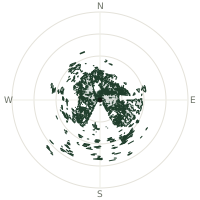
| N | 134 km | |
| NNE | 111 km | |
| NE | 95.9 km | |
| ENE | 137 km | |
| E | 135 km | |
| ESE | 173 km | |
| SE | 210 km | |
| SSE | 194 km | |
| S | 139 km | |
| SSW | 197 km | |
| SW | 247 km | |
| WSW | 176 km | |
| W | 133 km | |
| WNW | 147 km | |
| NW | 166 km | |
| NNW | 196 km |
Farthest named landmarks in view
1,829 named peaks, hills and headlands stand inside this viewshed. These are the farthest ones you could pick out on a clear day:
| Landmark | Visible distance | Direction | Elevation |
|---|---|---|---|
| Cerro Las Guacamayas | 282 km | WSW 238° | 2,639 m |
| Cerro Los Otates | 280 km | WSW 238° | 2,264 m |
| Cerro Agua Bendita | 275 km | WSW 241° | 2,309 m |
| Cerro Los Bueyes | 274 km | WSW 241° | 2,245 m |
| Cerro Azul | 266 km | SW 234° | 2,617 m |
| Cerro Tres Picachos | 265 km | SW 234° | 2,640 m |
About Iztaccíhuatl
Iztaccíhuatl, at 5,230 metres, is Mexico's third-highest peak after Pico de Orizaba and Popocatépetl. The name comes from Nahuatl meaning 'White Woman,' referring to the four individual snow-capped peaks that, when viewed from the east or west, depict the head, chest, knees, and feet of a sleeping figure. The mountain straddles the border of the State of Mexico and Puebla within Izta-Popo Zoquiapan National Park. On clear days, the silhouette is visible from Mexico City, some seventy kilometres away.
Did you know?
- Local legend tells of a Tlaxcalan princess who died of grief believing her warrior love Popocatépetl had fallen in battle: when he returned victorious, the gods turned them both into mountains so they could be together forever.
- The surrounding Izta-Popo Zoquiapan National Park was established in 1935, making it one of Mexico's oldest protected natural areas.
- Locals affectionately call the mountain La Mujer Dormida, 'The Sleeping Woman,' far more often than its formal Nahuatl name.
- Unlike its restless neighbour Popocatépetl, Iztaccíhuatl has no eruptions in recorded history, making it a popular training climb for mountaineers preparing for bigger Mexican volcanoes.
- Its highest of the four summits, El Pecho ('the chest'), is a common acclimatization stop for climbers aiming for Pico de Orizaba.
Frequently asked questions
How far can you see from Iztaccíhuatl?
On a clear day the terrain allows a line of sight of up to 301 km from Iztaccíhuatl. The average visible distance across all 360 directions is 162 km. Atmospheric conditions (haze, humidity) usually reduce practical visibility below the terrain-limited maximum.
What is the farthest point visible from Iztaccíhuatl?
The farthest terrain visible from Iztaccíhuatl lies 301 km to the west-southwest, at an elevation of 2,377 m. Earth's curvature and atmospheric refraction are accounted for in this calculation.
How high is Iztaccíhuatl?
The observation point at Iztaccíhuatl sits at 5,218 m above sea level (Copernicus GLO-30 elevation model).
How is this visibility map calculated?
UpToWhere traces lines of sight in 360 directions from the observer using 30 m-resolution Copernicus terrain data, correcting for Earth curvature and standard atmospheric refraction. You can run the same analysis for any point on Earth with the free calculator.
Run your own analysis
Want to know what you can see from your house, a summit you're planning to climb, or a plot of land? UpToWhere computes the same 360° viewshed for any point on Earth in seconds, free.
Try the viewshed calculator