 UpToWhere
What can you see from Torre de Cerredo (Picos de Europa)?
The true summit of the Picos de Europa is a scramble, not the famous horn everyone photographs.
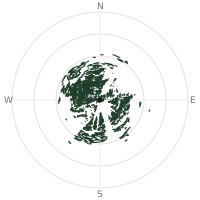
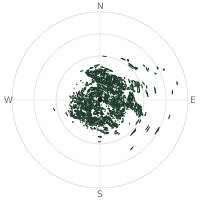
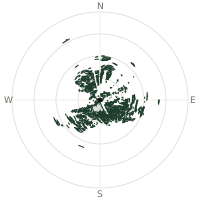
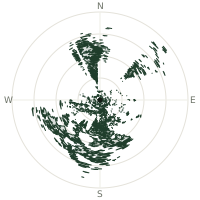
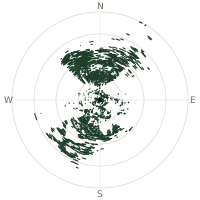
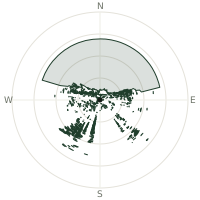
From Torre de Cerredo (Picos de Europa), the terrain-limited line of sight reaches up to 278 km. The single farthest piece of visible terrain lies 278 km to the south-southeast (bearing 165°), at 2,252 m elevation. These results account for Earth's curvature and standard atmospheric refraction, computed from 30-meter resolution Copernicus GLO-30 elevation data across 2,289,316 terrain samples.
Open the interactive visibility map →Visibility by direction
The horizon is most open toward the north, where sightlines run 194 km on average; terrain closes the view down fastest to the south, at 20.4 km.
| N | 194 km | |
| NNE | 194 km | |
| NE | 194 km | |
| ENE | 194 km | |
| E | 117 km | |
| ESE | 70.4 km | |
| SE | 135 km | |
| SSE | 36.0 km | |
| S | 20.4 km | |
| SSW | 103 km | |
| SW | 160 km | |
| WSW | 84.8 km | |
| W | 118 km | |
| WNW | 169 km | |
| NW | 194 km | |
| NNW | 194 km |
Farthest named landmarks in view
71 named peaks, hills and headlands stand inside this viewshed. These are the farthest ones you could pick out on a clear day:
| Landmark | Visible distance | Direction | Elevation |
|---|---|---|---|
| Bola del Mundo | 278 km | SSE 165° | 2,252 m |
| Codés | 214 km | ESE 106° | 1,417 m |
| Toloño mendilerroa / Sierra Toloño | 196 km | ESE 109° | 1,269 m |
| Larrasa | 196 km | ESE 109° | 1,449 m |
| Campiña | 196 km | SE 131° | 2,049 m |
| Pico de San Millán | 172 km | SE 128° | 2,131 m |
About Torre de Cerredo (Picos de Europa)
Torre de Cerredo, at 2,650 metres, is the highest peak of the Picos de Europa and of the entire Cantabrian range, rising in the massif's central Macizo de los Urrieles. It is far less photographed than the nearby Naranjo de Bulnes, a lower but more dramatic limestone horn that draws most of the region's climbers, yet Cerredo outranks it by more than 100 metres. French climbers Aymar d'Arlot and Paul Labrouche made the first recorded ascent on 30 July 1892 with a local guide, on terrain still notorious for loose rock and sudden fog.
Did you know?
- Climbing to Cerredo's summit itself needs no technical rock climbing: unlike the sheer vertical faces of the lower but far more demanding Naranjo de Bulnes nearby.
- The peak was first climbed in 1892 by French mountaineers with a local guide from the village of Espinama.
- Almost the entire massif is limestone, carved by glaciers and rainfall into a dramatic alpine karst landscape.
- Loose rock makes helmets standard equipment for climbers attempting the summit.
- The nearby Fuente Dé cable car lifts visitors 753 vertical metres in under four minutes, offering a shortcut into the high massif.
Frequently asked questions
How far can you see from Torre de Cerredo (Picos de Europa)?
On a clear day the terrain allows a line of sight of up to 278 km from Torre de Cerredo (Picos de Europa). The average visible distance across all 360 directions is 136 km. Atmospheric conditions (haze, humidity) usually reduce practical visibility below the terrain-limited maximum.
What is the farthest point visible from Torre de Cerredo (Picos de Europa)?
The farthest terrain visible from Torre de Cerredo (Picos de Europa) lies 278 km to the south-southeast, at an elevation of 2,252 m. Earth's curvature and atmospheric refraction are accounted for in this calculation.
How high is Torre de Cerredo (Picos de Europa)?
The observation point at Torre de Cerredo (Picos de Europa) sits at 2,566 m above sea level (Copernicus GLO-30 elevation model).
How is this visibility map calculated?
UpToWhere traces lines of sight in 360 directions from the observer using 30 m-resolution Copernicus terrain data, correcting for Earth curvature and standard atmospheric refraction. You can run the same analysis for any point on Earth with the free calculator.
Run your own analysis
Want to know what you can see from your house, a summit you're planning to climb, or a plot of land? UpToWhere computes the same 360° viewshed for any point on Earth in seconds, free.
Try the viewshed calculator