 UpToWhere
What can you see from Monte Perdido?
A naturalist spent five years and one failed expedition trying to reach its top.
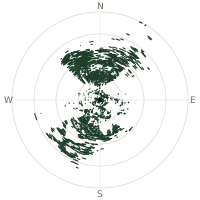
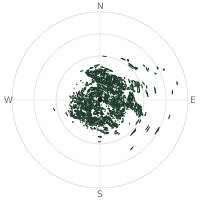
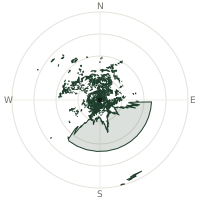
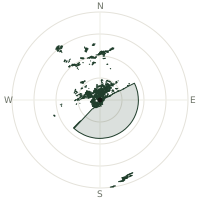
From Monte Perdido, the terrain-limited line of sight reaches up to 280 km. The single farthest piece of visible terrain lies 280 km to the south-southwest (bearing 211°), at 1,936 m elevation. These results account for Earth's curvature and standard atmospheric refraction, computed from 30-meter resolution Copernicus GLO-30 elevation data across 2,377,973 terrain samples.
Open the interactive visibility map →Visibility by direction
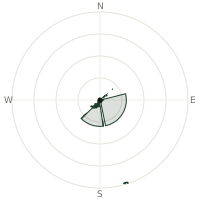
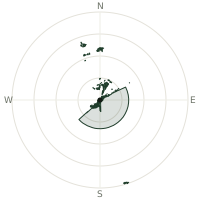
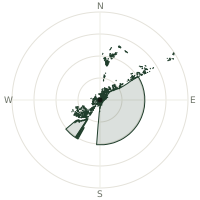
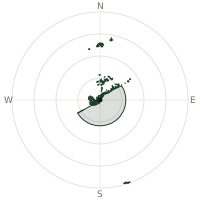
The horizon is most open toward the south-southwest, where sightlines run 230 km on average; terrain closes the view down fastest to the northwest, at 37.9 km.
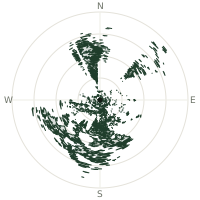
| N | 209 km | |
| NNE | 59.5 km | |
| NE | 168 km | |
| ENE | 125 km | |
| E | 60.1 km | |
| ESE | 107 km | |
| SE | 108 km | |
| SSE | 182 km | |
| S | 223 km | |
| SSW | 230 km | |
| SW | 199 km | |
| WSW | 212 km | |
| W | 144 km | |
| WNW | 47.1 km | |
| NW | 37.9 km | |
| NNW | 152 km |
Farthest named landmarks in view
364 named peaks, hills and headlands stand inside this viewshed. These are the farthest ones you could pick out on a clear day:
| Landmark | Visible distance | Direction | Elevation |
|---|---|---|---|
| Caimodorro | 280 km | SSW 211° | 1,936 m |
| Peñarroya | 260 km | SSW 193° | 2,028 m |
| Cerro San Lorenzo | 252 km | W 260° | 2,271 m |
| Sierra de Urbión | 251 km | WSW 254° | 2,228 m |
| Bel Vespré | 240 km | ENE 62° | 1,163 m |
| Sierra Cebollera | 236 km | WSW 252° | 2,132 m |
About Monte Perdido
Monte Perdido, at 3,355 metres, rises at the heart of Ordesa y Monte Perdido National Park, Spain's first protected area, and forms the highest limestone massif in Europe. French naturalist Louis Ramond de Carbonnières made repeated attempts, including one with a fifteen-person expedition in 1797, before finally reaching the summit on 10 August 1802, driven by a scientific dispute over the age of the Pyrenees' limestone. Its north face still holds one of the last surviving glaciers in the range, clinging to the rock between roughly 2,700 and 3,250 metres.
Did you know?
- Ramond de Carbonnières failed to reach the top in 1797 with a fifteen-person expedition before finally succeeding in 1802.
- A nearby peak, Soum de Ramond, was named after him in recognition of his years of attempts.
- The massif is shared with France as a single transboundary UNESCO World Heritage Site, one of the few in Europe to span two countries under one listing.
- Monte Perdido's glacier is the fourth-largest remaining in the Pyrenees, after those of Aneto, Maladeta, and Ossoue.
- The mountain forms one point of the Tres Sorores, or Three Sisters, a trio of peaks seen together from the Ordesa valley floor.
Frequently asked questions
How far can you see from Monte Perdido?
On a clear day the terrain allows a line of sight of up to 280 km from Monte Perdido. The average visible distance across all 360 directions is 142 km. Atmospheric conditions (haze, humidity) usually reduce practical visibility below the terrain-limited maximum.
What is the farthest point visible from Monte Perdido?
The farthest terrain visible from Monte Perdido lies 280 km to the south-southwest, at an elevation of 1,936 m. Earth's curvature and atmospheric refraction are accounted for in this calculation.
How high is Monte Perdido?
The observation point at Monte Perdido sits at 3,325 m above sea level (Copernicus GLO-30 elevation model).
How is this visibility map calculated?
UpToWhere traces lines of sight in 360 directions from the observer using 30 m-resolution Copernicus terrain data, correcting for Earth curvature and standard atmospheric refraction. You can run the same analysis for any point on Earth with the free calculator.
Run your own analysis
Want to know what you can see from your house, a summit you're planning to climb, or a plot of land? UpToWhere computes the same 360° viewshed for any point on Earth in seconds, free.
Try the viewshed calculator