 UpToWhere
What can you see from Horseshoe Bend?
The Colorado River loops back on itself in an impossible curve.
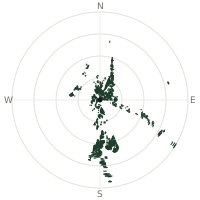
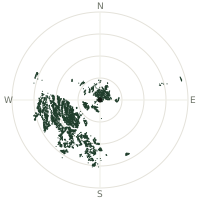
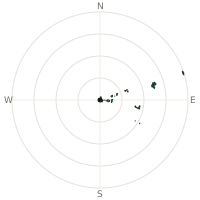
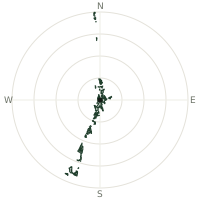
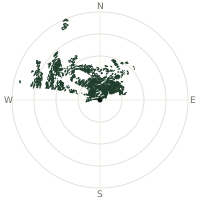
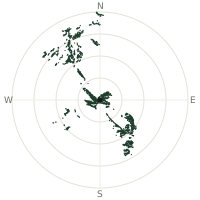
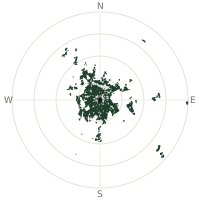
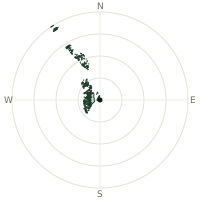
From Horseshoe Bend, the terrain-limited line of sight reaches up to 64.9 km. The single farthest piece of visible terrain lies 64.9 km to the north-northeast (bearing 18°), at 2,226 m elevation. These results account for Earth's curvature and standard atmospheric refraction, computed from 30-meter resolution Copernicus GLO-30 elevation data across 2,106,297 terrain samples.
Open the interactive visibility map →Visibility by direction
The horizon is most open toward the north-northeast, where sightlines run 27.0 km on average; terrain closes the view down fastest to the east, at 0.2 km.
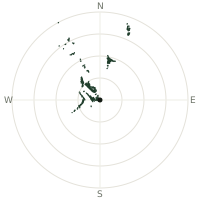
| N | 0.2 km | |
| NNE | 27.0 km | |
| NE | 0.4 km | |
| ENE | 0.3 km | |
| E | 0.2 km | |
| ESE | 0.2 km | |
| SE | 0.3 km | |
| SSE | 0.3 km | |
| S | 0.3 km | |
| SSW | 0.5 km | |
| SW | 2.3 km | |
| WSW | 12.3 km | |
| W | 13.3 km | |
| WNW | 12.2 km | |
| NW | 18.5 km | |
| NNW | 21.5 km |
Farthest named landmarks in view
3 named peaks, hills and headlands stand inside this viewshed. These are the farthest ones you could pick out on a clear day:
| Landmark | Visible distance | Direction | Elevation |
|---|---|---|---|
| Oley Knolls | 27.2 km | NNE 13° | 1,334 m |
| Powells Monument | 15.5 km | WSW 257° | 2,042 m |
| Echo Peak | 8.3 km | SW 235° | 1,656 m |
About Horseshoe Bend
Horseshoe Bend near Page, Arizona showcases the Colorado River's dramatic horseshoe-shaped incised meander. The phenomenon resulted from the region's geological uplift over millions of years, trapping the river and forcing rapid vertical erosion. The Navajo sandstone formation dates back 190 million years.
Did you know?
- The bend went viral on Instagram starting around 2010, and the resulting crowds prompted the Navajo Nation to build a paved viewpoint and guardrails in 2018 after several visitors fell to their deaths near the unprotected edge.
- Formed 6-5 million years ago during regional tectonic uplift period.
- The river loops nearly 270 degrees around the sandstone peninsula here: a hiker could walk a few hundred metres overland to cover a distance the river takes miles to travel.
- Perched nearly 1,000 feet above Colorado River water level.
Frequently asked questions
How far can you see from Horseshoe Bend?
On a clear day the terrain allows a line of sight of up to 64.9 km from Horseshoe Bend. The average visible distance across all 360 directions is 6.8 km. Atmospheric conditions (haze, humidity) usually reduce practical visibility below the terrain-limited maximum.
What is the farthest point visible from Horseshoe Bend?
The farthest terrain visible from Horseshoe Bend lies 64.9 km to the north-northeast, at an elevation of 2,226 m. Earth's curvature and atmospheric refraction are accounted for in this calculation.
How high is Horseshoe Bend?
The observation point at Horseshoe Bend sits at 1,265 m above sea level (Copernicus GLO-30 elevation model).
How is this visibility map calculated?
UpToWhere traces lines of sight in 360 directions from the observer using 30 m-resolution Copernicus terrain data, correcting for Earth curvature and standard atmospheric refraction. You can run the same analysis for any point on Earth with the free calculator.
Run your own analysis
Want to know what you can see from your house, a summit you're planning to climb, or a plot of land? UpToWhere computes the same 360° viewshed for any point on Earth in seconds, free.
Try the viewshed calculator