 UpToWhere
What can you see from Death Valley Badwater?
North America's lowest point shimmers in the California desert.
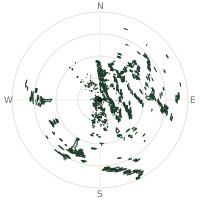
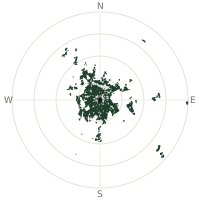
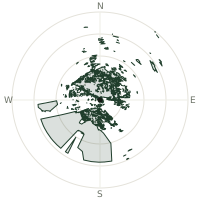
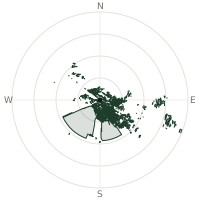
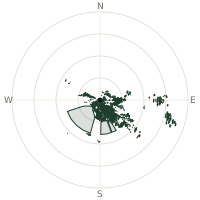
From Death Valley Badwater, the terrain-limited line of sight reaches up to 154 km. The single farthest piece of visible terrain lies 154 km to the north-northwest (bearing 327°), at 2,417 m elevation. These results account for Earth's curvature and standard atmospheric refraction, computed from 30-meter resolution Copernicus GLO-30 elevation data across 1,814,490 terrain samples.
Open the interactive visibility map →Visibility by direction
The horizon is most open toward the north-northwest, where sightlines run 78.9 km on average; terrain closes the view down fastest to the south-southwest, at 0.5 km.
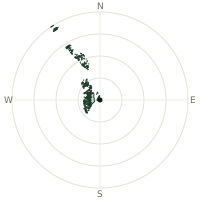
| N | 5.3 km | |
| NNE | 2.2 km | |
| NE | 2.2 km | |
| ENE | 2.0 km | |
| E | 2.6 km | |
| ESE | 1.4 km | |
| SE | 1.6 km | |
| SSE | 1.2 km | |
| S | 0.7 km | |
| SSW | 0.5 km | |
| SW | 17.1 km | |
| WSW | 29.8 km | |
| W | 27.5 km | |
| WNW | 26.7 km | |
| NW | 40.1 km | |
| NNW | 78.9 km |
Farthest named landmarks in view
12 named peaks, hills and headlands stand inside this viewshed. These are the farthest ones you could pick out on a clear day:
| Landmark | Visible distance | Direction | Elevation |
|---|---|---|---|
| Grapevine Peak | 88.4 km | NNW 338° | 2,662 m |
| Grapevine Mountains | 88.4 km | NNW 338° | 2,651 m |
| Amargosa Range | 88.4 km | NNW 338° | 2,659 m |
| Wahguyhe Peak | 84.2 km | NNW 339° | 2,577 m |
| Mount Palmer | 81.8 km | NNW 337° | 2,409 m |
| Thimble Peak | 69.0 km | NNW 340° | 1,936 m |
About Death Valley Badwater
Badwater Basin in Death Valley holds the distinction of being North America's lowest point at 86 meters below sea level. The salt flats cover nearly 200 square miles of sodium chloride deposits. Extreme heat, minimal rainfall, and extraordinary evaporation rates define this otherworldly landscape.
Did you know?
- Furnace Creek recorded 134°F (56.7°C) in July 1913, the highest air temperature ever officially measured on Earth.
- Nearby Racetrack Playa is famous for its 'sailing stones,' rocks that mysteriously drift across the flat desert floor: a mystery only solved in 2014, when researchers found thin ice sheets and light wind were nudging them along.
- Receives only 1.9 inches annual rainfall; evaporation rate 150 inches/year.
- Small spring-fed pool supports pickleweed, insects, and endemic snails.
Frequently asked questions
How far can you see from Death Valley Badwater?
On a clear day the terrain allows a line of sight of up to 154 km from Death Valley Badwater. The average visible distance across all 360 directions is 14.9 km. Atmospheric conditions (haze, humidity) usually reduce practical visibility below the terrain-limited maximum.
What is the farthest point visible from Death Valley Badwater?
The farthest terrain visible from Death Valley Badwater lies 154 km to the north-northwest, at an elevation of 2,417 m. Earth's curvature and atmospheric refraction are accounted for in this calculation.
How high is Death Valley Badwater?
The observation point at Death Valley Badwater sits at -83 m above sea level (Copernicus GLO-30 elevation model).
How is this visibility map calculated?
UpToWhere traces lines of sight in 360 directions from the observer using 30 m-resolution Copernicus terrain data, correcting for Earth curvature and standard atmospheric refraction. You can run the same analysis for any point on Earth with the free calculator.
Run your own analysis
Want to know what you can see from your house, a summit you're planning to climb, or a plot of land? UpToWhere computes the same 360° viewshed for any point on Earth in seconds, free.
Try the viewshed calculator