 UpToWhere
What can you see from Griffith Observatory?
The observatory's benefactor once shot his wife and served time for it.
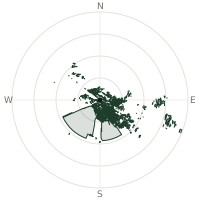
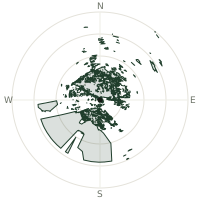
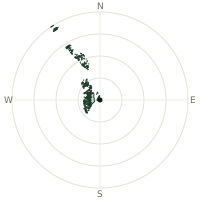
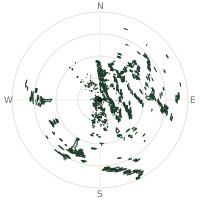
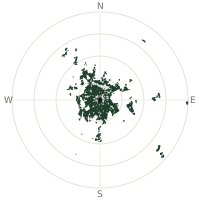
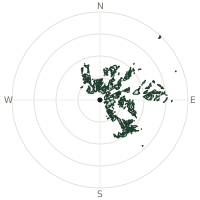
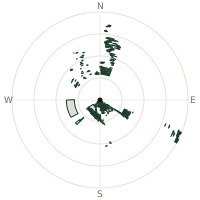
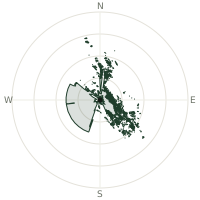
From Griffith Observatory, the terrain-limited line of sight reaches up to 185 km. The single farthest piece of visible terrain lies 185 km to the east-southeast (bearing 110°), at 2,650 m elevation. These results account for Earth's curvature and standard atmospheric refraction, computed from 30-meter resolution Copernicus GLO-30 elevation data across 1,935,531 terrain samples.
Open the interactive visibility map →Visibility by direction
The horizon is most open toward the east-southeast, where sightlines run 108 km on average; terrain closes the view down fastest to the north, at 1.2 km.
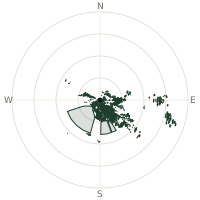
| N | 1.2 km | |
| NNE | 13.7 km | |
| NE | 23.3 km | |
| ENE | 39.2 km | |
| E | 108 km | |
| ESE | 108 km | |
| SE | 89.9 km | |
| SSE | 68.5 km | |
| S | 61.4 km | |
| SSW | 70.0 km | |
| SW | 74.4 km | |
| WSW | 55.0 km | |
| W | 18.5 km | |
| WNW | 46.5 km | |
| NW | 2.8 km | |
| NNW | 1.8 km |
Farthest named landmarks in view
114 named peaks, hills and headlands stand inside this viewshed. These are the farthest ones you could pick out on a clear day:
| Landmark | Visible distance | Direction | Elevation |
|---|---|---|---|
| Toro Peak | 186 km | ESE 110° | 2,650 m |
| Santa Rosa Mountain | 182 km | ESE 110° | 2,449 m |
| Devils Rockpile | 169 km | ESE 108° | 1,870 m |
| Pine Mountain | 169 km | ESE 108° | 2,147 m |
| Lion Peak | 168 km | ESE 108° | 2,089 m |
| Butterfly Peak | 168 km | ESE 109° | 1,895 m |
About Griffith Observatory
Griffith J. Griffith made his fortune in mining and real estate, then served two years in San Quentin after shooting his wife in 1903, who survived but lost an eye. He spent his later years trying to repair his reputation through philanthropy, donating the land that became Griffith Park and later funding this observatory, on condition that it always remain free to the public. It opened in 1935 with a Foucault pendulum as its first exhibit and a 12-inch Zeiss telescope now among the most-viewed on Earth.
Did you know?
- Griffith first offered to fund the observatory in 1912, but the city refused his tainted money for years: construction only began after his 1919 death, when officials finally accepted the bequest.
- Griffith's will specified the observatory must never charge admission, a condition the city has honored since it opened in 1935.
- More than 9 million visitors have looked through its 12-inch Zeiss telescope since opening, reportedly making it the most-viewed telescope in the world.
- A bronze bust of James Dean stands on the grounds, commissioned the night he died in a car crash in 1955, the same year "Rebel Without a Cause" filmed key scenes here.
- From the observatory's terraces, the Hollywood Sign, downtown Los Angeles, and on clear days the Pacific Ocean are all visible.
Frequently asked questions
How far can you see from Griffith Observatory?
On a clear day the terrain allows a line of sight of up to 185 km from Griffith Observatory. The average visible distance across all 360 directions is 48.9 km. Atmospheric conditions (haze, humidity) usually reduce practical visibility below the terrain-limited maximum.
What is the farthest point visible from Griffith Observatory?
The farthest terrain visible from Griffith Observatory lies 185 km to the east-southeast, at an elevation of 2,650 m. Earth's curvature and atmospheric refraction are accounted for in this calculation.
How high is Griffith Observatory?
The observation point at Griffith Observatory sits at 367 m above sea level (Copernicus GLO-30 elevation model).
How is this visibility map calculated?
UpToWhere traces lines of sight in 360 directions from the observer using 30 m-resolution Copernicus terrain data, correcting for Earth curvature and standard atmospheric refraction. You can run the same analysis for any point on Earth with the free calculator.
Run your own analysis
Want to know what you can see from your house, a summit you're planning to climb, or a plot of land? UpToWhere computes the same 360° viewshed for any point on Earth in seconds, free.
Try the viewshed calculator