 UpToWhere
What can you see from Twin Peaks (San Francisco)?
The Spanish had a much racier name for these two hills than "Twin Peaks".
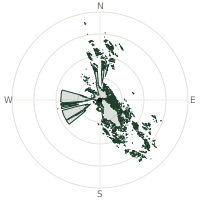
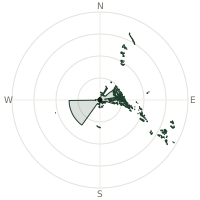
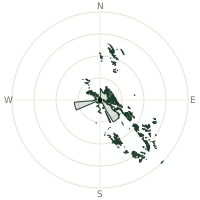
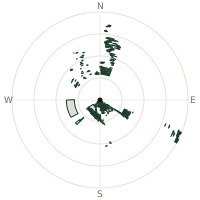
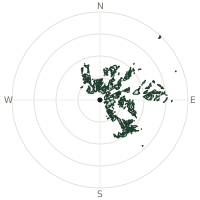
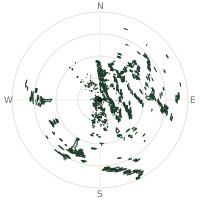
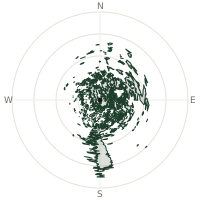
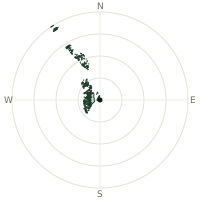
From Twin Peaks (San Francisco), the terrain-limited line of sight reaches up to 165 km. The single farthest piece of visible terrain lies 165 km to the southeast (bearing 134°), at 863 m elevation. These results account for Earth's curvature and standard atmospheric refraction, computed from 30-meter resolution Copernicus GLO-30 elevation data across 1,915,841 terrain samples.
Open the interactive visibility map →Visibility by direction
The horizon is most open toward the southeast, where sightlines run 94.4 km on average; terrain closes the view down fastest to the south, at 18.7 km.
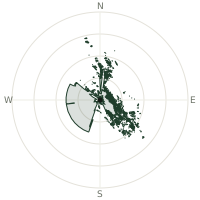
| N | 75.4 km | |
| NNE | 62.8 km | |
| NE | 24.7 km | |
| ENE | 31.4 km | |
| E | 45.6 km | |
| ESE | 74.0 km | |
| SE | 94.4 km | |
| SSE | 45.8 km | |
| S | 18.7 km | |
| SSW | 47.6 km | |
| SW | 64.4 km | |
| WSW | 64.4 km | |
| W | 63.7 km | |
| WNW | 62.5 km | |
| NW | 33.5 km | |
| NNW | 48.2 km |
Farthest named landmarks in view
160 named peaks, hills and headlands stand inside this viewshed. These are the farthest ones you could pick out on a clear day:
| Landmark | Visible distance | Direction | Elevation |
|---|---|---|---|
| Sugarloaf | 165 km | SE 134° | 863 m |
| Cibo Peak | 150 km | SE 133° | 846 m |
| Santa Ana Mountain | 143 km | SE 133° | 931 m |
| Cobb Mountain | 120 km | NNW 348° | 1,440 m |
| Castle Rock | 113 km | NNW 346° | 804 m |
| Red Hill | 112 km | NNW 346° | 768 m |
About Twin Peaks (San Francisco)
Early Spanish settlers named these two windswept hills "Los Pechos de la Chola," and the more sedate "Twin Peaks" only stuck after California passed to American control. At nearly 300 metres, they're the second and third highest points in San Francisco, low enough that nothing permanent has ever been built on the summits themselves thanks to near-constant wind and fog. Before a single consolidated tower took over in 1973, the city's TV and radio stations broadcast from scattered hilltop transmitters across the Bay Area rather than from here.
Did you know?
- The two summits, North and South, are individually named Eureka and Noe Peak, about 200 metres apart.
- Only Mount Davidson, one of San Francisco's other hills, rises higher within city limits than Twin Peaks.
- Despite the name, the TV series 'Twin Peaks' has no connection to these hills: it's set in a fictional town in Washington State, hundreds of miles away.
- A public-safety radio relay facility sits on the south peak, a functional descendant of the scattered broadcast towers that once ringed the city.
- From the overlook, the grid of San Francisco's neighborhoods fans out toward the Golden Gate Bridge, downtown, and the bay beyond.
Frequently asked questions
How far can you see from Twin Peaks (San Francisco)?
On a clear day the terrain allows a line of sight of up to 165 km from Twin Peaks (San Francisco). The average visible distance across all 360 directions is 53.5 km. Atmospheric conditions (haze, humidity) usually reduce practical visibility below the terrain-limited maximum.
What is the farthest point visible from Twin Peaks (San Francisco)?
The farthest terrain visible from Twin Peaks (San Francisco) lies 165 km to the southeast, at an elevation of 863 m. Earth's curvature and atmospheric refraction are accounted for in this calculation.
How high is Twin Peaks (San Francisco)?
The observation point at Twin Peaks (San Francisco) sits at 283 m above sea level (Copernicus GLO-30 elevation model).
How is this visibility map calculated?
UpToWhere traces lines of sight in 360 directions from the observer using 30 m-resolution Copernicus terrain data, correcting for Earth curvature and standard atmospheric refraction. You can run the same analysis for any point on Earth with the free calculator.
Run your own analysis
Want to know what you can see from your house, a summit you're planning to climb, or a plot of land? UpToWhere computes the same 360° viewshed for any point on Earth in seconds, free.
Try the viewshed calculator