 UpToWhere
What can you see from Golden Gate Bridge?
When it opened in 1937, it was the tallest and longest suspension bridge in the world.
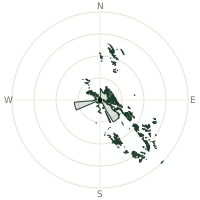
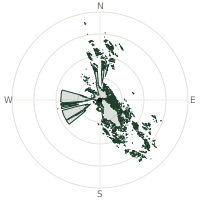
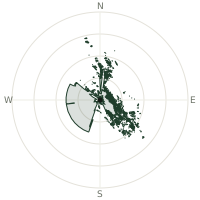
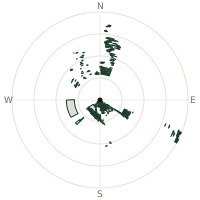
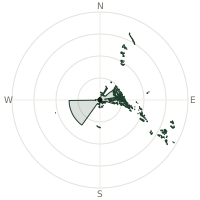
From Golden Gate Bridge, the terrain-limited line of sight reaches up to 93.5 km. The single farthest piece of visible terrain lies 93.5 km to the southeast (bearing 126°), at 1,278 m elevation. These results account for Earth's curvature and standard atmospheric refraction, computed from 30-meter resolution Copernicus GLO-30 elevation data across 1,860,836 terrain samples.
Open the interactive visibility map →Visibility by direction
The horizon is most open toward the east-southeast, where sightlines run 62.7 km on average; terrain closes the view down fastest to the north-northwest, at 1.6 km.
| N | 5.0 km | |
| NNE | 37.3 km | |
| NE | 14.0 km | |
| ENE | 22.7 km | |
| E | 30.9 km | |
| ESE | 62.7 km | |
| SE | 11.1 km | |
| SSE | 6.4 km | |
| S | 12.3 km | |
| SSW | 4.6 km | |
| SW | 29.7 km | |
| WSW | 32.7 km | |
| W | 18.4 km | |
| WNW | 2.0 km | |
| NW | 2.1 km | |
| NNW | 1.6 km |
Farthest named landmarks in view
48 named peaks, hills and headlands stand inside this viewshed. These are the farthest ones you could pick out on a clear day:
| Landmark | Visible distance | Direction | Elevation |
|---|---|---|---|
| Mount Hamilton | 90.9 km | SE 126° | 1,279 m |
| Cedar Mountain | 82.1 km | ESE 110° | 1,118 m |
| Mount Day | 81.7 km | ESE 123° | 1,164 m |
| Black Mountain | 80.7 km | ESE 122° | 1,170 m |
| Discovery Peak | 76.7 km | ESE 116° | 1,170 m |
| Rose Peak | 74.8 km | ESE 117° | 1,157 m |
About Golden Gate Bridge
The Golden Gate Bridge opened to the public on May 27, 1937, after four years of construction under chief engineer Joseph Strauss. The main span stretches 1,280 metres, suspended from two towers 227 metres high, with the roadway at midpoint 81 metres above mean high water. Upon completion, it was the world's tallest and longest suspension bridge. Chief engineer Strauss pioneered a movable safety net that saved 19 workers from falling during construction: a remarkable safety achievement for its era.
Did you know?
- The bridge's International Orange colour was meant to be a temporary primer before a final coat of grey or black: architect Irving Morrow convinced officials to keep it permanently for its visibility in fog and harmony with the landscape.
- At 1,280 metres, its main span was the longest suspension bridge when completed.
- The two towers rise 227 metres above the water, the tallest towers at that time.
- Structural engineer Charles Ellis worked out complex calculations but was fired before construction began.
- The bridge's summer fog forms when cold Pacific water chills moist air, which then rolls through the Golden Gate strait and over the towers, often burning off by afternoon.
Frequently asked questions
How far can you see from Golden Gate Bridge?
On a clear day the terrain allows a line of sight of up to 93.5 km from Golden Gate Bridge. The average visible distance across all 360 directions is 18.3 km. Atmospheric conditions (haze, humidity) usually reduce practical visibility below the terrain-limited maximum.
What is the farthest point visible from Golden Gate Bridge?
The farthest terrain visible from Golden Gate Bridge lies 93.5 km to the southeast, at an elevation of 1,278 m. Earth's curvature and atmospheric refraction are accounted for in this calculation.
How high is Golden Gate Bridge?
The observation point at Golden Gate Bridge sits at 70 m above sea level (Copernicus GLO-30 elevation model).
How is this visibility map calculated?
UpToWhere traces lines of sight in 360 directions from the observer using 30 m-resolution Copernicus terrain data, correcting for Earth curvature and standard atmospheric refraction. You can run the same analysis for any point on Earth with the free calculator.
Run your own analysis
Want to know what you can see from your house, a summit you're planning to climb, or a plot of land? UpToWhere computes the same 360° viewshed for any point on Earth in seconds, free.
Try the viewshed calculator