 UpToWhere
What can you see from Mount Rushmore?
Four 60-foot faces on land the US seized by breaking its own treaty.
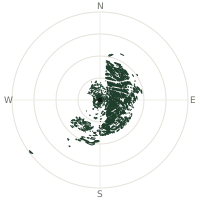
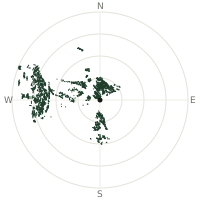
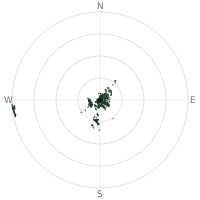
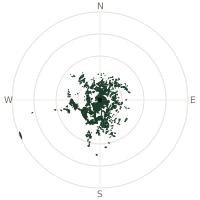
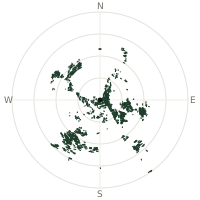
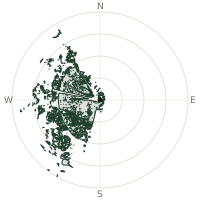
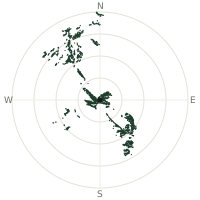
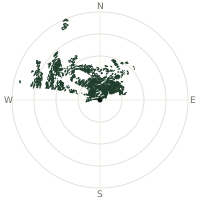
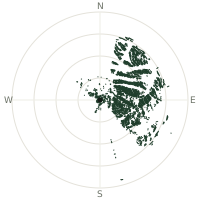
From Mount Rushmore, the terrain-limited line of sight reaches up to 142 km. The single farthest piece of visible terrain lies 142 km to the south-southeast (bearing 165°), at 1,335 m elevation. These results account for Earth's curvature and standard atmospheric refraction, computed from 30-meter resolution Copernicus GLO-30 elevation data across 2,178,267 terrain samples.
Open the interactive visibility map →Visibility by direction
The horizon is most open toward the east-southeast, where sightlines run 120 km on average; terrain closes the view down fastest to the west, at 4.7 km.
| N | 18.7 km | |
| NNE | 81.5 km | |
| NE | 108 km | |
| ENE | 107 km | |
| E | 95.8 km | |
| ESE | 120 km | |
| SE | 81.7 km | |
| SSE | 12.6 km | |
| S | 12.1 km | |
| SSW | 13.1 km | |
| SW | 5.6 km | |
| WSW | 6.1 km | |
| W | 4.7 km | |
| WNW | 16.7 km | |
| NW | 28.7 km | |
| NNW | 19.9 km |
Farthest named landmarks in view
61 named peaks, hills and headlands stand inside this viewshed. These are the farthest ones you could pick out on a clear day:
| Landmark | Visible distance | Direction | Elevation |
|---|---|---|---|
| Lookout Point | 134 km | SSE 165° | 1,241 m |
| Flannigan Butte | 132 km | SSE 165° | 1,255 m |
| Porcupine Butte | 120 km | SE 130° | 1,125 m |
| Table Top Butte | 116 km | NNE 20° | 913 m |
| Bliss Hill | 113 km | E 79° | 875 m |
| Saddle Butte | 109 km | NNE 24° | 910 m |
About Mount Rushmore
Sculptor Gutzon Borglum and around 400 workers spent from 1927 to 1941 carving the 18-metre-tall faces of Washington, Jefferson, Theodore Roosevelt, and Lincoln into this South Dakota granite, using dynamite to remove roughly 90 percent of the rock before finer chisel work began. No one died during the actual carving, a rare safety record for the era, though several workers later died of silicosis from the dust. The mountain, called the Six Grandfathers by the Lakota Sioux, sits on land the US seized in violation of an 1868 treaty, a dispute still unresolved.
Did you know?
- Borglum died in March 1941 with the monument unfinished; his son Lincoln took over to complete it that October, ending the project before full torsos could be carved.
- Roughly 90 percent of the mountain's granite was removed using dynamite, with finer carving done by hand-held jackhammers and chisels.
- Borglum planned a Hall of Records carved into the mountain behind the faces to house America's key historical documents; work stalled for decades until a small vault was finally completed and sealed there in 1998.
- The Lakota Sioux call the mountain the Six Grandfathers and have refused a US government settlement worth over a billion dollars, demanding the land itself back instead.
- Granite erodes at roughly one inch every 10,000 years, meaning the presidents' faces will stay recognizable for tens of thousands of years.
Frequently asked questions
How far can you see from Mount Rushmore?
On a clear day the terrain allows a line of sight of up to 142 km from Mount Rushmore. The average visible distance across all 360 directions is 45.7 km. Atmospheric conditions (haze, humidity) usually reduce practical visibility below the terrain-limited maximum.
What is the farthest point visible from Mount Rushmore?
The farthest terrain visible from Mount Rushmore lies 142 km to the south-southeast, at an elevation of 1,335 m. Earth's curvature and atmospheric refraction are accounted for in this calculation.
How high is Mount Rushmore?
The observation point at Mount Rushmore sits at 1,734 m above sea level (Copernicus GLO-30 elevation model).
How is this visibility map calculated?
UpToWhere traces lines of sight in 360 directions from the observer using 30 m-resolution Copernicus terrain data, correcting for Earth curvature and standard atmospheric refraction. You can run the same analysis for any point on Earth with the free calculator.
Run your own analysis
Want to know what you can see from your house, a summit you're planning to climb, or a plot of land? UpToWhere computes the same 360° viewshed for any point on Earth in seconds, free.
Try the viewshed calculator