 UpToWhere
What can you see from Haleakalā (Maui)?
A shield volcano whose summit crater formed not from eruption, but from two valleys merging at the top.
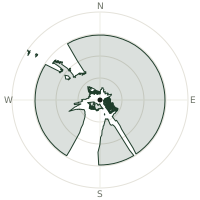
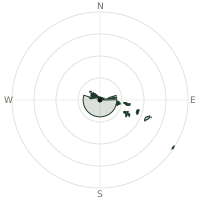
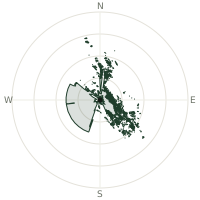
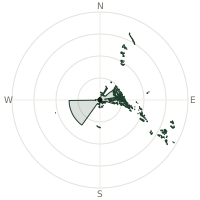
From Haleakalā (Maui), the terrain-limited line of sight reaches up to 215 km. The single farthest piece of visible terrain lies 215 km to the west-northwest (bearing 295°), at 1,229 m elevation. These results account for Earth's curvature and standard atmospheric refraction, computed from 30-meter resolution Copernicus GLO-30 elevation data across 2,348,750 terrain samples.
Open the interactive visibility map →Visibility by direction
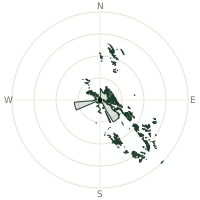
The horizon is most open toward the north, where sightlines run 212 km on average; terrain closes the view down fastest to the southeast, at 145 km.
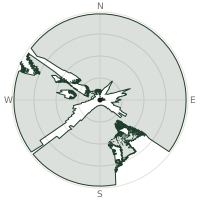
| N | 212 km | |
| NNE | 212 km | |
| NE | 212 km | |
| ENE | 212 km | |
| E | 212 km | |
| ESE | 212 km | |
| SE | 145 km | |
| SSE | 158 km | |
| S | 212 km | |
| SSW | 212 km | |
| SW | 203 km | |
| WSW | 212 km | |
| W | 212 km | |
| WNW | 207 km | |
| NW | 195 km | |
| NNW | 212 km |
Farthest named landmarks in view
904 named peaks, hills and headlands stand inside this viewshed. These are the farthest ones you could pick out on a clear day:
| Landmark | Visible distance | Direction | Elevation |
|---|---|---|---|
| Ka‘ala | 215 km | WNW 295° | 1,229 m |
| Kamaohanui | 215 km | WNW 295° | 1,024 m |
| Pu‘ukalena | 213 km | WNW 294° | 1,055 m |
| Pu‘ukūmakali‘i | 212 km | WNW 294° | 878 m |
| Kahuku Point | 211 km | WNW 302° | 2 m |
| Pu‘uhapapa | 210 km | WNW 294° | 877 m |
About Haleakalā (Maui)
Haleakalā, on Maui's 10,023-foot summit called Puʻu ʻUlaʻula (Red Hill), is a shield volcano built of basalt lava flows. Its most striking feature is a massive erosional crater: not a true volcanic crater, formed where the headwalls of two large valleys merged at the summit, creating a depression some eleven miles across and nearly 2,600 feet deep. The volcano has erupted at least ten times in the past 1,000 years, with the most recent eruptions between 1480 and 1600.
Did you know?
- At 10,023 feet, Haleakalā's summit Puʻu ʻUlaʻula (Red Hill) rises above the clouds most mornings.
- The park is a stronghold for the nēnē, Hawaii's state bird, which fell to around 30 individuals in the 1950s before captive breeding programs brought it back from the brink.
- In Hawaiian legend, the demigod Māui climbed to the summit and lassoed the sun as it rose, forcing it to slow its journey across the sky so his mother would have more daylight to dry her kapa cloth.
- The crater floor is one of the few places on Earth where the Haleakalā silversword grows: a rare plant that lives for decades before blooming once and dying.
- From the summit on clear mornings, visitors can watch the sun rise above a sea of clouds.
Frequently asked questions
How far can you see from Haleakalā (Maui)?
On a clear day the terrain allows a line of sight of up to 215 km from Haleakalā (Maui). The average visible distance across all 360 directions is 202 km. Atmospheric conditions (haze, humidity) usually reduce practical visibility below the terrain-limited maximum.
What is the farthest point visible from Haleakalā (Maui)?
The farthest terrain visible from Haleakalā (Maui) lies 215 km to the west-northwest, at an elevation of 1,229 m. Earth's curvature and atmospheric refraction are accounted for in this calculation.
How high is Haleakalā (Maui)?
The observation point at Haleakalā (Maui) sits at 3,063 m above sea level (Copernicus GLO-30 elevation model).
How is this visibility map calculated?
UpToWhere traces lines of sight in 360 directions from the observer using 30 m-resolution Copernicus terrain data, correcting for Earth curvature and standard atmospheric refraction. You can run the same analysis for any point on Earth with the free calculator.
Run your own analysis
Want to know what you can see from your house, a summit you're planning to climb, or a plot of land? UpToWhere computes the same 360° viewshed for any point on Earth in seconds, free.
Try the viewshed calculator