 UpToWhere
What can you see from Diamond Head (Oahu)?
A tuff cone born from a single explosive eruption 300,000 years ago, named by British sailors for its glimmer.
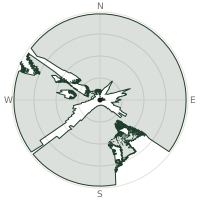
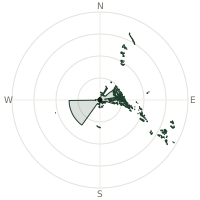
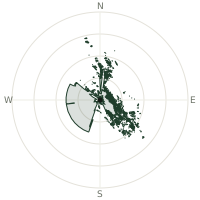
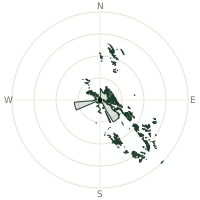
From Diamond Head (Oahu), the terrain-limited line of sight reaches up to 292 km. The single farthest piece of visible terrain lies 292 km to the east-southeast (bearing 123°), at 4,014 m elevation. These results account for Earth's curvature and standard atmospheric refraction, computed from 30-meter resolution Copernicus GLO-30 elevation data across 1,899,830 terrain samples.
Open the interactive visibility map →Visibility by direction
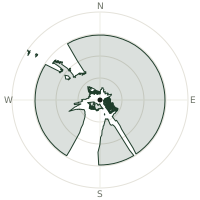
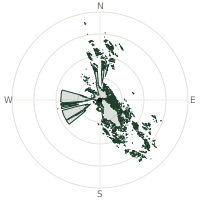
The horizon is most open toward the east-southeast, where sightlines run 132 km on average; terrain closes the view down fastest to the north-northeast, at 9.4 km.
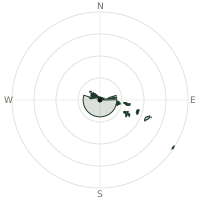
| N | 11.8 km | |
| NNE | 9.4 km | |
| NE | 10.3 km | |
| ENE | 14.5 km | |
| E | 54.0 km | |
| ESE | 132 km | |
| SE | 56.3 km | |
| SSE | 56.3 km | |
| S | 56.3 km | |
| SSW | 56.3 km | |
| SW | 56.3 km | |
| WSW | 56.3 km | |
| W | 56.3 km | |
| WNW | 38.6 km | |
| NW | 37.3 km | |
| NNW | 18.7 km |
Farthest named landmarks in view
165 named peaks, hills and headlands stand inside this viewshed. These are the farthest ones you could pick out on a clear day:
| Landmark | Visible distance | Direction | Elevation |
|---|---|---|---|
| Pu‘uwaiau | 292 km | ESE 123° | 4,014 m |
| Pu‘upoli‘ahu | 291 km | ESE 123° | 4,150 m |
| Pu‘upōhaku | 289 km | ESE 123° | 4,016 m |
| Hanakauhi | 179 km | ESE 109° | 2,706 m |
| Kalahaku Pali Cliffs | 174 km | ESE 109° | 2,516 m |
| Kilohana | 174 km | ESE 110° | 2,913 m |
About Diamond Head (Oahu)
Diamond Head, or Lēʻahi in Hawaiian (meaning 'browridge tuna' for the shape of its ridgeline), is a tuff cone on Oʻahu formed roughly 300,000 years ago by a single hydromagmatic explosion that ripped through coral reefs and ancient basalt. The distinctive profile became iconic, used in logos and films worldwide. British sailors in the 19th century named it for the calcite crystals that sparkle on adjacent beaches, catching the light like gemstones.
Did you know?
- The crater's interior once housed a US Army outpost, Fort Ruger, whose old bunkers, tunnels, and observation posts are still visible to hikers today.
- The eruption blasted through 200,000-year-old coral reefs and ancient Koʻolau basalt.
- Its Hawaiian name, Lēʻahi, likely derives from 'lae' (browridge) plus 'ʻahi' (tuna) for its distinctive shape.
- British sailors named it for calcite crystals on the beach that sparkle like diamonds in sunlight.
- It is part of the Honolulu Volcanic Series, a system of renewed eruptions from the long-dormant Koʻolau Volcano.
Frequently asked questions
How far can you see from Diamond Head (Oahu)?
On a clear day the terrain allows a line of sight of up to 292 km from Diamond Head (Oahu). The average visible distance across all 360 directions is 45.0 km. Atmospheric conditions (haze, humidity) usually reduce practical visibility below the terrain-limited maximum.
What is the farthest point visible from Diamond Head (Oahu)?
The farthest terrain visible from Diamond Head (Oahu) lies 292 km to the east-southeast, at an elevation of 4,014 m. Earth's curvature and atmospheric refraction are accounted for in this calculation.
How high is Diamond Head (Oahu)?
The observation point at Diamond Head (Oahu) sits at 216 m above sea level (Copernicus GLO-30 elevation model).
How is this visibility map calculated?
UpToWhere traces lines of sight in 360 directions from the observer using 30 m-resolution Copernicus terrain data, correcting for Earth curvature and standard atmospheric refraction. You can run the same analysis for any point on Earth with the free calculator.
Run your own analysis
Want to know what you can see from your house, a summit you're planning to climb, or a plot of land? UpToWhere computes the same 360° viewshed for any point on Earth in seconds, free.
Try the viewshed calculator