 UpToWhere
What can you see from Aoraki / Mount Cook?
New Zealand's highest peak, which lost 10 metres in a 1991 avalanche and has shrunk since.
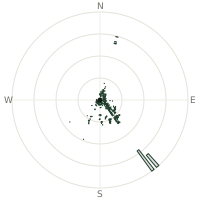
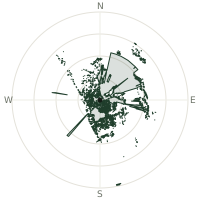
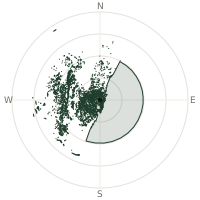
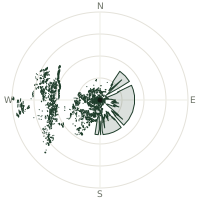
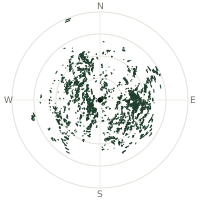
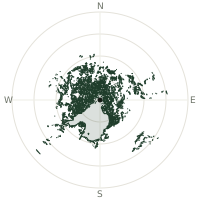
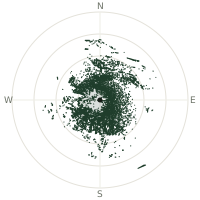
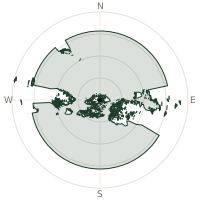
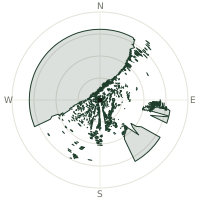
From Aoraki / Mount Cook, the terrain-limited line of sight reaches up to 289 km. The single farthest piece of visible terrain lies 289 km to the northeast (bearing 39°), at 1,476 m elevation. These results account for Earth's curvature and standard atmospheric refraction, computed from 30-meter resolution Copernicus GLO-30 elevation data across 2,415,526 terrain samples.
Open the interactive visibility map →Visibility by direction
The horizon is most open toward the north, where sightlines run 232 km on average; terrain closes the view down fastest to the south, at 108 km.
| N | 232 km | |
| NNE | 228 km | |
| NE | 205 km | |
| ENE | 117 km | |
| E | 152 km | |
| ESE | 109 km | |
| SE | 232 km | |
| SSE | 124 km | |
| S | 108 km | |
| SSW | 174 km | |
| SW | 165 km | |
| WSW | 186 km | |
| W | 232 km | |
| WNW | 232 km | |
| NW | 232 km | |
| NNW | 232 km |
Farthest named landmarks in view
423 named peaks, hills and headlands stand inside this viewshed. These are the farthest ones you could pick out on a clear day:
| Landmark | Visible distance | Direction | Elevation |
|---|---|---|---|
| The Haystack | 288 km | NE 39° | 1,249 m |
| Boundary Peak | 249 km | NE 39° | 1,097 m |
| Mount Wynn | 241 km | NE 41° | 1,307 m |
| Mount Maling | 239 km | NE 52° | 1,829 m |
| Mount Ossa | 236 km | NE 42° | 1,298 m |
| Dyke Head | 232 km | E 99° | 6 m |
About Aoraki / Mount Cook
Aoraki / Mount Cook rises 3,724 metres in the Southern Alps of New Zealand's South Island and is the country's highest mountain. A 1991 avalanche that crashed down the east face removed 10 million cubic metres of rock and snow, lowering the summit by 10 metres; subsequent erosion has reduced it by another 30 metres since. The first documented ascent came on 25 December 1894 by Tom Fyfe, Jack Clarke, and George Graham via the north ridge. Since then, roughly 80 people have died on the mountain: New Zealand's deadliest peak, with the climbing season running November through February.
Did you know?
- The mountain has three named summits along its ridge, low, middle, and high peak, and traversing all three in one push is considered one of New Zealand's great alpine test pieces.
- Sir Edmund Hillary trained on Aoraki/Mount Cook's glaciers and slopes in the years before his historic 1953 ascent of Everest.
- The Hermitage Hotel at the mountain's base, opened in 1884, has been destroyed twice, by flood in 1913 and fire in 1957, and rebuilt each time.
- Aoraki/Mount Cook National Park was inscribed as part of the Te Wahipounamu UNESCO World Heritage Site in 1990.
- Ngāi Tahu consider Aoraki the most sacred ancestor; climbing season November–February.
Frequently asked questions
How far can you see from Aoraki / Mount Cook?
On a clear day the terrain allows a line of sight of up to 289 km from Aoraki / Mount Cook. The average visible distance across all 360 directions is 185 km. Atmospheric conditions (haze, humidity) usually reduce practical visibility below the terrain-limited maximum.
What is the farthest point visible from Aoraki / Mount Cook?
The farthest terrain visible from Aoraki / Mount Cook lies 289 km to the northeast, at an elevation of 1,476 m. Earth's curvature and atmospheric refraction are accounted for in this calculation.
How high is Aoraki / Mount Cook?
The observation point at Aoraki / Mount Cook sits at 3,668 m above sea level (Copernicus GLO-30 elevation model).
How is this visibility map calculated?
UpToWhere traces lines of sight in 360 directions from the observer using 30 m-resolution Copernicus terrain data, correcting for Earth curvature and standard atmospheric refraction. You can run the same analysis for any point on Earth with the free calculator.
Run your own analysis
Want to know what you can see from your house, a summit you're planning to climb, or a plot of land? UpToWhere computes the same 360° viewshed for any point on Earth in seconds, free.
Try the viewshed calculator