 UpToWhere
What can you see from Mount Kosciuszko?
Australia's highest peak, named in 1840 after a Polish general and American Revolutionary War hero.
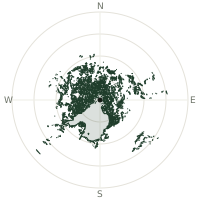
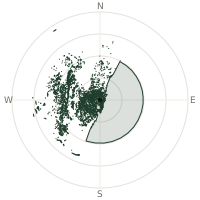
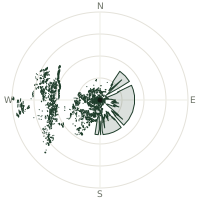
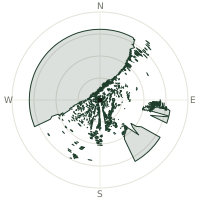
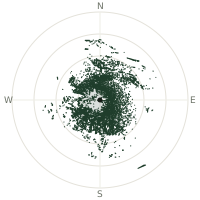
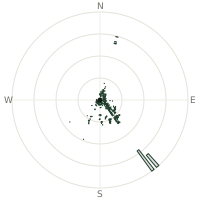
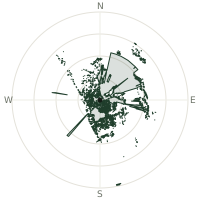
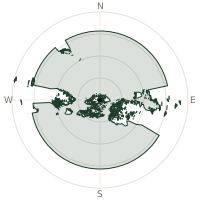
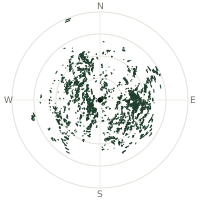
From Mount Kosciuszko, the terrain-limited line of sight reaches up to 173 km. The single farthest piece of visible terrain lies 173 km to the north-northwest (bearing 339°), at 470 m elevation. These results account for Earth's curvature and standard atmospheric refraction, computed from 30-meter resolution Copernicus GLO-30 elevation data across 2,247,074 terrain samples.
Open the interactive visibility map →Visibility by direction
The horizon is most open toward the east-northeast, where sightlines run 123 km on average; terrain closes the view down fastest to the south, at 48.7 km.
| N | 65.7 km | |
| NNE | 62.5 km | |
| NE | 89.9 km | |
| ENE | 123 km | |
| E | 108 km | |
| ESE | 112 km | |
| SE | 115 km | |
| SSE | 98.2 km | |
| S | 48.7 km | |
| SSW | 78.6 km | |
| SW | 122 km | |
| WSW | 109 km | |
| W | 114 km | |
| WNW | 97.4 km | |
| NW | 103 km | |
| NNW | 120 km |
Farthest named landmarks in view
179 named peaks, hills and headlands stand inside this viewshed. These are the farthest ones you could pick out on a clear day:
| Landmark | Visible distance | Direction | Elevation |
|---|---|---|---|
| Goombargana Hill | 171 km | WNW 298° | 380 m |
| Trapyard Hill | 168 km | SW 227° | 1,567 m |
| Coffin Rock Hill | 154 km | NW 324° | 338 m |
| Mount Poole | 139 km | SE 127° | 742 m |
| The Horn | 138 km | WSW 255° | 1,723 m |
| Green Hill | 137 km | WSW 253° | 1,375 m |
About Mount Kosciuszko
Mount Kosciuszko stands 2,228 metres in the Snowy Mountains of New South Wales, making it Australia's highest mainland peak. Polish explorer Paweł Edmund Strzelecki named it in 1840 to honour Tadeusz Kościuszko, a general and hero of both the Polish Kościuszko Uprising and the American Revolutionary War. Strzelecki summited on 12 March 1840. The mountain is accessible by a straightforward hike from Charlotte Pass or Thredbo village; the Thredbo Kosciuszko Express chairlift operates year-round. It sometimes ranks among the Seven Summits, though Indonesia's Puncak Jaya rivals it as the continent's highest.
Did you know?
- Unlike most of the Seven Summits, Kosciuszko is a gentle, rounded walk-up: no technical climbing is needed to reach Australia's highest point.
- Named in 1840 by Polish explorer Paweł Strzelecki after General Tadeusz Kościuszko.
- The Snowy Mountains Scheme, a massive hydroelectric and irrigation project built from 1949 to 1974 around the peak, employed workers from more than 30 countries and remains one of the largest engineering projects of its era.
- The surrounding alpine zone shelters the critically endangered corroboree frog and mountain pygmy possum, found nowhere else on Earth.
- Sometimes counted in the Seven Summits; Puncak Jaya (Indonesia) rivals it for Oceania's highest.
Frequently asked questions
How far can you see from Mount Kosciuszko?
On a clear day the terrain allows a line of sight of up to 173 km from Mount Kosciuszko. The average visible distance across all 360 directions is 97.9 km. Atmospheric conditions (haze, humidity) usually reduce practical visibility below the terrain-limited maximum.
What is the farthest point visible from Mount Kosciuszko?
The farthest terrain visible from Mount Kosciuszko lies 173 km to the north-northwest, at an elevation of 470 m. Earth's curvature and atmospheric refraction are accounted for in this calculation.
How high is Mount Kosciuszko?
The observation point at Mount Kosciuszko sits at 2,236 m above sea level (Copernicus GLO-30 elevation model).
How is this visibility map calculated?
UpToWhere traces lines of sight in 360 directions from the observer using 30 m-resolution Copernicus terrain data, correcting for Earth curvature and standard atmospheric refraction. You can run the same analysis for any point on Earth with the free calculator.
Run your own analysis
Want to know what you can see from your house, a summit you're planning to climb, or a plot of land? UpToWhere computes the same 360° viewshed for any point on Earth in seconds, free.
Try the viewshed calculator