 UpToWhere
What can you see from Mount Rinjani?
Indonesia's second-highest volcano, with a caldera formed by one of the world's largest Holocene eruptions.
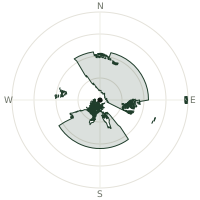
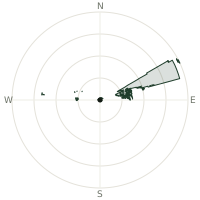
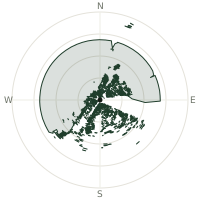
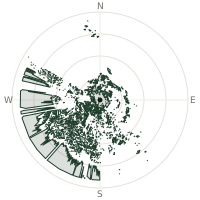
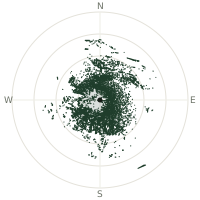
From Mount Rinjani, the terrain-limited line of sight reaches up to 296 km. The single farthest piece of visible terrain lies 296 km to the west-northwest (bearing 283°), at 1,240 m elevation. These results account for Earth's curvature and standard atmospheric refraction, computed from 30-meter resolution Copernicus GLO-30 elevation data across 2,420,293 terrain samples.
Open the interactive visibility map →Visibility by direction
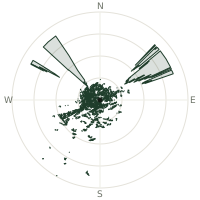
The horizon is most open toward the west-northwest, where sightlines run 236 km on average; terrain closes the view down fastest to the east-southeast, at 156 km.
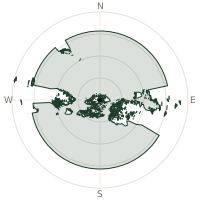
| N | 233 km | |
| NNE | 233 km | |
| NE | 233 km | |
| ENE | 233 km | |
| E | 213 km | |
| ESE | 156 km | |
| SE | 233 km | |
| SSE | 233 km | |
| S | 233 km | |
| SSW | 233 km | |
| SW | 233 km | |
| WSW | 233 km | |
| W | 215 km | |
| WNW | 236 km | |
| NW | 229 km | |
| NNW | 228 km |
Farthest named landmarks in view
1,112 named peaks, hills and headlands stand inside this viewshed. These are the farthest ones you could pick out on a clear day:
| Landmark | Visible distance | Direction | Elevation |
|---|---|---|---|
| Gunung Pringin | 296 km | WNW 283° | 1,240 m |
| Gunung Nangkaan | 295 km | WNW 284° | 779 m |
| Gunung Pendusan | 295 km | WNW 283° | 673 m |
| Gunung Lugu | 295 km | WNW 284° | 844 m |
| Gunung Malang | 294 km | WNW 285° | 379 m |
| Gunung Tambakukir | 293 km | WNW 284° | 707 m |
About Mount Rinjani
Mount Rinjani rises 3,726 metres on Lombok island and is Indonesia's second-highest volcano. The mountain's defining feature is its 6-by-8.5-kilometre caldera, created during the catastrophic 1257 CE eruption of Samalas stratovolcano. That eruption was one of the largest in the past 7,000 years and released the most sulphur to the stratosphere in that period. The caldera now contains a 230-metre-deep lake. Recent activity was confined to the post-caldera cone Barujari, which last erupted in 2010; the most significant historical eruptions occurred 1994–1995.
Did you know?
- The 1257 Samalas eruption may have triggered a documented spike in global cooling and crop failures recorded across medieval Europe and Asia the following year: a link researchers only confirmed through ice-core studies in the 2010s.
- The caldera lake, Segara Anak or 'Child of the Sea,' draws Hindu and Sasak pilgrims who throw offerings into its waters during the Mulang Pekelem ceremony.
- Hot springs on the caldera lake's shore, known as Aiq Kalak, are said locally to have healing properties and are a popular stop for trekkers.
- Rinjani is sacred to both the Sasak people of Lombok and Balinese Hindus, who consider the mountain a dwelling place of the gods.
- Historical eruptions (1847 onwards) confined to Barujari; most recent eruption May 2010.
Frequently asked questions
How far can you see from Mount Rinjani?
On a clear day the terrain allows a line of sight of up to 296 km from Mount Rinjani. The average visible distance across all 360 directions is 226 km. Atmospheric conditions (haze, humidity) usually reduce practical visibility below the terrain-limited maximum.
What is the farthest point visible from Mount Rinjani?
The farthest terrain visible from Mount Rinjani lies 296 km to the west-northwest, at an elevation of 1,240 m. Earth's curvature and atmospheric refraction are accounted for in this calculation.
How high is Mount Rinjani?
The observation point at Mount Rinjani sits at 3,715 m above sea level (Copernicus GLO-30 elevation model).
How is this visibility map calculated?
UpToWhere traces lines of sight in 360 directions from the observer using 30 m-resolution Copernicus terrain data, correcting for Earth curvature and standard atmospheric refraction. You can run the same analysis for any point on Earth with the free calculator.
Run your own analysis
Want to know what you can see from your house, a summit you're planning to climb, or a plot of land? UpToWhere computes the same 360° viewshed for any point on Earth in seconds, free.
Try the viewshed calculator