 UpToWhere
What can you see from Osaka Castle?
A gold-plated fortress that's been levelled and rebuilt three times over.
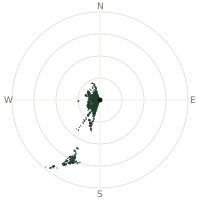
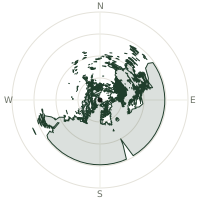
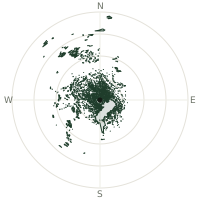
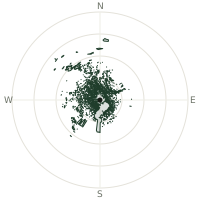
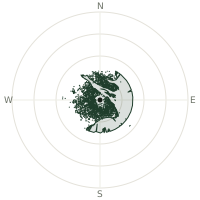
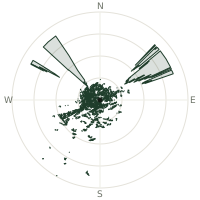
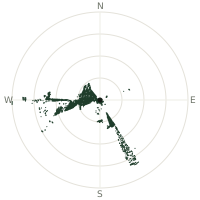
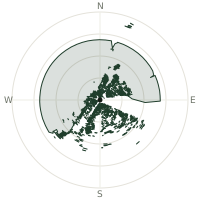
From Osaka Castle, the terrain-limited line of sight reaches up to 172 km. The single farthest piece of visible terrain lies 172 km to the west-southwest (bearing 237°), at 1,800 m elevation. These results account for Earth's curvature and standard atmospheric refraction, computed from 30-meter resolution Copernicus GLO-30 elevation data across 1,868,257 terrain samples.
Open the interactive visibility map →Visibility by direction
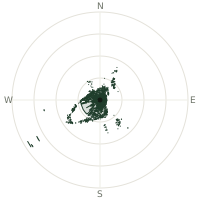
The horizon is most open toward the southwest, where sightlines run 78.9 km on average; terrain closes the view down fastest to the east, at 13.6 km.
| N | 24.5 km | |
| NNE | 45.1 km | |
| NE | 42.3 km | |
| ENE | 17.5 km | |
| E | 13.6 km | |
| ESE | 13.7 km | |
| SE | 41.9 km | |
| SSE | 36.5 km | |
| S | 39.1 km | |
| SSW | 43.8 km | |
| SW | 78.9 km | |
| WSW | 73.8 km | |
| W | 42.6 km | |
| WNW | 26.1 km | |
| NW | 27.2 km | |
| NNW | 28.7 km |
Farthest named landmarks in view
53 named peaks, hills and headlands stand inside this viewshed. These are the farthest ones you could pick out on a clear day:
| Landmark | Visible distance | Direction | Elevation |
|---|---|---|---|
| Mi Une | 170 km | WSW 237° | 1,886 m |
| Tsurugi San | 161 km | SW 235° | 1,954 m |
| Maruzasa Yama | 160 km | SW 236° | 1,706 m |
| Kōtsu Zan | 143 km | WSW 239° | 1,125 m |
| Hidega Take | 77.3 km | SE 136° | 1,688 m |
| Sen Zan | 72.9 km | WSW 240° | 1,005 m |
About Osaka Castle
Warlord Toyotomi Hideyoshi built this castle in 1583 on the ruins of a fortified Buddhist temple, deliberately designing it to outshine his former lord's castle, with gold leaf and golden tiger ornaments covering the main tower. It fell in 1615 when Tokugawa forces crushed the Toyotomi clan, was rebuilt in the 1620s, burned down after a lightning strike in 1665, and stood in ruins for over two centuries before a concrete reconstruction went up in 1931.
Did you know?
- Hideyoshi's original castle was covered in gold leaf, with golden tiger and mythical shachi ornaments meant to both impress and ward off fire.
- The current main tower is a 1931 ferroconcrete reconstruction based on historical folding-screen paintings, since the original burned down in 1665.
- The castle fell in the 1615 Siege of Osaka, the battle that finally ended the Toyotomi clan and secured two and a half centuries of Tokugawa rule.
- Its stone walls include megaliths estimated to weigh over 100 tonnes each, hauled in from distant quarries by rival lords as forced tribute.
- From the observation deck, Osaka's dense downtown and, on clear days, the hills ringing the Osaka plain are visible in every direction.
Frequently asked questions
How far can you see from Osaka Castle?
On a clear day the terrain allows a line of sight of up to 172 km from Osaka Castle. The average visible distance across all 360 directions is 37.2 km. Atmospheric conditions (haze, humidity) usually reduce practical visibility below the terrain-limited maximum.
What is the farthest point visible from Osaka Castle?
The farthest terrain visible from Osaka Castle lies 172 km to the west-southwest, at an elevation of 1,800 m. Earth's curvature and atmospheric refraction are accounted for in this calculation.
How high is Osaka Castle?
The observation point at Osaka Castle sits at 98 m above sea level (Copernicus GLO-30 elevation model).
How is this visibility map calculated?
UpToWhere traces lines of sight in 360 directions from the observer using 30 m-resolution Copernicus terrain data, correcting for Earth curvature and standard atmospheric refraction. You can run the same analysis for any point on Earth with the free calculator.
Run your own analysis
Want to know what you can see from your house, a summit you're planning to climb, or a plot of land? UpToWhere computes the same 360° viewshed for any point on Earth in seconds, free.
Try the viewshed calculator