 UpToWhere
What can you see from Mount Fuji?
Japan's sacred conical volcano symbolizes the nation's spirit.
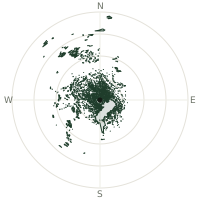
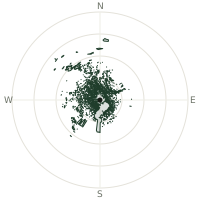
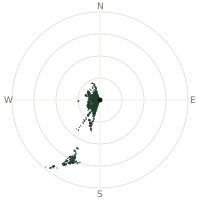
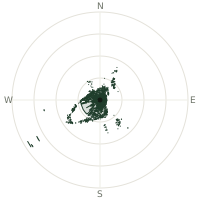
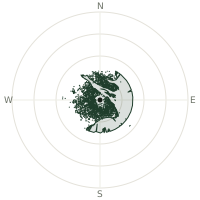
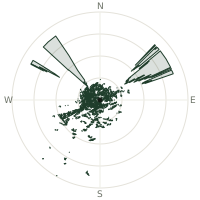
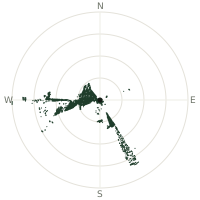
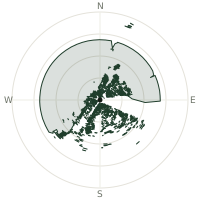
From Mount Fuji, the terrain-limited line of sight reaches up to 319 km. The single farthest piece of visible terrain lies 319 km to the southwest (bearing 236°), at 896 m elevation. These results account for Earth's curvature and standard atmospheric refraction, computed from 30-meter resolution Copernicus GLO-30 elevation data across 2,426,889 terrain samples.
Open the interactive visibility map →Visibility by direction
The horizon is most open toward the west-southwest, where sightlines run 256 km on average; terrain closes the view down fastest to the west-northwest, at 76.3 km.
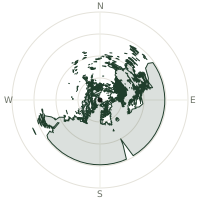
| N | 159 km | |
| NNE | 192 km | |
| NE | 221 km | |
| ENE | 235 km | |
| E | 235 km | |
| ESE | 235 km | |
| SE | 235 km | |
| SSE | 230 km | |
| S | 235 km | |
| SSW | 235 km | |
| SW | 242 km | |
| WSW | 256 km | |
| W | 118 km | |
| WNW | 76.3 km | |
| NW | 131 km | |
| NNW | 145 km |
Farthest named landmarks in view
376 named peaks, hills and headlands stand inside this viewshed. These are the farthest ones you could pick out on a clear day:
| Landmark | Visible distance | Direction | Elevation |
|---|---|---|---|
| Myōjōga Dake | 290 km | WSW 244° | 1,891 m |
| Hakken-san | 290 km | WSW 244° | 1,914 m |
| Mi Sen | 289 km | WSW 244° | 1,870 m |
| Tosakao Yama | 289 km | WSW 245° | 1,101 m |
| Gyōjagaeri Dake | 285 km | WSW 244° | 1,533 m |
| Sanjōga-dake | 283 km | WSW 245° | 1,703 m |
About Mount Fuji
Mount Fuji rises 3,776 meters on Honshu, Japan's highest mountain and cultural icon. This graceful stratovolcano last erupted in 1707 and remains geologically active. Climbing the mountain has held religious significance for centuries and continues attracting millions of visitors annually.
Did you know?
- Fuji's nearly perfect symmetrical cone inspired Hokusai's famous woodblock series 'Thirty-Six Views of Mount Fuji,' including 'The Great Wave,' cementing the mountain as a global art icon.
- Beneath its famous cone, Fuji is actually built from three stacked volcanoes formed over hundreds of thousands of years, each older cone buried by the eruptions that built the next.
- Japanese speakers typically call it Fujisan; foreigners often use Fujiyama.
- The official climbing season lasts barely two months, from July to early September, when mountain huts and safety stations are open: outside that window, ice and severe weather make the ascent far more dangerous.
Frequently asked questions
How far can you see from Mount Fuji?
On a clear day the terrain allows a line of sight of up to 319 km from Mount Fuji. The average visible distance across all 360 directions is 199 km. Atmospheric conditions (haze, humidity) usually reduce practical visibility below the terrain-limited maximum.
What is the farthest point visible from Mount Fuji?
The farthest terrain visible from Mount Fuji lies 319 km to the southwest, at an elevation of 896 m. Earth's curvature and atmospheric refraction are accounted for in this calculation.
How high is Mount Fuji?
The observation point at Mount Fuji sits at 3,778 m above sea level (Copernicus GLO-30 elevation model).
How is this visibility map calculated?
UpToWhere traces lines of sight in 360 directions from the observer using 30 m-resolution Copernicus terrain data, correcting for Earth curvature and standard atmospheric refraction. You can run the same analysis for any point on Earth with the free calculator.
Run your own analysis
Want to know what you can see from your house, a summit you're planning to climb, or a plot of land? UpToWhere computes the same 360° viewshed for any point on Earth in seconds, free.
Try the viewshed calculator