 UpToWhere
What can you see from Denali (Mount McKinley)?
Its Koyukon name restored after 40 years of bureaucratic standoff on 29 August 2015.
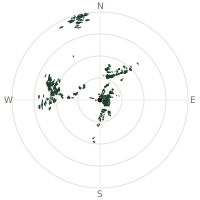
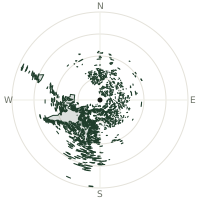
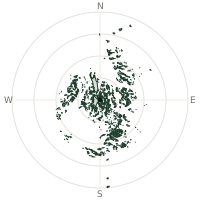
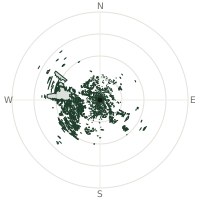
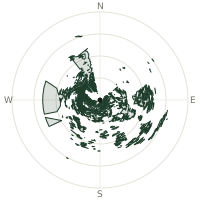
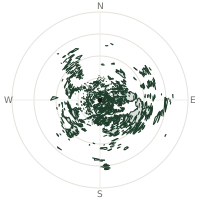
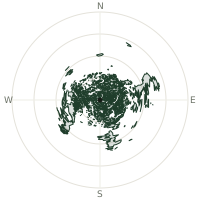
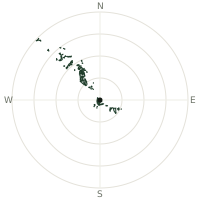
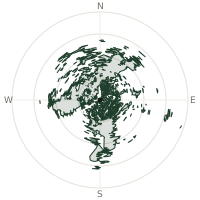
From Denali (Mount McKinley), the terrain-limited line of sight reaches up to 429 km. The single farthest piece of visible terrain lies 429 km to the east-southeast (bearing 107°), at 3,870 m elevation. These results account for Earth's curvature and standard atmospheric refraction, computed from 30-meter resolution Copernicus GLO-30 elevation data across 2,650,899 terrain samples.
Open the interactive visibility map →Visibility by direction
The horizon is most open toward the northeast, where sightlines run 335 km on average; terrain closes the view down fastest to the south-southwest, at 209 km.
| N | 290 km | |
| NNE | 304 km | |
| NE | 335 km | |
| ENE | 212 km | |
| E | 295 km | |
| ESE | 294 km | |
| SE | 258 km | |
| SSE | 268 km | |
| S | 333 km | |
| SSW | 209 km | |
| SW | 217 km | |
| WSW | 244 km | |
| W | 290 km | |
| WNW | 295 km | |
| NW | 292 km | |
| NNW | 291 km |
Farthest named landmarks in view
312 named peaks, hills and headlands stand inside this viewshed. These are the farthest ones you could pick out on a clear day:
| Landmark | Visible distance | Direction | Elevation |
|---|---|---|---|
| Parka Peak | 431 km | ESE 107° | 3,870 m |
| Atna Peaks | 427 km | ESE 107° | 4,098 m |
| Castle Peak | 425 km | ESE 109° | 3,039 m |
| Rime Peak | 424 km | ESE 107° | 3,762 m |
| Mount Blackburn | 419 km | ESE 107° | 4,839 m |
| Mount Jarvis | 397 km | ESE 104° | 4,050 m |
About Denali (Mount McKinley)
Denali means 'the tall one' in the Koyukon Athabaskan language, the name used by indigenous peoples around Alaska's highest peak for millennia. Though Alaska officially renamed it in 1975, the federal government resisted the change for four decades until Secretary of the Interior Sally Jewell declared it Denali on 29 August 2015. The peak's full elevation, estimated from sea level rather than the deep ocean floor, makes it genuinely the tallest mountain on the continent.
Did you know?
- On 29 August 2015, the U.S. Department of the Interior officially renamed the peak Denali after a 40-year standoff.
- The Koyukon Athabaskan people have called it Denali or Dinale, meaning 'the high one,' for thousands of years.
- Alaska state law renamed it Denali in 1975, but federal resistance delayed national recognition until 2015.
- The mountain was named after President William McKinley in 1896, only 56 years after his birth.
- At 20,310 feet, Denali is North America's tallest and stands in its own wilderness range.
Frequently asked questions
How far can you see from Denali (Mount McKinley)?
On a clear day the terrain allows a line of sight of up to 429 km from Denali (Mount McKinley). The average visible distance across all 360 directions is 277 km. Atmospheric conditions (haze, humidity) usually reduce practical visibility below the terrain-limited maximum.
What is the farthest point visible from Denali (Mount McKinley)?
The farthest terrain visible from Denali (Mount McKinley) lies 429 km to the east-southeast, at an elevation of 3,870 m. Earth's curvature and atmospheric refraction are accounted for in this calculation.
How high is Denali (Mount McKinley)?
The observation point at Denali (Mount McKinley) sits at 6,190 m above sea level (Copernicus GLO-30 elevation model).
How is this visibility map calculated?
UpToWhere traces lines of sight in 360 directions from the observer using 30 m-resolution Copernicus terrain data, correcting for Earth curvature and standard atmospheric refraction. You can run the same analysis for any point on Earth with the free calculator.
Run your own analysis
Want to know what you can see from your house, a summit you're planning to climb, or a plot of land? UpToWhere computes the same 360° viewshed for any point on Earth in seconds, free.
Try the viewshed calculator