 UpToWhere
What can you see from Mulhacén?
Named for a deposed sultan supposedly buried at the summit, though no grave has ever turned up.
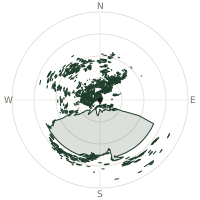
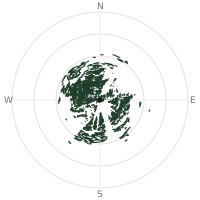
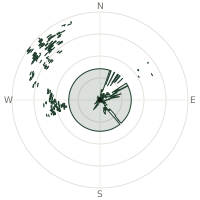
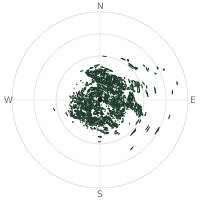
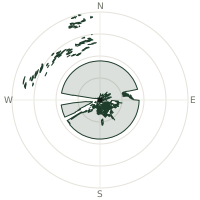
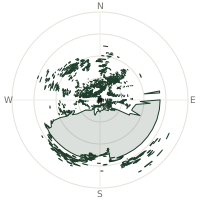
From Mulhacén, the terrain-limited line of sight reaches up to 330 km. The single farthest piece of visible terrain lies 330 km to the southeast (bearing 138°), at 1,276 m elevation. These results account for Earth's curvature and standard atmospheric refraction, computed from 30-meter resolution Copernicus GLO-30 elevation data across 2,395,211 terrain samples.
Open the interactive visibility map →Visibility by direction
The horizon is most open toward the southeast, where sightlines run 298 km on average; terrain closes the view down fastest to the east-northeast, at 124 km.
| N | 171 km | |
| NNE | 137 km | |
| NE | 139 km | |
| ENE | 124 km | |
| E | 171 km | |
| ESE | 234 km | |
| SE | 298 km | |
| SSE | 281 km | |
| S | 255 km | |
| SSW | 260 km | |
| SW | 261 km | |
| WSW | 196 km | |
| W | 137 km | |
| WNW | 237 km | |
| NW | 200 km | |
| NNW | 172 km |
Farthest named landmarks in view
1,156 named peaks, hills and headlands stand inside this viewshed. These are the farthest ones you could pick out on a clear day:
| Landmark | Visible distance | Direction | Elevation |
|---|---|---|---|
| Djebel es Sat | 330 km | SE 139° | 1,350 m |
| Djebel Morsott | 316 km | SE 140° | 1,190 m |
| Dyar Louffaga | 311 km | SSE 154° | 1,096 m |
| Djebel Bou Ides | 311 km | SE 143° | 1,343 m |
| Moussa Malek | 311 km | SSE 154° | 1,151 m |
| Jbel Bou Kouali | 310 km | SSE 167° | 1,647 m |
About Mulhacén
Mulhacén, at 3,479 metres, is the highest peak on mainland Spain and in the whole Iberian Peninsula, rising from the Sierra Nevada above Granada. It takes its name from Muley Hacén, the second-to-last Nasrid sultan of Granada, who legend says asked to be buried on the remote, snow-covered summit rather than in the city he had lost. Historical records instead place his burial in Guadix and later near the Alhambra, but the story still gives the mountain its name and its air of melancholy.
Did you know?
- For years, neighbouring Pico Veleta was popularly assumed to be the taller of the pair, until careful surveying confirmed Mulhacén's summit as the higher one.
- The wider Sierra Nevada range became a UNESCO Biosphere Reserve in 1986 and one of Spain's largest national parks in 1999, protecting the ibex, high-altitude lakes, and alpine plants around Mulhacén's slopes.
- Mulhacén overlooks Europe's southernmost ski resort, which sits just below its neighbouring peak, Pico Veleta.
- On exceptionally clear days, the Rif Mountains of Morocco are visible across the Alboran Sea to the south.
- The summit is one of the few places in mainland Spain where patches of snow can persist into July.
Frequently asked questions
How far can you see from Mulhacén?
On a clear day the terrain allows a line of sight of up to 330 km from Mulhacén. The average visible distance across all 360 directions is 205 km. Atmospheric conditions (haze, humidity) usually reduce practical visibility below the terrain-limited maximum.
What is the farthest point visible from Mulhacén?
The farthest terrain visible from Mulhacén lies 330 km to the southeast, at an elevation of 1,276 m. Earth's curvature and atmospheric refraction are accounted for in this calculation.
How high is Mulhacén?
The observation point at Mulhacén sits at 3,482 m above sea level (Copernicus GLO-30 elevation model).
How is this visibility map calculated?
UpToWhere traces lines of sight in 360 directions from the observer using 30 m-resolution Copernicus terrain data, correcting for Earth curvature and standard atmospheric refraction. You can run the same analysis for any point on Earth with the free calculator.
Run your own analysis
Want to know what you can see from your house, a summit you're planning to climb, or a plot of land? UpToWhere computes the same 360° viewshed for any point on Earth in seconds, free.
Try the viewshed calculator