 UpToWhere
Can you see Niagara Falls from New York City (Empire State Building)?
495 km line of sight toward the west-northwest (bearing 303°), computed on 30 m Copernicus terrain with Earth curvature and standard atmospheric refraction.
No. Niagara Falls is 495 km from New York City and sits about 15,581 m below the horizon at standard refraction: Earth's curvature hides it.
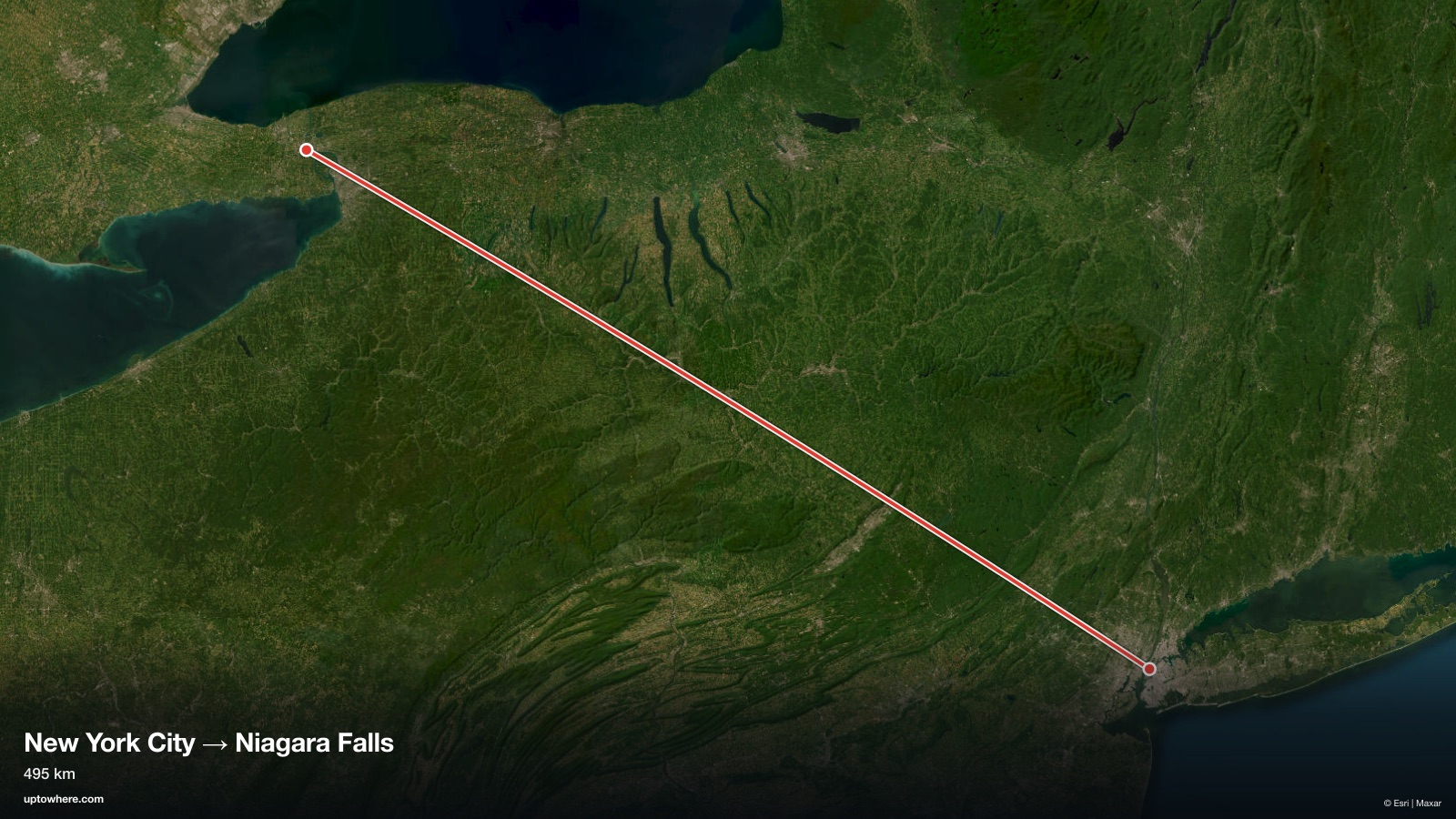
No terrain trickery needed here: the planet itself is the obstacle. Over 495 km, Earth's curvature drops Niagara Falls a full 16,712 m below a flat sightline, leaving its summit about 15,581 m under the grazing line from New York City (Empire State Building). No viewpoint at this location, however clear the day, can see over that.
The falls sit at the far western end of New York State, about 600 kilometres from the city and closer to Toronto than to Manhattan. No observation deck bridges that: from the top of the Empire State Building the horizon is 72 kilometres away. The drive is around seven hours.
The terrain profile
Frequently asked questions
Can you see Niagara Falls from New York City (Empire State Building)?
No, not under standard atmospheric conditions. Across 495 km, the view is cut off before reaching the target (see the terrain profile above for exactly where).
How far is Niagara Falls from New York City (Empire State Building) in a straight line?
495 km great-circle distance, on a bearing of 303° (west-northwest).
What exactly blocks the view?
Earth's curvature. Over this distance the target drops about 16,712 m below a flat sightline and ends up roughly 15,581 m below the horizon. Only exceptional atmospheric refraction can (sometimes) lift it into view.
How was this calculated?
UpToWhere walks the full terrain profile between the two points on 30 m-resolution Copernicus GLO-30 elevation data, applying Earth curvature and standard atmospheric refraction (k = 0.13), the same physics surveyors use. You can run the same point-to-point check between any two places on Earth.
More famous sightlines
- NO165 kmCan you see Key West, Florida from Havana (El Morro lighthouse)?
- YES74 kmCan you see Cerro Santa Ana, Venezuela from Jamanota, Aruba?
- YES4.4 kmCan you see the Statue of Liberty from the Brooklyn Bridge walkway?
Wondering about a different pair?
The free calculator shows how far you can see from any point on Earth. Pro adds point-to-point checks: this exact analysis, between any two places you choose.
Open the calculator