 UpToWhere
What can you see from Mount Teide?
Guanche legend jailed a devil-god inside it; geologists call it Earth's third-tallest volcano.
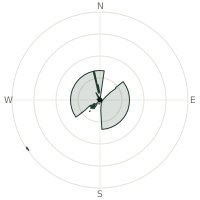
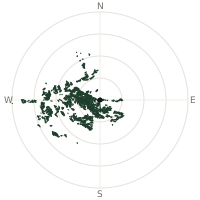
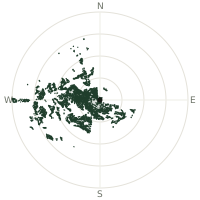
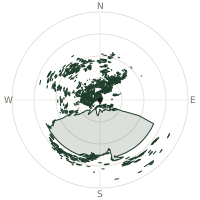
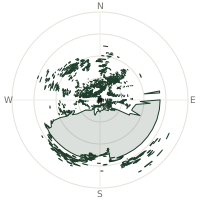
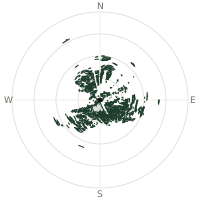
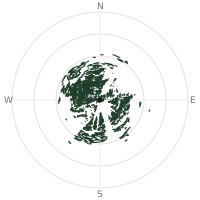
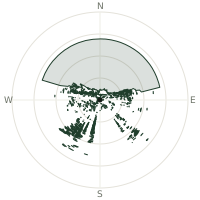
From Mount Teide, the terrain-limited line of sight reaches up to 324 km. The single farthest piece of visible terrain lies 324 km to the east-northeast (bearing 71°), at 582 m elevation. These results account for Earth's curvature and standard atmospheric refraction, computed from 30-meter resolution Copernicus GLO-30 elevation data across 2,420,567 terrain samples.
Open the interactive visibility map →Visibility by direction
The horizon is most open toward the east-northeast, where sightlines run 252 km on average; terrain closes the view down fastest to the west-northwest, at 155 km.
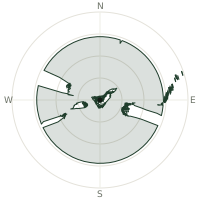
| N | 233 km | |
| NNE | 233 km | |
| NE | 233 km | |
| ENE | 252 km | |
| E | 245 km | |
| ESE | 171 km | |
| SE | 233 km | |
| SSE | 233 km | |
| S | 233 km | |
| SSW | 233 km | |
| SW | 233 km | |
| WSW | 211 km | |
| W | 233 km | |
| WNW | 155 km | |
| NW | 233 km | |
| NNW | 233 km |
Farthest named landmarks in view
162 named peaks, hills and headlands stand inside this viewshed. These are the farthest ones you could pick out on a clear day:
| Landmark | Visible distance | Direction | Elevation |
|---|---|---|---|
| Peñas del Chache | 319 km | ENE 72° | 672 m |
| Risco de Famara | 319 km | ENE 72° | 572 m |
| Monte Hacha Grande | 288 km | ENE 76° | 545 m |
| Monte Muda | 265 km | E 82° | 595 m |
| Montaña Tindaya | 264 km | E 82° | 401 m |
| Pico de la Fortaleza | 262 km | E 84° | 585 m |
About Mount Teide
Mount Teide is Spain's highest peak at 3,715 metres, and measured from the seafloor rather than sea level, it ranks as the third-tallest volcanic structure on the planet, after Hawaii's Mauna Loa and Mauna Kea. The indigenous Guanches believed the volcano, which they called Echeyde, imprisoned the demon Guayota after he kidnapped the sun god Magec and plunged the world into darkness. Teide National Park, built around the volcano's otherworldly caldera, became a UNESCO World Heritage Site in 2007 and now draws more annual visitors than any other national park in Spain or Europe.
Did you know?
- Teide's otherworldly volcanic terrain has doubled for alien and lunar landscapes in numerous films, including scenes from 'Clash of the Titans' and 'One Million Years B.C.'
- The Teide violet, a small flower found nowhere else on Earth, grows in cracks near the summit despite the extreme cold, wind, and thin air at that altitude.
- A cable car climbs from 2,100 metres to within a short walk of the crater rim at 3,555 metres.
- The Teide Observatory, opened in 1964, is one of the world's largest solar observatories thanks to the site's exceptionally still, clear air.
- On exceptionally clear days, the outlines of La Palma, Gran Canaria, and La Gomera are visible across the Atlantic.
Frequently asked questions
How far can you see from Mount Teide?
On a clear day the terrain allows a line of sight of up to 324 km from Mount Teide. The average visible distance across all 360 directions is 225 km. Atmospheric conditions (haze, humidity) usually reduce practical visibility below the terrain-limited maximum.
What is the farthest point visible from Mount Teide?
The farthest terrain visible from Mount Teide lies 324 km to the east-northeast, at an elevation of 582 m. Earth's curvature and atmospheric refraction are accounted for in this calculation.
How high is Mount Teide?
The observation point at Mount Teide sits at 3,716 m above sea level (Copernicus GLO-30 elevation model).
How is this visibility map calculated?
UpToWhere traces lines of sight in 360 directions from the observer using 30 m-resolution Copernicus terrain data, correcting for Earth curvature and standard atmospheric refraction. You can run the same analysis for any point on Earth with the free calculator.
Run your own analysis
Want to know what you can see from your house, a summit you're planning to climb, or a plot of land? UpToWhere computes the same 360° viewshed for any point on Earth in seconds, free.
Try the viewshed calculator