 UpToWhere
What can you see from Great Smoky Mountains?
Misty peaks straddle the Tennessee-North Carolina border.
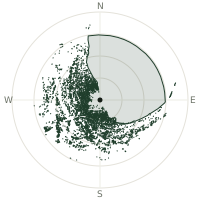
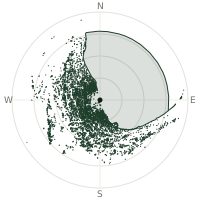
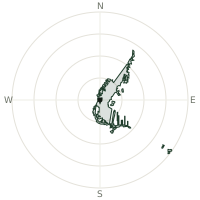
From Great Smoky Mountains, the terrain-limited line of sight reaches up to 242 km. The single farthest piece of visible terrain lies 242 km to the northeast (bearing 48°), at 1,425 m elevation. These results account for Earth's curvature and standard atmospheric refraction, computed from 30-meter resolution Copernicus GLO-30 elevation data across 2,217,469 terrain samples.
Open the interactive visibility map →Visibility by direction
The horizon is most open toward the northeast, where sightlines run 181 km on average; terrain closes the view down fastest to the south-southwest, at 46.7 km.
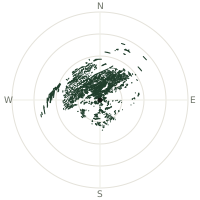
| N | 121 km | |
| NNE | 151 km | |
| NE | 181 km | |
| ENE | 58.5 km | |
| E | 87.3 km | |
| ESE | 49.4 km | |
| SE | 58.4 km | |
| SSE | 67.1 km | |
| S | 73.8 km | |
| SSW | 46.7 km | |
| SW | 62.6 km | |
| WSW | 89.9 km | |
| W | 151 km | |
| WNW | 124 km | |
| NW | 109 km | |
| NNW | 111 km |
Farthest named landmarks in view
661 named peaks, hills and headlands stand inside this viewshed. These are the farthest ones you could pick out on a clear day:
| Landmark | Visible distance | Direction | Elevation |
|---|---|---|---|
| Flattop Mountain | 207 km | NE 46° | 1,379 m |
| Clinch Mountain Spur | 206 km | NE 44° | 1,132 m |
| Whiterock Mountain | 206 km | NE 46° | 1,218 m |
| Bald Rock | 205 km | NE 44° | 1,178 m |
| Redrock Mountain | 203 km | NE 46° | 1,345 m |
| Rock House Mountain | 202 km | NE 46° | 1,208 m |
About Great Smoky Mountains
The Great Smoky Mountains host Kuwohi (formerly Clingmans Dome), the highest peak at 2,025 meters. Located atop the Appalachian Trail, this mountain commands the region's landscape. The range's name derives from the persistent atmospheric haze created by natural forest emissions.
Did you know?
- The Smokies are one of the most biodiverse temperate regions on Earth, hosting more tree species than all of Europe and enough salamander species to earn the nickname 'Salamander Capital of the World.'
- The spiral concrete observation tower atop Kuwohi, built in 1959, offers 360-degree views and remains one of the Appalachian Trail's most recognisable landmarks.
- Kuwohi means 'mulberry place' in Cherokee; the 2024 restoration reversed an 1859 renaming after Thomas Clingman, a U.S. senator who left the Union to fight for the Confederacy.
- Cherokee name Kuwohi officially restored in September 2024 by geographic board.
Frequently asked questions
How far can you see from Great Smoky Mountains?
On a clear day the terrain allows a line of sight of up to 242 km from Great Smoky Mountains. The average visible distance across all 360 directions is 96.6 km. Atmospheric conditions (haze, humidity) usually reduce practical visibility below the terrain-limited maximum.
What is the farthest point visible from Great Smoky Mountains?
The farthest terrain visible from Great Smoky Mountains lies 242 km to the northeast, at an elevation of 1,425 m. Earth's curvature and atmospheric refraction are accounted for in this calculation.
How high is Great Smoky Mountains?
The observation point at Great Smoky Mountains sits at 2,014 m above sea level (Copernicus GLO-30 elevation model).
How is this visibility map calculated?
UpToWhere traces lines of sight in 360 directions from the observer using 30 m-resolution Copernicus terrain data, correcting for Earth curvature and standard atmospheric refraction. You can run the same analysis for any point on Earth with the free calculator.
Run your own analysis
Want to know what you can see from your house, a summit you're planning to climb, or a plot of land? UpToWhere computes the same 360° viewshed for any point on Earth in seconds, free.
Try the viewshed calculator