 UpToWhere
What can you see from Statue of Liberty?
A gift from France to the US, it was dedicated in 1886 and holds a tablet inscribed with 1776.
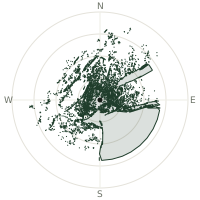
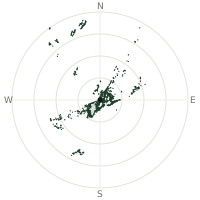
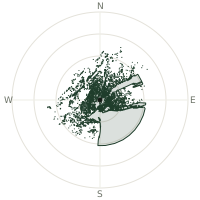
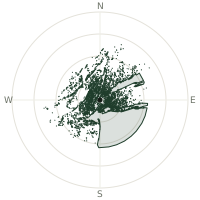
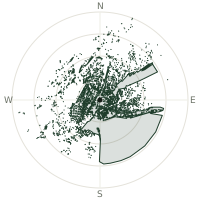
From Statue of Liberty, the terrain-limited line of sight reaches up to 87.9 km. The single farthest piece of visible terrain lies 87.9 km to the north (bearing 9°), at 376 m elevation. These results account for Earth's curvature and standard atmospheric refraction, computed from 30-meter resolution Copernicus GLO-30 elevation data across 1,869,607 terrain samples.
Open the interactive visibility map →Visibility by direction
The horizon is most open toward the north, where sightlines run 59.3 km on average; terrain closes the view down fastest to the northeast, at 13.0 km.
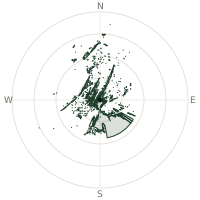
| N | 59.3 km | |
| NNE | 38.8 km | |
| NE | 13.0 km | |
| ENE | 25.4 km | |
| E | 23.2 km | |
| ESE | 29.0 km | |
| SE | 38.8 km | |
| SSE | 38.8 km | |
| S | 33.7 km | |
| SSW | 25.4 km | |
| SW | 28.0 km | |
| WSW | 38.1 km | |
| W | 35.4 km | |
| WNW | 21.1 km | |
| NW | 25.7 km | |
| NNW | 49.5 km |
Farthest named landmarks in view
58 named peaks, hills and headlands stand inside this viewshed. These are the farthest ones you could pick out on a clear day:
| Landmark | Visible distance | Direction | Elevation |
|---|---|---|---|
| South Beacon Mountain | 88.4 km | N 5° | 491 m |
| Crows Nest | 80.1 km | N 4° | 429 m |
| Spy Rock | 78.0 km | N 1° | 441 m |
| Denning Hill | 76.7 km | N 9° | 309 m |
| Long Pond Mountain | 75.6 km | N 1° | 384 m |
| Dunderberg Mountain | 66.4 km | N 4° | 325 m |
About Statue of Liberty
The Statue of Liberty was dedicated on October 28, 1886, as a gift from the French people to the United States, designed by sculptor Frédéric Auguste Bartholdi with its internal iron framework built by Gustave Eiffel. Standing 305 feet 1 inch from ground to torch tip, the 151-foot copper-clad statue holds a torch above her head in her right hand and carries a tablet inscribed with July 4, 1776 in Roman numerals in her left. The crown features seven pointed rays representing the seven continents and seven seas, making Liberty one of the world's most recognizable symbols of freedom.
Did you know?
- The statue's copper skin is just 2.4 millimetres thick, roughly the thickness of two stacked pennies, despite the monument's massive scale.
- The internal iron framework was designed by Gustave Eiffel, creator of the Eiffel Tower.
- The statue turned from shiny copper-brown to its now-iconic green patina over about 30 years of oxidation; officials at the time debated painting over it before deciding to leave it be.
- A broken chain lies at Liberty's feet, partly hidden by her robes, symbolising the abolition of oppression and slavery: a detail many visitors never notice.
- Emma Lazarus wrote her famous poem 'The New Colossus' in 1883 to help raise funds for the pedestal, but it wasn't actually mounted inside on a bronze plaque until 1903.
Frequently asked questions
How far can you see from Statue of Liberty?
On a clear day the terrain allows a line of sight of up to 87.9 km from Statue of Liberty. The average visible distance across all 360 directions is 32.7 km. Atmospheric conditions (haze, humidity) usually reduce practical visibility below the terrain-limited maximum.
What is the farthest point visible from Statue of Liberty?
The farthest terrain visible from Statue of Liberty lies 87.9 km to the north, at an elevation of 376 m. Earth's curvature and atmospheric refraction are accounted for in this calculation.
How high is Statue of Liberty?
The observation point at Statue of Liberty sits at 103 m above sea level (Copernicus GLO-30 elevation model).
How is this visibility map calculated?
UpToWhere traces lines of sight in 360 directions from the observer using 30 m-resolution Copernicus terrain data, correcting for Earth curvature and standard atmospheric refraction. You can run the same analysis for any point on Earth with the free calculator.
Run your own analysis
Want to know what you can see from your house, a summit you're planning to climb, or a plot of land? UpToWhere computes the same 360° viewshed for any point on Earth in seconds, free.
Try the viewshed calculator