 UpToWhere
On August 12, 2026, a total solar eclipse will cross northern Spain, the first one visible from the Spanish mainland since 1905. Cities including A Coruña, Oviedo, Gijón, Santander, Bilbao, Zaragoza, Valencia and Palma de Mallorca all lie inside the path of totality, and millions of people will be within an hour's drive of it.
But this eclipse comes with a catch that most guides mention only in passing: it happens just before sunset. Totality sweeps across Spain between roughly 20:27 and 20:33 CEST, with the sun sitting only a few degrees above the west-northwest horizon, around 10–12° in the far northwest and lower the further east you go, until in the Balearics the eclipsed sun hangs barely above the sea.
That changes everything about how you choose a viewing spot.
A low sun turns geography into the main problem
When an eclipse happens high in the sky, "clear weather" is the only thing you need. When it happens at 5–10° of altitude, the terrain between you and the horizon becomes just as important as the clouds.
At 8° of solar altitude, an obstacle only needs to rise about 140 metres (459 ft) for every kilometre (0.6 mi) of distance to block the sun. In practice:
- A 300 m (984 ft) ridge 3 km (1.9 mi) to your west hides the sun completely.
- A row of six-storey buildings 200 m (656 ft) away does the same in a city.
- Even gentle hills 10–20 km (6.2–12 mi) away can matter on the flatter parts of the path.
And Spain is one of the most mountainous countries in Europe. The totality band crosses the Cantabrian Mountains, the Basque hills, the Iberian System and the Ebro valley: landscapes full of west-facing slopes that will be in shadow at exactly the wrong moment.
This is what a low totality actually looks like when the horizon cooperates. On July 2, 2019 the eclipsed sun stood about 13° over the Chilean Andes at ESO's La Silla observatory, almost exactly the altitude Galicia gets in 2026:
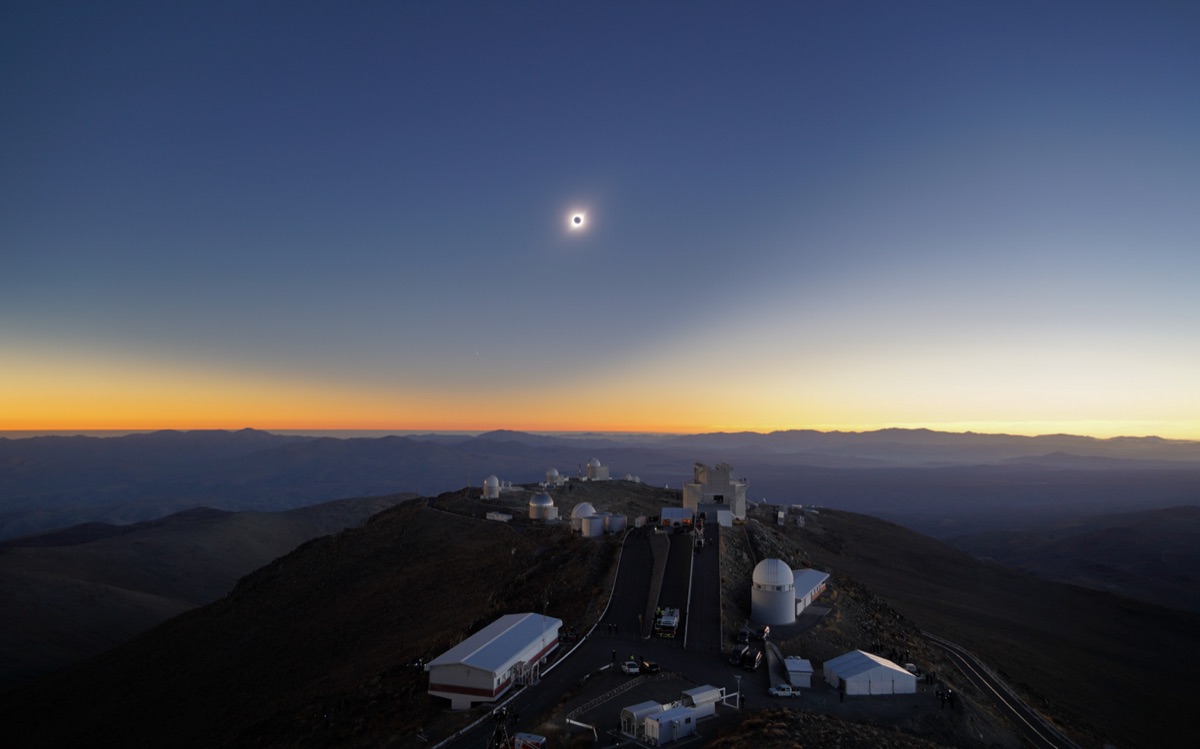
Photo: ESO/R. Lucchesi, CC BY 4.0, via Wikimedia Commons.

Check your exact spot in 30 seconds
This is precisely the problem a terrain line-of-sight analysis solves. UpToWhere computes what is visible from any point on Earth using 30-metre-resolution Copernicus elevation data, accounting for Earth's curvature and atmospheric refraction.
The fastest route to an answer is the Eclipse Horizon Checker, a free map built for this one afternoon: search your town or click anywhere on the totality band and it tells you straight away whether the eclipsed sun clears your own skyline, computed cell by cell on the same 30 m elevation data.
To check a spot outside the band, or any other date, the general tool does the same job in three steps:
- Open the free viewshed calculator and drop a pin on your planned viewing spot. The link opens it already set to eclipse day.
- Run the analysis and look at the visibility map toward the west-northwest (bearing ≈ 285°), the direction where the eclipsed sun will be.
- If the map shows terrain blocking that direction within your sightline, the sun will set behind it before or during totality. Move: even a few hundred metres uphill or northwest can fix it.
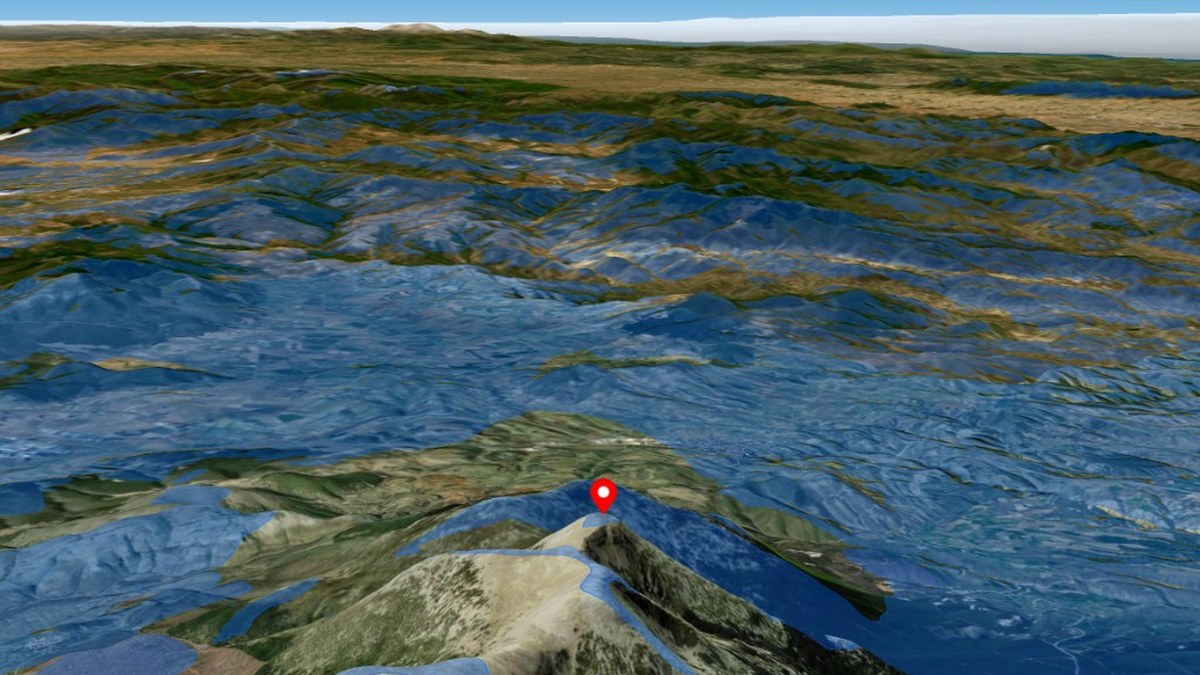
A good eclipse spot for 2026 is one where the visibility map shows 10 km (6.2 mi) or more of open terrain toward 285°: a west-facing slope, a summit, a reservoir shore, the coastline looking out to sea, or the edge of the Ebro depression.
An open horizon buys you more than the sun itself. During totality the edge of the moon's shadow glows like a sunset in every direction at once: a 360° twilight ring that only exists for whoever can see far enough to catch it:
Photo: O'Dea, CC BY-SA 4.0, via Wikimedia Commons.

Where the eclipse will be highest, and lowest
The sun's altitude during totality varies along the path:
| Region | Approx. totality (CEST) | Sun altitude | Notes | Check a real spot |
|---|---|---|---|---|
| Galicia / A Coruña | 20:27 | ~10–12° | Highest sun of the Spanish path | A Coruña: clears by 5.9° |
| Asturias / Cantabria | 20:28 | ~9–10° | Longest durations (~1 min 45 s near Oviedo/Gijón) | Gijón: clears by 9.1° |
| Burgos / La Rioja / Zaragoza | 20:29–20:30 | ~6–8° | Wide, accessible band; watch the Iberian System to your west | Burgos: blocked by 7.0° |
| Valencia coast | 20:32–20:33 | ~3–5° | Sun very low; pick the shoreline or elevation | Valencia: clears by 0.7° |
| Balearic Islands | 20:32–20:33 | ~1–3° | Sun practically on the sea horizon; totality ends near sunset | Palma: blocked by 0.8° |
Two of those five are the point. Burgos sits in the widest, most accessible stretch of the band and still loses totality to the Iberian System behind it, and Palma misses by less than a degree. Both look fine on a map. Open any row to see the horizon that decides it.
Madrid and Barcelona are outside the band: they will see a deep partial eclipse, but "99% partial" is nothing like totality. If you're in either city, it's worth the trip north, and worth checking your destination's western horizon before you commit to it.
We ran that check across the entire path. Who actually sees totality in Spain gives the computed verdict for every town of 3,000 people or more inside the band, including the 104 of them where a distant mountain deletes totality outright.
Don't wait until August 11
The best spots (west-facing miradores with road access inside the band) will be crowded, and accommodation along the path is already filling up. Checking your horizon takes half a minute; do it before you book.
Check your eclipse spot's western horizon, free
Frequently asked questions
What time is the total eclipse in Spain on August 12, 2026?
Totality crosses Spain between about 20:27 CEST (Galicia) and 20:33 CEST (Valencia and the Balearics), roughly an hour before sunset. Maximum durations on the centreline are around 1 minute 45 seconds.
How high will the sun be during totality?
Low everywhere: roughly 10–12 degrees above the horizon in Galicia, 6–10 degrees across the northern interior, and under 5 degrees near the Mediterranean coast and the Balearics. The sun will be toward the west-northwest, at a bearing of about 285 degrees.
Can I see the total eclipse from Madrid or Barcelona?
No. Both cities are outside the path of totality and will see a very deep partial eclipse. To experience darkness, the corona and the temperature drop, you must be physically inside the band: for Madrid that means driving roughly 100–150 km (62–93 mi) north.
How do I know if a mountain will block my view?
Run a free visibility analysis from your exact spot with UpToWhere and check the sightline toward bearing 285 degrees. If terrain blocks that direction, the eclipsed sun will be hidden behind it; choose higher ground or a position with an open west-northwest horizon. The Eclipse Horizon Checker answers the same question in one click for any point inside the Spanish totality band.